
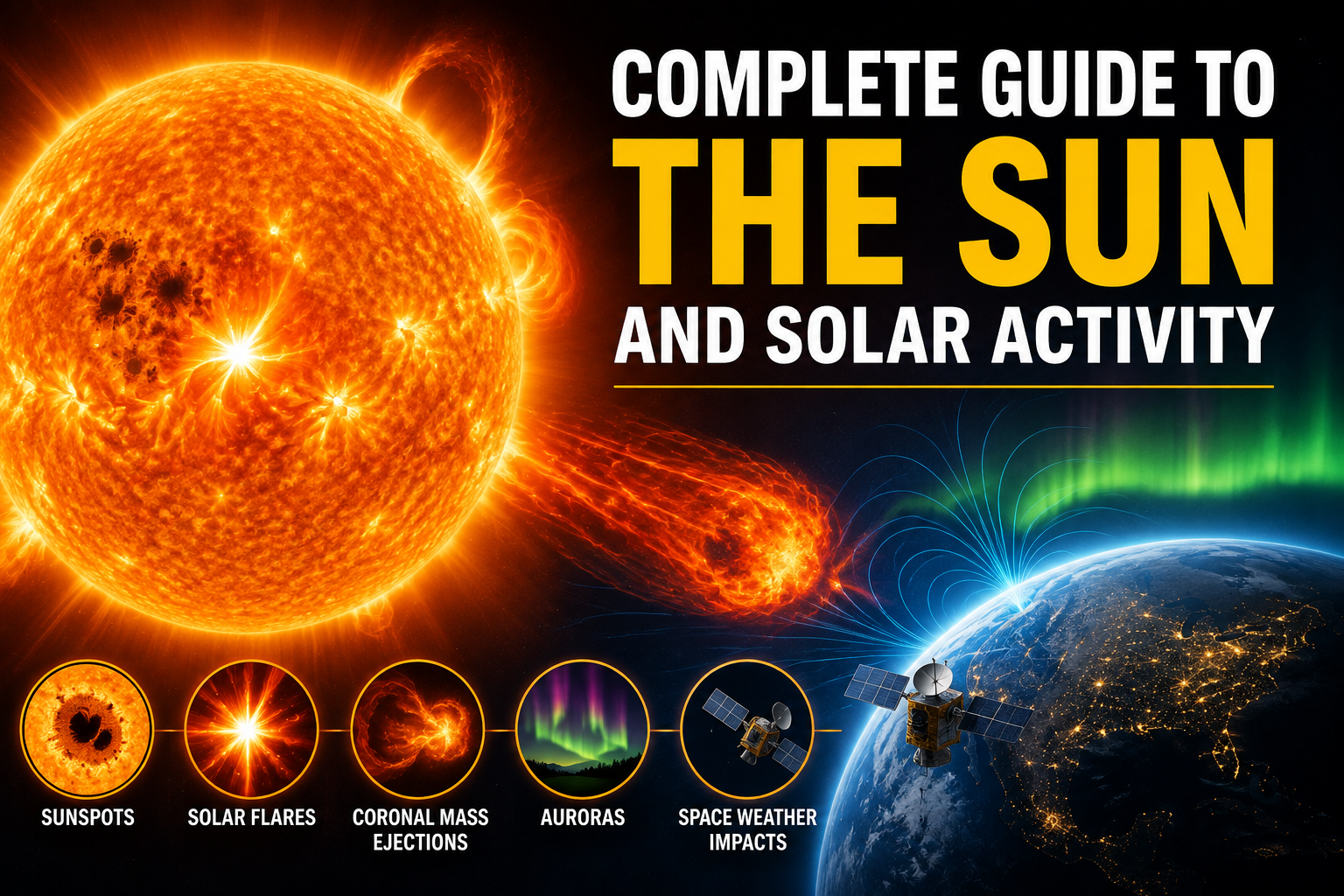
Complete Guide to the Sun and Solar Activity
The Sun is the closest star to Earth and the primary source of energy that makes life on our planet possible. Although it appears relatively constant from our perspective, the Sun is an active, dynamic environment where magnetic fields twist, reconnect, and release enormous amounts of energy.
Solar activity can produce phenomena ranging from sunspots and solar flares to coronal mass ejections and solar storms. Some of these events create spectacular auroras, while stronger events can interfere with satellites, radio communications, navigation systems, and electrical infrastructure.
Understanding the Sun and its activity helps explain not only what happens on the solar surface, but also how events occurring millions of kilometers away can affect technology and conditions around Earth.
What Is the Sun?
The Sun is a star located at the center of our solar system. It is a massive sphere of extremely hot plasma composed primarily of hydrogen and helium.
Its gravity holds the planets, dwarf planets, asteroids, comets, and other objects of the solar system in orbit.
The Sun is approximately 4.6 billion years old and is classified as a G-type main-sequence star, commonly called a G-type or yellow dwarf star.
Despite its familiar appearance in Earth’s sky, the Sun is enormous compared with our planet. Its diameter is roughly 109 times that of Earth, while its mass is more than 300,000 times Earth’s mass.
Most importantly for life on Earth, the Sun provides the energy that drives Earth’s climate, weather, ecosystems, and water cycle.
How Does the Sun Produce Energy?
The Sun produces energy through nuclear fusion in its core.
Under the enormous temperature and pressure found deep inside the Sun, hydrogen nuclei undergo a series of reactions that ultimately produce helium.
During this process, a small amount of mass is converted into energy.
That energy gradually moves outward through the Sun before eventually reaching space as electromagnetic radiation.
The sunlight that reaches Earth includes:
- Visible light
- Infrared radiation
- Ultraviolet radiation
- Smaller amounts of other forms of electromagnetic radiation
The energy arriving from the Sun powers photosynthesis, influences Earth’s climate system, and provides the fundamental energy source for most ecosystems.
The Main Layers of the Sun
The Sun is not a solid object with a simple surface. Scientists generally describe it using several major layers.
1. The Solar Core
The core is the central region of the Sun where nuclear fusion occurs.
Temperatures and pressures are extraordinarily high, allowing hydrogen fusion to take place.
The core is the ultimate source of the Sun’s energy.
2. The Radiative Zone
Surrounding the core is the radiative zone.
Energy moves through this region primarily through the absorption and re-emission of radiation.
The journey of energy through the Sun is not comparable to sunlight traveling directly from a lamp to a nearby object. Energy can undergo an enormous number of interactions before eventually moving farther outward.
3. The Convection Zone
Above the radiative zone is the convection zone.
Here, hot plasma rises toward the outer regions, cools, and then sinks again.
This movement is known as convection.
The convection zone plays an important role in the generation and movement of the Sun’s magnetic fields.
What Is the Sun’s Photosphere?
The photosphere is the visible layer commonly described as the Sun’s surface.
It is not a solid surface like Earth’s ground.
Instead, it is the region from which much of the visible sunlight we see originates.
The photosphere is also where many familiar solar features can be observed, including sunspots.
What Is the Chromosphere?
Above the photosphere is the chromosphere.
The chromosphere is a relatively thin layer of the solar atmosphere.
Under certain observing conditions, it can appear as a reddish layer around the Sun, particularly during a total solar eclipse.
The chromosphere is also associated with various dynamic structures and solar phenomena.
What Is the Solar Corona?
The corona is the Sun’s outer atmosphere.
It extends millions of kilometers into space and is much hotter than the layers immediately beneath it.
This creates one of the most interesting puzzles in solar physics: the solar corona reaches temperatures of roughly millions of degrees Kelvin, while the photosphere beneath it is much cooler.
Scientists continue to study the physical mechanisms responsible for heating the corona.
The corona is also where the solar wind originates.
What Is Solar Activity?
Solar activity refers to the changing physical conditions and phenomena associated with the Sun’s magnetic field and atmosphere.
The Sun is not equally active at all times.
Its activity changes over cycles, with periods of relatively low activity followed by periods of greater activity.
Solar activity can include:
- Sunspots
- Solar flares
- Coronal mass ejections
- Prominences
- Filaments
- Coronal holes
- Changes in the solar wind
- Magnetic-field disturbances
These events are interconnected because many are driven by the Sun’s constantly changing magnetic field.
What Are Sunspots?
Sunspots are relatively dark regions that appear on the photosphere.
They look dark because they are cooler than the surrounding solar surface, although they are still extremely hot by Earth’s standards.
Sunspots form in areas where strong magnetic fields emerge through the photosphere.
They can range from relatively small features to enormous structures containing several individual spots.
A higher number of sunspots generally indicates greater solar activity.
Why Do Sunspots Appear Dark?
Sunspots are cooler than their surroundings because strong magnetic fields inhibit some of the convection that transports heat from deeper layers of the Sun.
The surrounding photosphere therefore appears brighter.
The contrast makes sunspots visible when the Sun is observed using appropriate solar-viewing equipment.
Never look directly at the Sun without properly designed solar viewing protection.
What Is the Solar Cycle?
Solar activity follows an approximately 11-year cycle in which the number and distribution of sunspots generally rise and fall.
Scientists refer to periods of lower activity as solar minimum and periods of higher activity as solar maximum.
The cycle is associated with changes in the Sun’s magnetic field.
However, the cycle does not behave like a perfectly predictable clock. The duration and intensity of individual cycles can vary.
During solar maximum, scientists generally observe more sunspots, solar flares, and other forms of solar activity.
What Is a Solar Maximum?
A solar maximum is the period around the peak of a solar cycle when solar activity is generally elevated.
During this period, the Sun can produce more frequent and sometimes more powerful:
- Sunspots
- Solar flares
- Coronal mass ejections
- Geomagnetic disturbances
Solar maximum does not mean that the Sun continuously produces major eruptions.
Activity varies from day to day, and individual solar events can differ dramatically in strength.
What Is a Solar Minimum?
A solar minimum is the relatively quiet phase of the solar cycle.
Sunspot numbers decrease, and major solar eruptions generally become less frequent.
However, the Sun never becomes completely inactive.
Solar wind continues to flow, and certain solar phenomena can still occur during periods of relatively low activity.
What Are Solar Flares?
A solar flare is a sudden release of energy from the Sun’s atmosphere.
Solar flares are closely associated with changes in magnetic fields, particularly in regions around sunspots.
Flares can produce intense electromagnetic radiation across a broad range of wavelengths.
Scientists classify many solar flares according to their X-ray intensity, using categories such as:
- A-class
- B-class
- C-class
- M-class
- X-class
Each category represents an increase in energy output, with X-class flares being the strongest category.
The scale can also include numerical subdivisions, such as M5 or X2.
Why Are Solar Flares Important?
Solar flares can produce intense bursts of radiation that reach Earth in roughly eight minutes because electromagnetic radiation travels at the speed of light.
Strong flares can affect the ionosphere and interfere with some forms of radio communication.
They can also contribute to increased radiation exposure for astronauts and spacecraft operating beyond the protection provided by Earth’s atmosphere and magnetic field.
However, a solar flare does not automatically mean that a major geomagnetic storm will occur on Earth.
The nature and location of the flare, as well as whether it is associated with a coronal mass ejection directed toward Earth, matter greatly.
What Is a Coronal Mass Ejection?
A coronal mass ejection, or CME, is a huge eruption of magnetized plasma from the Sun’s corona.
A CME can contain billions of tons of material and travel through interplanetary space at hundreds or even thousands of kilometers per second.
If a CME is directed toward Earth, it can interact with Earth’s magnetosphere and potentially produce a geomagnetic storm.
Not every CME travels toward Earth.
This distinction is important because the Sun produces many eruptions that have little or no direct effect on our planet.
Solar Flares vs. Coronal Mass Ejections
Solar flares and CMEs are related but different phenomena.
| Feature | Solar Flare | Coronal Mass Ejection |
|---|---|---|
| What it is | Sudden release of electromagnetic energy | Ejection of magnetized plasma |
| Main effect | Radiation reaches Earth quickly | Plasma can arrive later |
| Travel speed | Radiation travels at light speed | Plasma travels much slower |
| Main risks | Radio disruption and radiation effects | Geomagnetic storms |
| Always Earth-directed? | No | No |
A single solar eruption can sometimes involve both a flare and a CME, but they should not be treated as interchangeable terms.
What Is the Solar Wind?
The solar wind is a continuous flow of charged particles escaping from the Sun into space.
It consists primarily of protons and electrons, along with other particles.
The solar wind travels throughout the solar system and interacts with planets, moons, magnetic fields, and other objects.
Earth’s magnetic field deflects much of this particle flow, helping protect the atmosphere and surface from many of its effects.
What Are Coronal Holes?
Coronal holes are regions of the solar corona where magnetic field lines are more open to space.
They can allow faster solar wind to escape.
When high-speed solar wind from a coronal hole interacts with slower solar wind, disturbances can develop that may contribute to geomagnetic activity near Earth.
Unlike sunspots, coronal holes can sometimes appear as dark regions when the Sun is viewed in certain extreme-ultraviolet wavelengths.
What Are Solar Prominences?
Solar prominences are large structures of relatively cool, dense plasma suspended above the Sun’s surface by magnetic fields.
They can extend far above the photosphere.
When viewed against the bright solar disk, a prominence may appear as a dark filament.
When viewed against the darkness of space from the side of the Sun, the same type of structure can appear bright.
What Are Solar Filaments?
A solar filament is essentially a prominence viewed against the solar disk.
Because the structure is cooler and denser than the surrounding atmosphere, it can appear as a dark, elongated feature.
Filaments can remain stable for days or weeks before changing or erupting.
An erupting filament can sometimes be associated with a CME.
What Happens During a Solar Storm?
A solar storm can occur when solar activity significantly disturbs the space environment around Earth.
One of the most important effects is a geomagnetic storm.
When solar particles and magnetic fields interact with Earth’s magnetosphere, they can cause disturbances in Earth’s magnetic environment.
Potential effects include:
- Stronger auroras
- Disruptions to some radio communications
- Satellite operational challenges
- Navigation errors
- Increased drag on some satellites
- Effects on electrical infrastructure
- Radiation concerns for astronauts and high-altitude aviation
The severity depends on the characteristics of the solar event and how it interacts with Earth’s magnetic field.
What Is a Geomagnetic Storm?
A geomagnetic storm is a significant disturbance in Earth’s magnetosphere caused by solar activity.
CMEs are among the most important causes of major geomagnetic storms.
The strongest storms can produce spectacular auroras at much lower latitudes than usual.
They can also create technological problems.
Historically, severe geomagnetic storms have demonstrated that solar activity can affect electrical systems and communications over large areas.
How Does Solar Activity Affect Satellites?
Satellites operate in an environment directly exposed to space weather.
Solar activity can affect satellites through:
- Increased radiation
- Electrical charging
- Communication disruptions
- Navigation disturbances
- Changes in the upper atmosphere
During strong geomagnetic storms, Earth’s upper atmosphere can expand.
That expansion increases atmospheric drag on some low-Earth-orbit satellites, potentially changing their orbits and increasing the amount of energy needed to maintain them.
How Does Solar Activity Affect GPS?
GPS and other satellite navigation systems rely on signals traveling through Earth’s atmosphere.
Solar activity can disturb the ionosphere, which can introduce errors into satellite navigation signals.
The impact varies according to the intensity of the event, location, frequency of the signal, and characteristics of the ionospheric disturbance.
Modern navigation systems use multiple techniques to improve accuracy, but severe space weather can still create challenges.
Can Solar Storms Affect Electricity?
Yes.
Strong geomagnetic storms can generate electric currents in long conductors on Earth’s surface.
Power grids are therefore one of the technologies that can be vulnerable to severe space weather.
The potential impact depends heavily on factors such as:
- Storm intensity
- Earth’s magnetic-field orientation
- Geographic location
- Grid design
- Ground conductivity
- Infrastructure characteristics
Modern electrical systems have measures intended to reduce and manage these risks.
What Causes the Northern and Southern Lights?
One of the most beautiful consequences of solar activity is the aurora.
The Northern Lights are called aurora borealis, while the Southern Lights are known as aurora australis.
Auroras occur when energetic particles interact with gases in Earth’s upper atmosphere.
Earth’s magnetic field guides many charged particles toward polar regions.
When these particles interact with atmospheric atoms and molecules, energy is released as light.
Different atmospheric gases and altitudes can contribute to different auroral colors.
Why Are Auroras Different Colors?
Auroral colors depend partly on the atmospheric gases involved and the altitude at which the interactions occur.
Common colors include:
- Green: Often associated with oxygen at certain altitudes
- Red: Can also be produced by oxygen at higher altitudes
- Blue and purple: Often associated with nitrogen
The resulting displays can appear as arcs, curtains, rays, waves, and other constantly changing structures.
Can Solar Activity Affect Human Health?
For people on Earth’s surface, the atmosphere and magnetic field provide substantial protection from most solar radiation and particles associated with ordinary space weather.
However, space weather becomes more significant for astronauts and people at high altitudes.
Aircrew operating on certain polar routes can also experience increased exposure to energetic particles during strong solar events.
Solar ultraviolet radiation is a separate and much more routine concern for people on Earth.
Excessive UV exposure can damage skin and eyes, making sun protection important regardless of whether a major solar storm is occurring.
Why Space Weather Matters
Space weather is increasingly important because modern society depends heavily on technologies that operate in or interact with space.
These include:
- Communication satellites
- Navigation systems
- Weather satellites
- Earth-observation spacecraft
- Aviation systems
- Radio networks
- Electrical grids
- Satellite internet
- Timing systems
- Scientific spacecraft
As dependence on these technologies increases, understanding and forecasting solar activity becomes increasingly valuable.
How Scientists Monitor the Sun
Scientists use a combination of ground-based observatories and spacecraft to monitor the Sun.
They study:
- Sunspots
- Magnetic fields
- Solar flares
- Coronal mass ejections
- Solar wind
- X-rays
- Ultraviolet radiation
- Radio emissions
- Solar particles
Different instruments reveal different aspects of solar behavior.
Some spacecraft observe the Sun continuously, while others monitor the solar wind and Earth’s surrounding space environment.
Why the Sun Is Difficult to Predict
Despite decades of research, solar activity cannot be predicted with perfect accuracy.
The Sun is an enormously complex plasma environment governed by magnetic fields and fluid dynamics.
Scientists can identify many warning signs, such as rapidly changing magnetic fields and growing sunspot regions, but predicting exactly when a particular eruption will occur remains difficult.
Forecasting becomes especially challenging when trying to determine whether an eruption will affect Earth and how severe its effects will be.
Can We Predict Solar Storms?
Scientists can often identify potentially active solar regions and monitor eruptions once they occur.
After a CME is observed, researchers can estimate its speed, direction, and likely arrival time.
However, uncertainty remains.
One particularly important factor is the orientation of the CME’s magnetic field when it reaches Earth.
A CME can arrive at Earth without producing a major geomagnetic storm, while another event can generate a much stronger response.
Forecasting therefore involves probabilities rather than absolute certainty.
Solar Activity and Earth’s Climate
The Sun provides virtually all of the energy driving Earth’s climate system, so changes in solar output naturally matter.
However, the variations in solar energy associated with the approximately 11-year solar cycle are relatively small compared with the changes in Earth’s climate driven by other factors.
Modern climate science distinguishes between natural solar variability and the much larger long-term warming influence associated with increasing greenhouse gas concentrations.
Solar activity therefore matters for space weather and Earth’s atmosphere, but it should not be treated as the primary explanation for modern global warming.
Why the Sun Will Not Last Forever
Like every star, the Sun has a finite lifetime.
It formed approximately 4.6 billion years ago and currently remains in the main sequence stage of stellar evolution.
Billions of years from now, the Sun will gradually exhaust the hydrogen fuel available for fusion in its core.
It will then undergo major changes and eventually expand into a red giant.
Its outer layers will later be shed, leaving behind a dense stellar remnant known as a white dwarf.
These changes are so far in the future that they have no practical relevance to everyday human civilization today.
Common Solar Activity Myths
“The Sun Is a Ball of Fire”
The Sun is extremely hot, but it is not burning through ordinary chemical combustion.
Its energy comes primarily from nuclear fusion.
“Every Solar Flare Causes a Solar Storm”
No.
A solar flare is an electromagnetic energy release, while a geomagnetic storm involves disturbances in Earth’s magnetosphere.
A flare may occur without producing a significant geomagnetic storm.
“Solar Storms Destroy Everything Electronic”
This is an exaggeration.
Strong space-weather events can interfere with certain technologies, but their effects vary considerably.
Modern infrastructure also incorporates monitoring, protection, and mitigation measures.
“The Sun Is Completely Predictable”
It is not.
Scientists understand many aspects of solar behavior, but predicting individual eruptions and their effects remains challenging.
“Solar Activity Makes the Sun Dangerous to Earth Every Day”
The Sun constantly emits radiation and particles, but Earth’s atmosphere and magnetic field provide substantial protection.
Ordinary solar activity is a normal part of Earth’s space environment.
How to Safely Observe the Sun
The Sun should never be viewed directly with the naked eye, binoculars, or an ordinary telescope.
Concentrated sunlight can cause permanent eye damage.
Safe solar observation requires equipment specifically designed for solar viewing, such as certified solar filters or dedicated solar telescopes.
A particularly important rule is:
Never place an ordinary filter over the eyepiece of a telescope or binoculars.
The concentrated sunlight can damage the equipment and your eyes.
Solar viewing should always follow established safety guidance and use equipment designed for the purpose.
Frequently Asked Questions About the Sun
How hot is the Sun?
The Sun’s temperature varies dramatically depending on the layer being considered. The visible photosphere is roughly 5,500°C, while the core reaches approximately 15 million°C.
The corona can reach temperatures of around one million degrees Celsius or more, depending on the region and conditions.
How far away is the Sun?
Earth’s average distance from the Sun is approximately 150 million kilometers, a distance known as one astronomical unit.
Because Earth’s orbit is slightly elliptical, the actual distance changes throughout the year.
How long does sunlight take to reach Earth?
Light from the Sun takes approximately 8 minutes and 20 seconds to travel to Earth.
This means that when we observe the Sun, we are seeing it as it was several minutes earlier.
Does the Sun rotate?
Yes.
The Sun rotates, but because it is made of plasma rather than solid material, different regions rotate at different rates.
This behavior is known as differential rotation.
Why does the Sun have magnetic fields?
The Sun’s magnetic field is generated by the movement of electrically conducting plasma inside the star.
The magnetic field plays a central role in sunspots, solar flares, prominences, CMEs, and the broader solar cycle.
Can solar activity affect Earth?
Yes.
Strong solar events can affect Earth’s upper atmosphere, magnetic environment, satellites, radio communications, navigation systems, power infrastructure, and auroras.
The effects depend on the strength and characteristics of the event.
Understanding Our Active Star
The Sun may look like a steady disk in the sky, but beneath that familiar appearance is an extraordinarily dynamic star. Its magnetic fields constantly evolve, its atmosphere erupts, and streams of charged particles flow throughout the solar system.
For Earth, these processes are more than an astronomical curiosity. Solar activity connects the physics of a distant star with satellites overhead, communication networks, navigation systems, power infrastructure, astronauts, and the spectacular auroras visible in the night sky.
The more humanity depends on space-based technology, the more important it becomes to understand solar activity, space weather, and the ways our planet responds to its nearest star.


2 Comments
Micle harison
June 7, 2019Lorem ipsum dolor sit amet, usu ut perfecto postulant deterruisset, libris causae volutpat at est, ius id modus laoreet urbanitas. Mel ei delenit dolores.
John Doe
June 7, 2019Some consultants are employed indirectly by the client via a consultancy staffing company.