
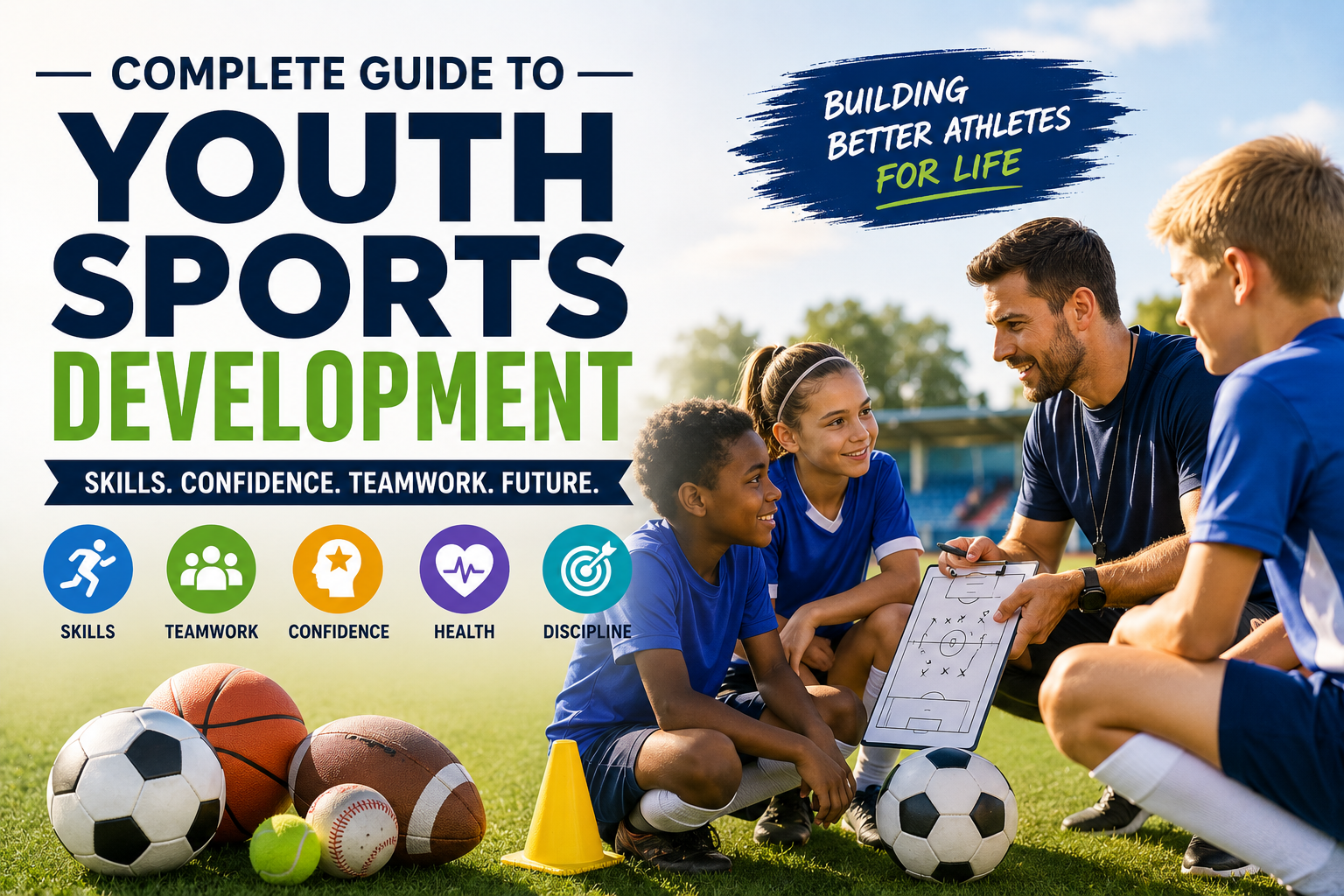
Complete Guide to Youth Sports Development
Youth sports can do far more than teach children how to throw a ball, run faster, or score goals. When thoughtfully designed, sports programs can help young people develop physical skills, confidence, teamwork, discipline, decision-making abilities, and healthy habits that can continue into adulthood.
However, effective youth sports development is not simply about increasing training hours or creating more competitive teams. Children develop at different rates, and programs that prioritize long-term development over short-term results are generally better positioned to help young athletes enjoy sports and build lasting skills.
This complete guide explores the foundations of youth sports development, from physical literacy and skill development to coaching, competition, injury prevention, nutrition, mental well-being, and the role parents can play.
What Is Youth Sports Development?
Youth sports development is the structured process of helping children and adolescents develop the physical, technical, tactical, psychological, and social abilities needed to participate successfully in sport.
It can include organized activities such as:
- School sports
- Community recreation programs
- Youth clubs
- Competitive teams
- Individual sports
- Multi-sport programs
- Development academies
- Informal play
The goal should not necessarily be to produce professional athletes. A strong youth sports system should serve children with different interests, abilities, goals, and levels of commitment.
For some young athletes, sport may eventually become a high-level competitive pursuit. For others, the primary benefit may be improved fitness, friendships, confidence, or enjoyment.
Why Youth Sports Development Matters
Participation in well-designed sports programs can provide young people with opportunities to develop several areas of life simultaneously.
Physical development
Regular physical activity helps children develop fundamental movement abilities such as:
- Running
- Jumping
- Throwing
- Catching
- Balancing
- Changing direction
- Coordinating movements
- Controlling body position
These abilities form the foundation for more specialized sporting skills.
Social development
Team sports can create opportunities to learn how to:
- Communicate with others
- Cooperate toward shared goals
- Handle disagreements
- Respect teammates and opponents
- Follow rules
- Accept different roles
Even individual sports can provide valuable social experiences through coaches, training partners, competitions, and clubs.
Emotional development
Sport can expose children to manageable challenges. Learning how to respond to mistakes, setbacks, competition, and pressure can contribute to emotional resilience.
The environment matters, however. Excessive criticism or unrealistic expectations can turn sport into a source of anxiety rather than a positive developmental experience.
Personal development
Young athletes can learn habits related to:
- Commitment
- Goal setting
- Time management
- Responsibility
- Patience
- Self-discipline
- Persistence
These lessons can extend beyond the playing field.
The Foundation: Physical Literacy
One of the most important concepts in youth sports development is physical literacy.
Physical literacy refers broadly to developing the confidence, competence, knowledge, and motivation needed to participate in physical activity throughout life.
Rather than specializing immediately in one sport, young children can benefit from experiencing a broad range of movements.
For example, a child might participate in activities involving:
- Running
- Swimming
- Climbing
- Cycling
- Throwing
- Catching
- Dancing
- Jumping
- Balancing
A broad movement foundation can make it easier for children to learn sport-specific skills later.
Fundamental Movement Skills
Fundamental movement skills can generally be divided into three broad categories.
Locomotor skills
These involve moving the body from one place to another.
Examples include:
- Walking
- Running
- Hopping
- Skipping
- Jumping
- Leaping
Object-control skills
These involve controlling objects.
Examples include:
- Throwing
- Catching
- Kicking
- Striking
- Dribbling
Stability skills
These involve controlling and positioning the body.
Examples include:
- Balancing
- Turning
- Twisting
- Landing
- Maintaining body position
Youth programs should provide opportunities to practice all three categories rather than focusing exclusively on competition.
Choosing the Right Sports for Children
There is no single sport that is best for every child.
The right choice depends on factors such as:
- Age
- Physical development
- Interests
- Personality
- Accessibility
- Family circumstances
- Local opportunities
- Desired level of competition
A child who enjoys team interaction may thrive in football, basketball, hockey, volleyball, or another team-based activity.
Another child may prefer swimming, athletics, gymnastics, martial arts, cycling, tennis, or another individual or small-group sport.
Perhaps the most important factor is whether the child actually enjoys participating.
Early Specialization Versus Multi-Sport Participation
Youth sports development often involves a debate about whether children should specialize in one sport at an early age or participate in several sports.
Early specialization means concentrating heavily on one sport from a relatively young age.
Multi-sport participation exposes children to different sports and movement patterns.
For many children, multi-sport participation can provide a broad physical foundation while reducing the monotony that may come from repeating the same movements throughout the year.
Some sports have different developmental pathways and may require specialized training at particular stages. Nevertheless, young athletes should not automatically assume that more specialization, more training, or more competition will produce better long-term results.
The appropriate approach depends on the sport, athlete, developmental stage, training environment, and individual circumstances.
Age-Appropriate Training
Training should change as children grow.
A program designed for a six-year-old should not simply be a smaller version of an adult training program.
Younger children
Early programs should emphasize:
- Fun
- Movement exploration
- Basic coordination
- Simple rules
- Fundamental skills
- Short activities
- Positive reinforcement
Middle childhood
Programs can gradually introduce:
- More structured skill development
- Basic tactical concepts
- Coordination challenges
- Greater independence
- More organized competition
Adolescents
Older athletes may begin working on:
- Sport-specific technique
- Strength and conditioning
- Tactical understanding
- Performance goals
- Competition strategies
- Mental skills
The transition should be gradual rather than based solely on chronological age.
The Importance of Developmental Differences
Two children of the same age can have very different physical and emotional development.
One teenager may have already experienced significant physical maturation, while another may still be developing.
Coaches should therefore avoid judging young athletes exclusively by current physical performance.
A child who is smaller or less physically mature today may have significant potential later.
Effective youth development considers the athlete’s developmental trajectory rather than treating current performance as a permanent prediction of future ability.
Building Technical Skills
Technical development involves learning the specific skills required by a sport.
For example, a football player may need to develop:
- Ball control
- Passing
- Shooting
- Dribbling
- Receiving
- Tackling
A basketball player may work on:
- Shooting
- Passing
- Dribbling
- Footwork
- Rebounding
- Defensive positioning
Skill development should generally progress from simple movements toward increasingly complex situations.
Practice should have purpose
Young athletes learn more effectively when they understand what they are practicing.
Instead of repeating a movement without context, coaches can gradually introduce:
- The basic movement
- Controlled practice
- Decision-making
- Pressure
- Game-like situations
This helps athletes understand not only how to perform a skill but also when and why to use it.
Developing Tactical Awareness
Technical skills are only one part of sports development.
Tactical development involves understanding how to make decisions during competition.
Young athletes may gradually learn to recognize:
- Space
- Position
- Timing
- Opponent movement
- Teammate positioning
- Risk and reward
- Changing game situations
Coaches can encourage tactical learning by asking questions rather than always giving immediate instructions.
For example:
“What options did you see when you received the ball?”
Questions encourage athletes to think about the game and develop independent decision-making skills.
The Role of Strength and Conditioning
Strength and conditioning can play an important role in youth athletic development when appropriately designed and supervised.
A youth strength program does not have to resemble an adult bodybuilding program.
It can focus on:
- Movement quality
- Balance
- Coordination
- Body control
- Strength
- Power
- Mobility
- Speed
- Agility
Technique and appropriate progression should take priority over lifting the heaviest possible weight.
Young athletes should also have adequate recovery between demanding training sessions.
Speed, Agility and Coordination
Many sports require athletes to accelerate, decelerate, change direction, and respond quickly.
These qualities can be developed through age-appropriate activities such as:
- Short sprints
- Direction-change drills
- Reaction games
- Jumping exercises
- Balance activities
- Movement challenges
The best programs often combine physical exercises with decision-making rather than relying exclusively on repetitive drills.
Injury Prevention in Youth Sports
Injury prevention should be an integral part of youth sports development.
Children and adolescents are still growing, and training loads need to reflect their developmental stage.
Important considerations include:
- Proper technique
- Appropriate equipment
- Gradual progression
- Adequate recovery
- Warm-up activities
- Hydration
- Sleep
- Communication about pain or discomfort
- Appropriate medical evaluation when necessary
A young athlete should not be encouraged to ignore significant pain simply to remain in competition.
Understanding overuse
Repeating the same movements excessively without sufficient recovery can contribute to overuse problems.
Programs can reduce unnecessary repetitive load by incorporating:
- Rest periods
- Training variation
- Cross-training
- Appropriate scheduling
- Monitoring workload
- Off-seasons or breaks where appropriate
Nutrition for Young Athletes
Nutrition supports growth as well as physical activity, making it particularly important for young athletes.
Children and adolescents generally need adequate energy and nutrients to support normal development and exercise.
A balanced eating pattern can include:
- Fruits
- Vegetables
- Whole grains
- Protein-rich foods
- Dairy or suitable alternatives
- Healthy fats
- Adequate fluids
Young athletes should not be placed on restrictive diets simply to achieve a particular body shape or performance target without appropriate professional guidance.
Hydration and Youth Sports
Hydration needs vary according to factors such as:
- Temperature
- Humidity
- Exercise intensity
- Duration
- Individual sweat rate
Young athletes should have regular access to fluids, particularly during longer or more demanding activities.
Coaches and parents should also understand that children may not always recognize or communicate early signs of dehydration or overheating.
In hot environments, training plans should account for environmental conditions and appropriate breaks.
Sleep and Athletic Development
Sleep is sometimes overlooked in sports programs, but it is fundamental to recovery and overall well-being.
Young people have significant sleep needs because their bodies and brains are still developing.
Poor sleep can affect areas such as:
- Concentration
- Mood
- Learning
- Reaction time
- Recovery
- Training quality
A strong youth sports program should therefore treat sleep as part of preparation rather than something athletes sacrifice for additional training.
The Role of Coaches
Coaches have enormous influence over young athletes.
A good youth coach is not simply someone who knows the technical aspects of a sport. The coach should also understand child development, communication, safety, motivation, and age-appropriate training.
Effective youth coaches should:
- Create a safe environment
- Communicate clearly
- Encourage effort
- Teach rather than intimidate
- Provide constructive feedback
- Treat athletes fairly
- Respect developmental differences
- Model good sportsmanship
- Encourage enjoyment
- Recognize when an athlete needs rest
A coach’s behavior can influence whether a child continues participating in sport for years or decides to quit.
Creating a Positive Sports Culture
Culture is often more influential than a training drill.
A healthy youth sports environment should make children feel that they are valued regardless of whether they score the most points or make the starting lineup.
Positive cultures emphasize:
- Effort
- Learning
- Improvement
- Teamwork
- Respect
- Fair play
- Responsibility
- Enjoyment
Winning can be part of competitive sport without becoming the sole measure of success.
The Role of Parents
Parents can have a powerful positive influence on youth sports development.
Supportive parents can:
- Encourage participation
- Provide transportation and logistical support
- Attend competitions when possible
- Help children maintain healthy routines
- Listen to concerns
- Celebrate effort
- Allow coaches to coach
Parents do not need to become assistant coaches from the sidelines.
Constant instructions during games can sometimes create confusion or additional pressure.
A simple message such as “Have fun and give your best” may be more beneficial than a stream of tactical instructions.
Managing Competitive Pressure
Competition can be valuable when introduced appropriately.
It can teach children how to:
- Deal with uncertainty
- Manage disappointment
- Work toward goals
- Respond to mistakes
- Compete respectfully
- Celebrate achievements appropriately
Problems arise when adults make winning more important than the child’s well-being.
Warning signs of excessive pressure can include:
- Fear of making mistakes
- Persistent anxiety before competitions
- Loss of enjoyment
- Avoidance of practice
- Emotional distress after poor performances
- Feeling that parental approval depends on results
Adults should pay attention to these signals.
Building Mental Skills
Mental skills can become increasingly important as athletes mature.
Useful skills include:
Goal setting
Athletes can establish realistic goals focused on improvement rather than only outcomes.
For example:
- Improve passing accuracy
- Develop a stronger non-dominant side
- Improve defensive positioning
- Complete a specific training routine consistently
Concentration
Athletes can learn techniques for maintaining attention during practice and competition.
Positive self-talk
Constructive internal dialogue can help athletes respond to mistakes without becoming overwhelmed by them.
Visualization
Older athletes may use mental rehearsal to imagine performing specific skills or responding to situations.
Teaching Children How to Handle Failure
Failure is an unavoidable part of sport.
A missed shot, lost match, dropped catch, poor race, or unsuccessful trial can become a learning opportunity.
Adults can help by asking:
- What happened?
- What did you learn?
- What would you try differently?
- What went well?
- What can you practice next?
This approach shifts the focus from embarrassment to learning.
Measuring Youth Sports Development
Development should not be measured only through wins, rankings, or statistics.
A broader assessment can consider:
| Development Area | Examples |
|---|---|
| Physical | Strength, coordination, speed, mobility |
| Technical | Sport-specific skills |
| Tactical | Decision-making and game understanding |
| Psychological | Confidence, focus, resilience |
| Social | Communication and teamwork |
| Behavioral | Discipline and responsibility |
| Health | Recovery, nutrition, sleep habits |
| Enjoyment | Motivation and continued participation |
This broader perspective gives coaches and families a better understanding of progress.
Common Mistakes in Youth Sports Development
Several mistakes can undermine an otherwise promising program.
Focusing exclusively on winning
Short-term victories do not necessarily indicate long-term athlete development.
Training too much
More training is not automatically better. Recovery is part of development.
Specializing too early
Intensive specialization may not be appropriate for every child or sport.
Comparing children constantly
Young athletes develop at different rates.
Ignoring enjoyment
If children stop enjoying sport, they may stop participating altogether.
Treating children like miniature adults
Training, communication, expectations, and competition should reflect developmental needs.
Neglecting non-sport skills
Young athletes are also students, friends, family members, and developing individuals. Sport should complement their broader lives.
How to Build a Long-Term Youth Sports Program
A strong program can follow a long-term framework.
Step 1: Establish fundamental movement skills
Give young children broad opportunities to move, play, and explore.
Step 2: Introduce multiple sports and activities
Allow children to discover what they enjoy and develop varied movement experiences.
Step 3: Develop sport-specific skills gradually
As interest and ability develop, introduce increasingly specialized technical and tactical training.
Step 4: Increase training complexity
Older athletes can progressively handle more structured practice, tactical work, and physical conditioning.
Step 5: Introduce appropriate competition
Competition should challenge athletes without overwhelming them.
Step 6: Develop independence
Older athletes should increasingly take responsibility for preparation, recovery, goal setting, and decision-making.
Step 7: Prepare athletes for different pathways
Not every athlete needs to pursue elite competition. Programs can support recreational participation, school sports, competitive pathways, or high-performance development.
Recreational Versus Elite Youth Sports
Youth sports programs generally serve different objectives.
Recreational sports
The primary priorities may include:
- Enjoyment
- Fitness
- Social interaction
- Skill development
- Participation
Competitive sports
Competitive programs generally place greater emphasis on:
- Performance
- Tactical development
- Structured training
- Competition
- Skill progression
High-performance pathways
Advanced athletes may require:
- Specialized coaching
- Individualized training
- Performance analysis
- Structured recovery
- Sport-specific conditioning
- Competition planning
The pathway should remain appropriate for the athlete’s age, development, health, and goals.
Making Youth Sports More Inclusive
A strong sports environment should make participation possible for children with different abilities, backgrounds, resources, and interests.
Programs can improve accessibility by considering:
- Equipment costs
- Transportation
- Facility access
- Program fees
- Adapted activities
- Flexible participation options
- Inclusive coaching practices
Inclusion benefits the entire sporting community by expanding participation and creating broader opportunities for young people.
Technology in Youth Sports Development
Technology can increasingly support athlete development, but it should be used thoughtfully.
Tools may include:
- Video analysis
- Performance tracking
- Digital training platforms
- Wearable devices
- Online educational resources
- Communication systems
Technology should complement coaching rather than replace human judgment.
For younger athletes especially, excessive data collection can distract from fundamental skills and enjoyment.
A Practical Youth Sports Development Checklist
Parents, coaches, and organizations can use the following checklist when evaluating a program:
- Is the program age appropriate?
- Are children encouraged to enjoy participation?
- Does training include fundamental movement skills?
- Are training loads increased gradually?
- Is adequate recovery provided?
- Are coaches appropriately trained?
- Is injury prevention taken seriously?
- Are children treated respectfully?
- Are developmental differences recognized?
- Is competition appropriate for the athletes?
- Are parents encouraged to provide positive support?
- Can athletes communicate concerns safely?
- Is the program inclusive?
- Are progress and effort valued alongside results?
- Does the program encourage long-term participation?
If several of these questions receive a “no,” the program may need to reconsider its approach.
What Successful Youth Development Looks Like
The strongest youth sports programs do not simply produce better athletes. They help young people become more capable, confident, resilient, and physically active individuals.
Success might look like a child learning a new skill after weeks of practice. It might be a teenager becoming more confident speaking with teammates. It could be an athlete learning how to recover from a disappointing performance without giving up.
For some athletes, the pathway eventually leads to elite competition. For many others, the greatest achievement is developing a lifelong relationship with physical activity.
Building Athletes Who Want to Keep Playing
The long-term value of youth sports is not measured only by trophies, medals, or professional contracts. It is also measured by whether young people develop the skills, confidence, relationships, and enjoyment that encourage them to remain active.
A development-first approach gives children room to learn, make mistakes, recover, compete, and grow. When coaches, parents, schools, clubs, and sports organizations work together around those principles, youth sports can become more than a training ground for competition—it can become a foundation for lifelong physical activity and personal development.



2 Comments
Micle harison
June 7, 2019Lorem ipsum dolor sit amet, usu ut perfecto postulant deterruisset, libris causae volutpat at est, ius id modus laoreet urbanitas. Mel ei delenit dolores.
John Doe
June 7, 2019Some consultants are employed indirectly by the client via a consultancy staffing company.