
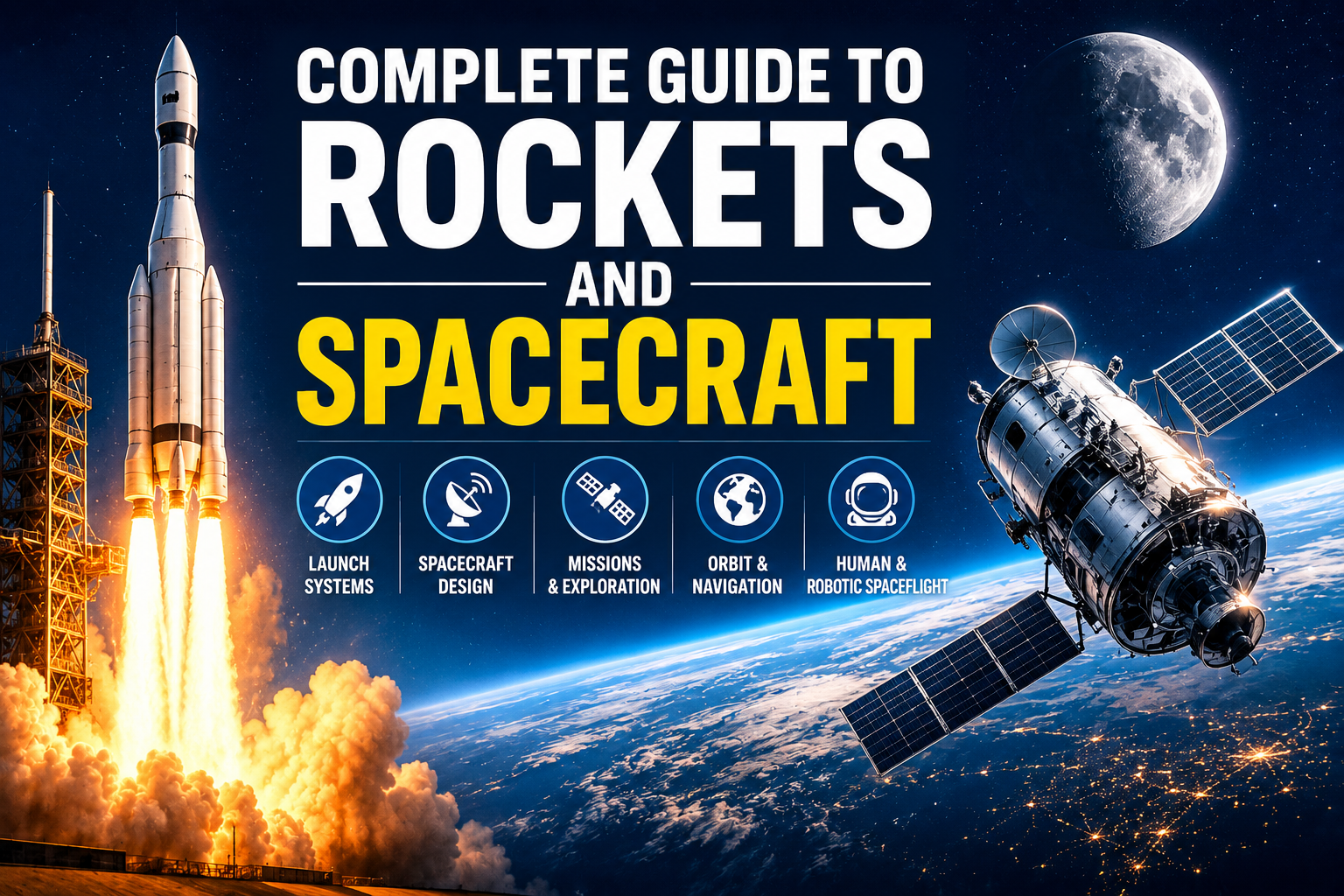
Complete Guide to Rockets and Spacecraft
Rockets and spacecraft are two of the most important technologies in the history of space exploration. Rockets provide the enormous thrust needed to escape Earth’s gravity and place payloads into orbit, while spacecraft are designed to operate in the harsh environment beyond Earth’s atmosphere.
From weather satellites and communication systems to robotic probes traveling across the Solar System and crewed vehicles carrying astronauts, modern life increasingly depends on technology that began as a solution to one fundamental problem: how do we reliably travel and operate in space?
This complete guide explains how rockets and spacecraft work, the major types, the technologies inside them, how launches happen, and what the future of space transportation could look like.
What Is a Rocket?
A rocket is a vehicle or propulsion system that produces thrust by expelling mass at high velocity.
Unlike aircraft, rockets do not need surrounding air to generate thrust. This makes them suitable for space, where there is essentially no atmosphere.
The basic principle is described by Newton’s third law of motion: when a rocket expels exhaust in one direction, the rocket is pushed in the opposite direction.
A simplified rocket engine therefore has three fundamental functions:
- Store or generate propellant.
- Convert propellant into high-speed exhaust.
- Direct that exhaust to produce thrust.
The rocket does not “push against” the air or ground. Its motion results from the momentum carried away by its exhaust.
How Do Rockets Work?
A rocket engine combines fuel and an oxidizer, or uses another mechanism capable of producing high-energy exhaust.
In many chemical rockets, combustion produces extremely hot, high-pressure gases. These gases expand through a specially shaped nozzle, accelerating the exhaust to very high speeds.
The resulting reaction force pushes the rocket forward.
A simplified sequence looks like this:
Propellant → combustion or energy release → expanding gases → high-speed exhaust → thrust
The amount of thrust produced depends on several factors, including the rate at which mass is expelled and the velocity of the exhaust.
Why Rockets Need So Much Fuel
Getting into space is difficult because Earth has substantial gravity.
A launch vehicle must accelerate upward while also overcoming atmospheric drag and Earth’s gravitational pull. More importantly, an orbital spacecraft must reach an enormous horizontal velocity rather than simply travel upward.
For a low Earth orbit, a vehicle generally needs to reach roughly 7.8 kilometers per second of orbital velocity, with additional performance required to account for atmospheric drag and gravity losses.
This is one reason rockets are large, complex machines even when the spacecraft or payload they carry may be relatively small.
What Is a Spacecraft?
A spacecraft is a vehicle designed to operate beyond Earth’s atmosphere or in the upper atmosphere for space-related missions.
Spacecraft can be:
- Crewed
- Uncrewed
- Robotic
- Orbital
- Interplanetary
- Scientific
- Commercial
- Military
- Communications-oriented
A spacecraft may spend years operating hundreds of millions of kilometers from Earth, or it may perform a mission lasting only minutes or hours.
Unlike rockets, spacecraft are primarily designed to perform a mission in space.
A rocket’s main job is transportation and propulsion during launch and, in some cases, later stages of a mission. A spacecraft’s job may involve communication, observation, scientific measurement, navigation, habitation, cargo transport, or exploration.
Rockets and Spacecraft: What Is the Difference?
The two terms are sometimes used interchangeably, but they describe different things.
| Feature | Rocket | Spacecraft |
|---|---|---|
| Primary purpose | Provide transportation and propulsion | Perform a mission in space |
| Main operating phase | Launch and propulsion | Orbit, exploration, observation or habitation |
| Requires propulsion | Yes | Often, but not always |
| Can carry payloads | Yes | May itself be the payload |
| Designed for long-term space operation | Not necessarily | Usually |
| Examples | Launch vehicle, booster | Satellite, probe, crew vehicle |
A launch system can contain both.
For example, a rocket may carry a spacecraft into orbit and then separate from it. The spacecraft continues its mission while the rocket stages may fall back to Earth, burn up in the atmosphere, enter another trajectory, or be recovered.
Major Types of Rockets
Rockets can be classified in several ways, including their propellant, number of stages, intended mission and whether they are reusable.
Chemical Rockets
Chemical rockets remain the dominant technology for launching large payloads from Earth.
They use chemical reactions to release energy and generate high-temperature exhaust.
There are two major categories.
Liquid-Propellant Rockets
Liquid rockets generally store fuel and oxidizer separately before feeding them into a combustion chamber.
Their advantages include:
- Precise control
- Ability to throttle many engines
- Potential to restart engines
- High performance
- Flexible mission design
Liquid propulsion is widely used in modern orbital launch vehicles.
Solid-Propellant Rockets
Solid rockets contain fuel and oxidizer in a solid propellant grain.
They are comparatively simple and can remain stored for long periods, making them useful for certain launch systems and other applications.
However, once a solid motor is ignited, controlling its operation can be more limited than with many liquid engines.
Hybrid Rockets
Hybrid rockets combine characteristics of liquid and solid propulsion.
Typically, one propellant is stored as a solid while another is supplied separately.
Hybrid systems can offer advantages in simplicity and controllability, although they have historically seen less widespread use than conventional liquid and solid propulsion.
Single-Stage and Multistage Rockets
One of the biggest challenges in spaceflight is carrying the mass of the rocket itself.
A rocket becomes more efficient when it can discard hardware that is no longer needed.
This is why many orbital launch vehicles use multiple stages.
How Rocket Staging Works
Imagine a rocket with three stages.
The first stage provides thrust during the early portion of flight. Once its propellant is exhausted, the stage is separated.
The remaining vehicle is now lighter.
The second stage then accelerates the vehicle further before being discarded, followed by the upper stage.
Each separation removes unnecessary mass and allows the remaining vehicle to accelerate more efficiently.
This principle is fundamental to conventional orbital launch systems.
Why Rockets Launch Vertically
Rockets usually launch vertically because it allows them to quickly gain altitude and move through the densest part of Earth’s atmosphere.
But reaching orbit is not primarily about going “up.”
Once a vehicle is above much of the atmosphere, it begins pitching over and accelerating horizontally.
The objective is to achieve enough sideways velocity that the spacecraft continuously falls toward Earth while Earth’s surface curves away beneath it.
That continuous free-fall is what creates an orbit.
Understanding Orbit
An orbit is not simply a location high above Earth.
It is a carefully controlled trajectory governed by gravity and velocity.
If a spacecraft travels too slowly, gravity pulls it back toward Earth.
If it reaches the appropriate velocity and trajectory, it can remain in orbit.
If it receives substantially more energy, it may escape Earth’s gravitational influence or travel toward another celestial body.
Common Types of Earth Orbit
Low Earth Orbit
Low Earth orbit, or LEO, is relatively close to Earth and is used by many satellites and crewed spacecraft.
Typical applications include:
- Earth observation
- Scientific research
- Communications
- Human spaceflight
- Technology demonstrations
Medium Earth Orbit
Medium Earth orbit is used for applications requiring broader coverage and particular orbital characteristics.
Navigation satellite systems commonly use medium Earth orbits.
Geostationary Orbit
A geostationary orbit is located at an altitude of approximately 35,786 kilometers above Earth’s equator.
A spacecraft in this orbit can appear to remain above approximately the same point on Earth’s surface because its orbital period matches Earth’s rotation.
This makes geostationary orbit particularly valuable for certain communication and weather satellites.
Polar Orbit
A polar orbit takes a spacecraft over or near Earth’s poles.
These orbits are useful for Earth observation because Earth’s rotation allows satellites to eventually pass over large portions of the planet.
What Is a Spacecraft Made Of?
A spacecraft is effectively a self-contained technological ecosystem.
Depending on its mission, it may contain:
- Structural systems
- Power systems
- Computers
- Communications equipment
- Sensors
- Propulsion
- Thermal-control equipment
- Navigation systems
- Scientific instruments
- Robotic mechanisms
- Life-support systems
Every kilogram matters.
Adding equipment increases mission capability but also increases launch requirements, cost and complexity.
Spacecraft Power Systems
Spacecraft require electricity to operate computers, sensors, communication equipment, heaters, motors and scientific instruments.
Solar Power
Solar panels are among the most common spacecraft power sources.
They convert sunlight into electricity and can support missions for many years.
Solar power becomes less effective as spacecraft travel farther from the Sun because sunlight becomes weaker with distance.
Radioisotope Power
Some deep-space spacecraft use radioisotope power systems.
These systems generate electricity from heat produced by radioactive decay.
They can be particularly useful where sunlight is too weak for practical solar power or where spacecraft must operate for long periods.
How Spacecraft Communicate With Earth
Spacecraft commonly communicate using radio waves.
A spacecraft can transmit scientific data, health information and navigation information toward Earth while receiving commands from ground stations.
Deep-space communication presents major challenges because signals weaken over enormous distances.
There is also an unavoidable communication delay.
For example, a command sent to a spacecraft millions of kilometers away may take significant time to arrive. Controllers therefore cannot always operate distant spacecraft in real time.
This means advanced spacecraft often need considerable onboard autonomy.
How Spacecraft Stay Warm or Cool
Space is often described as extremely cold, but thermal management in space is more complicated than simply dealing with low temperatures.
A spacecraft can absorb radiation from the Sun and Earth while also generating heat internally.
Because there is no surrounding atmosphere to carry heat away through conventional convection, spacecraft rely heavily on:
- Radiators
- Insulation
- Reflective surfaces
- Heaters
- Thermal coatings
- Heat pipes
Managing temperature can be just as important as managing power or fuel.
Spacecraft Propulsion
A spacecraft may need propulsion after launch to change its orbit, correct its trajectory, rendezvous with another vehicle or travel between planets.
Several propulsion technologies are used or being developed.
Chemical Propulsion
Chemical engines provide high thrust and are useful for major maneuvers.
They are particularly valuable when a spacecraft needs a substantial change in velocity within a short period.
Electric Propulsion
Electric propulsion systems accelerate charged particles to generate thrust.
They generally provide much lower thrust than conventional chemical engines but can operate for extremely long periods while using propellant efficiently.
This makes them valuable for certain satellite and deep-space missions.
Ion Propulsion
Ion engines are one example of electric propulsion.
They accelerate ions using electric fields and eject them at very high velocities.
The resulting thrust is small, but continuous operation can gradually produce significant changes in spacecraft velocity.
Crewed Spacecraft
Crewed spacecraft must meet requirements that robotic spacecraft do not.
A human-rated vehicle needs systems capable of protecting astronauts from the dangers of space.
These include:
- Oxygen supply
- Carbon dioxide removal
- Temperature regulation
- Pressure control
- Radiation protection
- Fire safety
- Waste management
- Emergency systems
- Food and water
- Crew communications
Reliability is particularly important because a malfunction that might destroy an unmanned satellite could threaten human life in a crewed vehicle.
Robotic Spacecraft
Robotic spacecraft have transformed our understanding of the Solar System.
They include:
- Orbiters
- Landers
- Rovers
- Flyby probes
- Space telescopes
- Sample-return vehicles
Robotic missions can travel into environments that would be dangerous or impossible for humans to reach.
They can also operate for years without requiring the enormous infrastructure needed to keep astronauts alive.
How Space Probes Explore Other Worlds
Interplanetary missions typically involve several major phases:
- Launch from Earth.
- Earth departure.
- Cruise through interplanetary space.
- Trajectory corrections.
- Arrival at the target.
- Orbit insertion, landing or flyby.
- Scientific operations.
- Data transmission to Earth.
Mission designers must calculate these trajectories with extraordinary precision.
A spacecraft may need to reach a moving planet or moon at exactly the right location and velocity years after leaving Earth.
Gravity Assists
One of the most elegant techniques in spaceflight is the gravitational assist.
A spacecraft can fly close to a planet and use the planet’s motion and gravity to alter its trajectory and velocity relative to the Sun.
This can reduce the amount of propellant needed for certain missions.
Gravity assists have enabled spacecraft to visit distant parts of the Solar System that would otherwise require significantly more launch energy.
What Makes Space Travel Difficult?
Spaceflight combines several extremely challenging engineering problems.
Gravity
Earth’s gravity makes reaching orbit energy-intensive.
Atmospheric Drag
The atmosphere creates resistance during launch and can generate intense heating during atmospheric reentry.
Extreme Temperatures
Spacecraft encounter dramatic thermal environments.
Radiation
Beyond Earth’s protective atmosphere and magnetic field, spacecraft can experience increased exposure to energetic particles and radiation.
Vacuum
Space provides essentially no atmospheric pressure, requiring spacecraft systems to be designed for vacuum operation.
Distance
Deep-space missions can be separated from Earth by hundreds of millions or even billions of kilometers.
Reliability
A component may need to work flawlessly for years without physical access for repairs.
How Spacecraft Return to Earth
Returning a spacecraft from orbit involves another major engineering challenge.
A vehicle entering Earth’s atmosphere at orbital velocity carries enormous kinetic energy.
Atmospheric friction and compression of air ahead of the vehicle generate extreme heat.
Spacecraft therefore require thermal protection systems.
Different vehicles use different approaches, including:
- Heat shields
- Ablative materials
- Reusable thermal-protection systems
- Controlled aerodynamic flight
A successful reentry requires precise control of speed, angle and trajectory.
Reusable Rockets
Traditional rockets were largely designed for single use.
Reusable launch technology aims to recover and fly some or all components multiple times.
Potential benefits include:
- Lower hardware cost per flight
- Faster turnaround
- Increased launch frequency
- Reduced manufacturing requirements
- More flexible access to orbit
However, reusability introduces its own engineering challenges, including thermal protection, structural fatigue, landing systems, refurbishment and reliability.
The Future of Rockets
Rocket development is increasingly focused on making space transportation more capable, reusable and affordable.
Future launch systems may incorporate:
- More reusable stages
- Autonomous flight systems
- Advanced engines
- Improved manufacturing
- New propellants
- Larger payload capacities
- Rapid turnaround
- More sophisticated recovery systems
One long-term goal is to make launching into space more routine rather than an exceptional event.
The Future of Spacecraft
Spacecraft are also evolving rapidly.
Future vehicles are likely to become more autonomous, efficient and capable.
Potential developments include:
Autonomous Spacecraft
Artificial intelligence and advanced onboard computing could allow spacecraft to make more decisions without waiting for instructions from Earth.
More Efficient Propulsion
Electric propulsion and other advanced systems could reduce propellant requirements for long-duration missions.
In-Space Manufacturing
Manufacturing components in orbit could eventually reduce the need to launch every structure and tool from Earth.
Space Stations
Larger and more capable orbital habitats could support scientific research, commercial activities and technology development.
Lunar Spacecraft
The Moon is likely to remain an important destination for exploration, science and technology demonstrations.
Mars Missions
Mars presents one of the most difficult long-term targets for human exploration because of its distance, radiation environment, limited resources and challenging entry, descent and landing requirements.
Why Rockets and Spacecraft Matter on Earth
The benefits of space technology extend far beyond exploration.
Space-based systems support everyday activities such as:
- Navigation
- Weather forecasting
- Telecommunications
- Television broadcasting
- Disaster monitoring
- Agriculture
- Environmental observation
- Scientific research
- Climate monitoring
- Mapping
- Emergency response
In many cases, people use space-enabled technologies without realizing that satellites are involved.
Frequently Asked Questions About Rockets and Spacecraft
How does a rocket move in space without air?
A rocket does not need air to move. It accelerates by expelling mass, such as high-speed exhaust, in the opposite direction of its motion.
What is the difference between a rocket and a spacecraft?
A rocket primarily provides propulsion and transportation, especially during launch. A spacecraft is designed to perform a mission in space, such as communication, observation, exploration or carrying people.
Why do rockets have multiple stages?
Multiple stages allow rockets to discard empty tanks, engines and other hardware once they are no longer needed. Removing this mass makes the remaining vehicle more efficient.
How fast does a spacecraft travel?
Speed varies dramatically depending on the mission. A spacecraft in low Earth orbit travels at roughly 7.8 kilometers per second, while interplanetary spacecraft can reach substantially different velocities depending on their trajectories.
Can spacecraft fly like airplanes in space?
Not in the conventional sense. Airplanes depend on atmospheric lift and aerodynamic control surfaces, while spacecraft primarily use propulsion, orbital mechanics and, during atmospheric flight, aerodynamic forces.
How long can spacecraft operate?
Mission lifetimes range from minutes to decades. Some spacecraft are designed for short missions, while others can continue operating long after their original mission objectives have been completed.
The Technology Behind Humanity’s Reach Into Space
Rockets and spacecraft represent two halves of the same extraordinary engineering challenge. Rockets make it possible to leave Earth and deliver payloads to space, while spacecraft allow those payloads to survive, navigate and accomplish useful missions once they get there.
Understanding both technologies also reveals why space exploration is difficult. Every launch involves a carefully balanced combination of propulsion, structures, navigation, thermal control, electronics and orbital mechanics.
As these technologies continue to mature, the boundary between Earth and space is likely to become increasingly connected to everyday life. The next generation of rockets and spacecraft may not simply take people farther into space—they could change how humanity uses orbit, explores other worlds and builds infrastructure beyond Earth.


2 Comments
Micle harison
June 7, 2019Lorem ipsum dolor sit amet, usu ut perfecto postulant deterruisset, libris causae volutpat at est, ius id modus laoreet urbanitas. Mel ei delenit dolores.
John Doe
June 7, 2019Some consultants are employed indirectly by the client via a consultancy staffing company.