
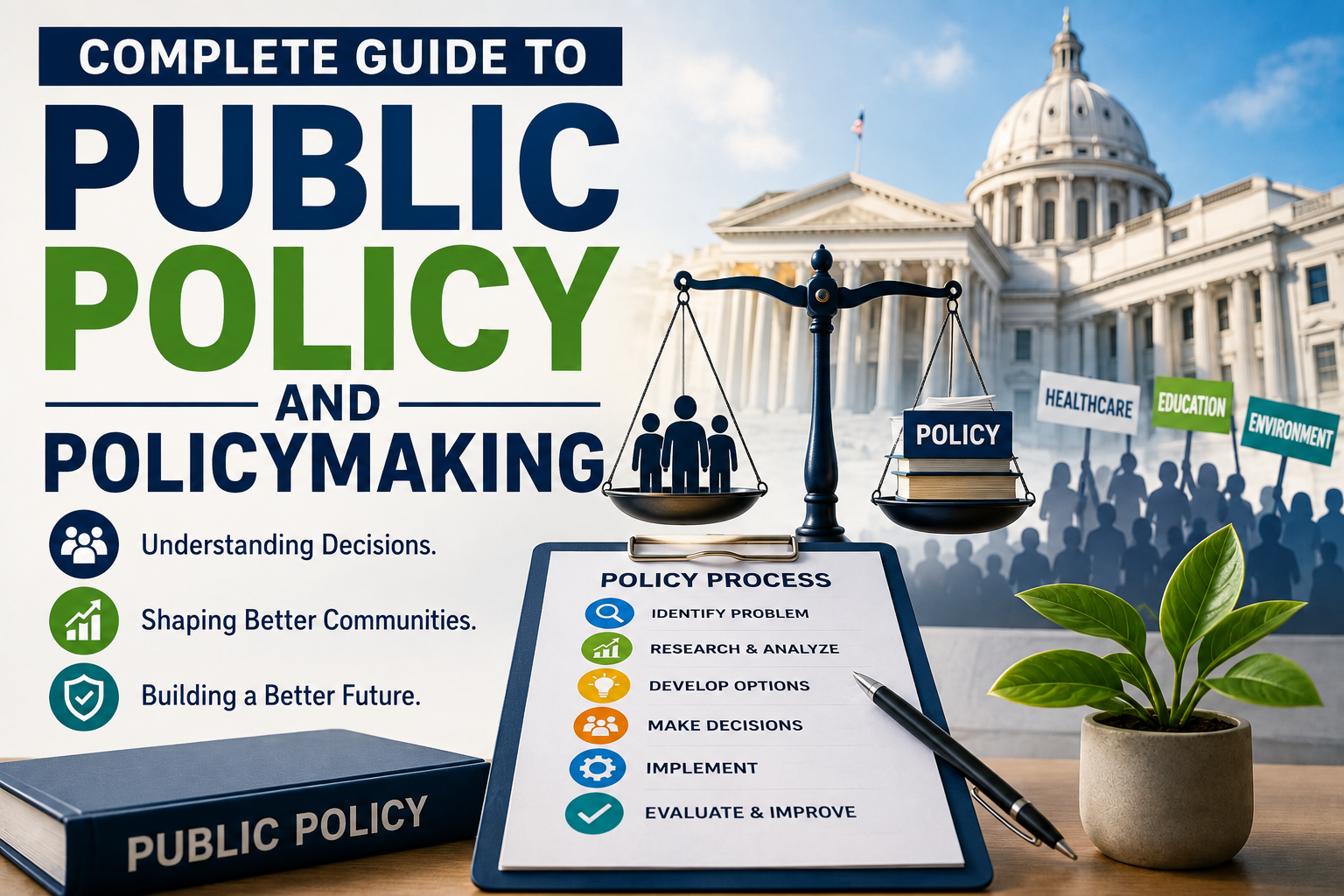
Complete Guide to Public Policy and Policymaking
Public policy shapes many of the decisions that affect everyday life. From education and healthcare to transportation, taxation, environmental protection, housing, and public safety, governments use policies to address problems, allocate resources, establish rules, and pursue broader social goals.
Yet policymaking is often misunderstood. It is not simply a matter of politicians deciding what should happen. Effective policy development can involve elected officials, civil servants, researchers, businesses, community organizations, advocacy groups, experts, courts, journalists, and members of the public.
Understanding how public policy works makes it easier to evaluate government decisions, participate in civic life, and distinguish between political promises, actual policies, and measurable outcomes.
This complete guide explains what public policy is, how policies are developed, who influences them, how governments evaluate their effectiveness, and why implementation can be just as important as the original policy decision.
What Is Public Policy?
Public policy is a course of action, set of decisions, rules, or principles adopted by a government to address a public issue or achieve a particular objective.
Policies can take many forms, including:
- Laws and regulations
- Government programs
- Tax policies
- Spending decisions
- Public services
- Administrative rules
- International agreements
- Standards and guidelines
- Social protection programs
- Environmental measures
A policy does not always require a new law. Governments can influence outcomes through budgets, administrative decisions, regulatory frameworks, public programs, and enforcement practices.
For example, a government seeking to improve road safety might combine legislation, speed regulations, infrastructure investment, public education, licensing requirements, and enforcement.
Public Policy Versus Politics
Politics and public policy are closely connected, but they are not the same thing.
Politics concerns the competition and negotiation through which individuals and groups seek influence over government decisions.
Public policy concerns the decisions and actions that result from those processes.
Politics can influence:
- Which problems receive attention
- Which solutions are considered
- How resources are allocated
- Which groups are consulted
- What compromises are made
- How policies are communicated
Policy, meanwhile, provides a framework for government action.
A political campaign might promise to improve healthcare. A public policy would determine the specific mechanisms used to pursue that objective.
Why Public Policy Matters
Public policy affects both individuals and institutions.
A single policy decision can influence:
- Household finances
- Business conditions
- Access to healthcare
- Educational opportunities
- Employment
- Housing
- Transportation
- Environmental quality
- Public safety
- Infrastructure
- Social welfare
Policies can also produce unintended consequences.
A measure designed to solve one problem may create new incentives, costs, administrative burdens, or inequalities elsewhere.
That is why good policymaking requires more than identifying a desirable goal. Policymakers must consider how proposed interventions will work in practice.
The Main Goals of Public Policy
Different policies pursue different objectives, but common goals include:
Economic stability
Governments may develop policies designed to support employment, maintain stable economic conditions, encourage investment, or manage public finances.
Public health
Health policies can address disease prevention, healthcare access, sanitation, nutrition, emergency preparedness, and health education.
Education
Education policies can determine how schools are funded, how curricula are established, how teachers are trained, and how educational opportunities are distributed.
Public safety
Governments use laws, regulations, emergency services, infrastructure, and enforcement systems to protect communities.
Environmental protection
Environmental policies can address pollution, conservation, resource management, climate risks, waste, and sustainable development.
Social protection
Social policies can provide assistance or services to people facing unemployment, disability, poverty, old age, or other challenges.
Economic development
Governments may use infrastructure investment, business regulations, taxation, skills development, and other measures to encourage economic activity.
The Policy Cycle Explained
Policymaking is often described as a cycle rather than a single event.
A simplified policy cycle contains several stages:
- Problem identification
- Agenda setting
- Policy formulation
- Policy adoption
- Implementation
- Monitoring
- Evaluation
- Policy revision
In reality, these stages frequently overlap.
A new problem can emerge during implementation. Evaluation can lead policymakers back to formulation. Political events can alter priorities at almost any stage.
Nevertheless, the policy cycle provides a useful framework for understanding how public decisions develop.
Step One: Identifying the Problem
Every policy begins with a perceived problem or objective.
However, identifying a problem is more complicated than simply observing that something is wrong.
Policymakers must determine:
- What is happening?
- Who is affected?
- How large is the problem?
- What caused it?
- Is government intervention necessary?
- What evidence supports the assessment?
- What would happen without intervention?
Different groups may define the same situation differently.
For example, rising housing costs might be described as:
- A shortage of housing supply
- An affordability problem
- A household income problem
- A zoning problem
- A financing problem
- A transportation problem
The way a problem is framed can influence which solutions appear reasonable.
Step Two: Setting the Policy Agenda
Governments face more problems than they can address at once.
Agenda setting determines which issues receive political and administrative attention.
Issues can gain prominence because of:
- Public concern
- Research findings
- Elections
- Economic conditions
- Crises
- Advocacy campaigns
- Media attention
- Court decisions
- Interest-group activity
- International developments
Agenda setting is therefore an important part of policymaking.
A problem may be widely recognized but remain low on the government’s priority list.
Step Three: Developing Policy Options
Once an issue receives attention, policymakers can begin examining possible solutions.
A policy problem may have several potential responses.
For example, a government trying to reduce traffic congestion might consider:
- Public transportation investment
- Road expansion
- Congestion pricing
- Parking reforms
- Carpool incentives
- Land-use changes
- Cycling infrastructure
- Flexible working policies
Each option has advantages, disadvantages, costs, and trade-offs.
The objective is not necessarily to find a perfect solution. Policymakers often need to identify the option that provides the best balance among competing objectives and constraints.
Evidence-Based Policymaking
Evidence can help policymakers understand whether an intervention is likely to work.
Useful forms of evidence include:
- Academic research
- Government statistics
- Administrative data
- Surveys
- Economic analysis
- Program evaluations
- Expert assessments
- Historical comparisons
- Pilot programs
- International comparisons
Evidence does not eliminate political judgment.
Policymakers still have to decide which objectives matter most and how much society should spend to pursue them.
The strongest policymaking combines evidence with democratic decision-making, practical knowledge, ethical considerations, and an understanding of local circumstances.
Cost-Benefit Analysis
Cost-benefit analysis attempts to compare the expected costs and benefits of a policy.
Costs might include:
- Government spending
- Administrative expenses
- Compliance costs
- Lost economic activity
- Environmental impacts
- Opportunity costs
Benefits might include:
- Improved health
- Increased productivity
- Reduced accidents
- Higher employment
- Better infrastructure
- Environmental improvements
- Increased public safety
Not every important benefit can be easily expressed in monetary terms.
For this reason, policymakers may use cost-effectiveness analysis, distributional analysis, or other evaluation methods alongside traditional cost-benefit analysis.
The Role of Stakeholders
Public policy rarely affects only the people who create it.
Stakeholders can include:
- Citizens
- Businesses
- Workers
- Nonprofit organizations
- Professional associations
- Community groups
- Researchers
- Local governments
- Public agencies
- Industry representatives
Stakeholders may provide information, identify practical problems, advocate for particular outcomes, or challenge proposed policies.
Consultation can improve policymaking by revealing information that policymakers may not otherwise have.
However, consultation also needs safeguards to ensure that groups with greater financial or political resources do not automatically receive disproportionate influence.
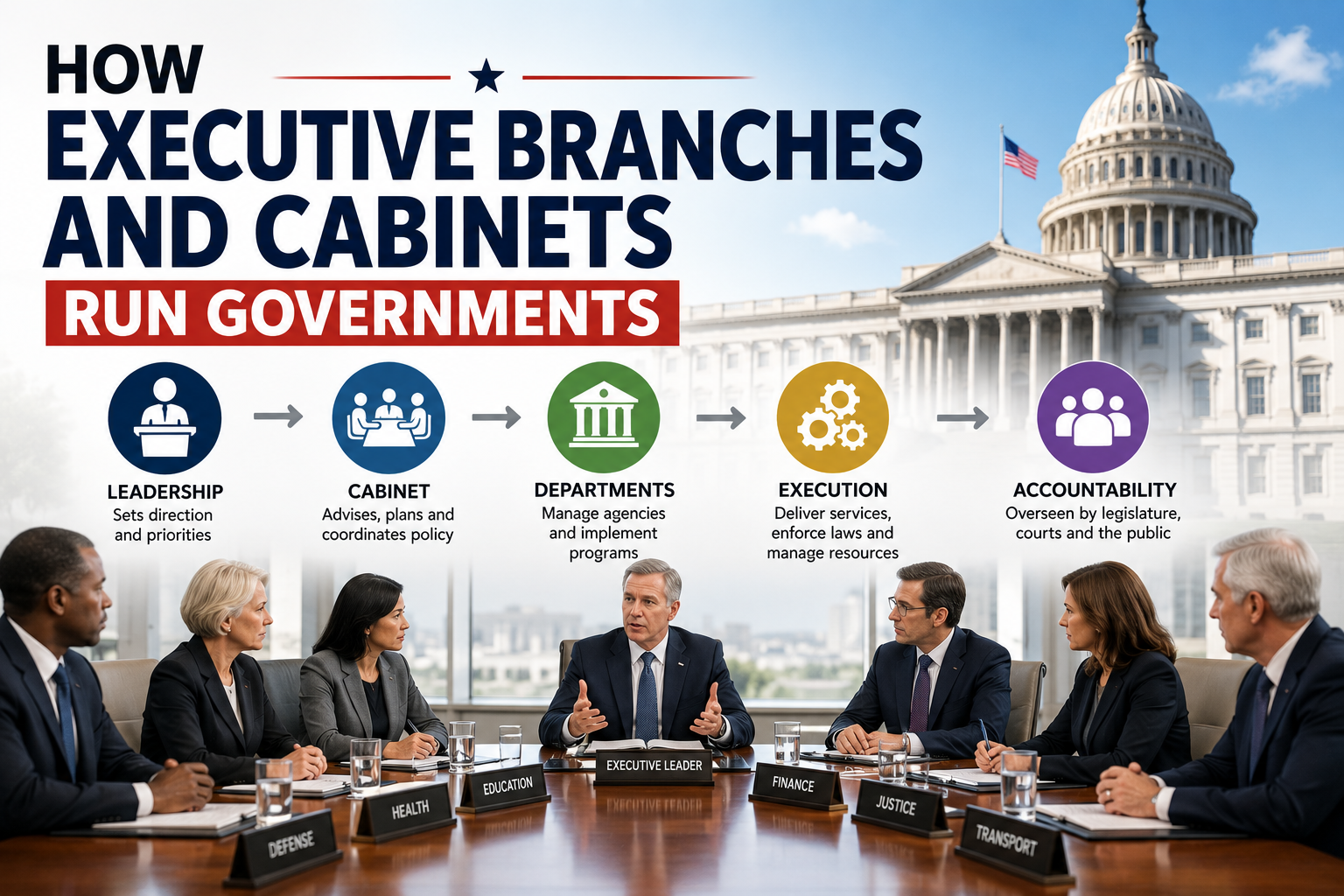
The Role of Government Institutions
Policymaking usually involves multiple government institutions.
Legislatures
Legislatures debate and pass laws, approve budgets, conduct oversight, and represent constituencies.
Executives
Executive institutions often establish priorities, coordinate government programs, implement laws, and oversee public administration.
Government agencies
Agencies frequently develop regulations, deliver public services, collect information, and enforce laws.
Courts
Courts can interpret laws and determine whether government actions comply with constitutional or legal requirements.
Local governments
Municipal and regional governments may be responsible for areas such as:
- Local infrastructure
- Waste management
- Land use
- Public transportation
- Local health services
- Community development
The exact division of responsibilities differs between countries.
Policy Instruments
Governments have many tools available when attempting to change behavior or achieve policy goals.
Regulation
Regulations establish requirements, restrictions, standards, or permissions.
Examples can include:
- Safety standards
- Environmental limits
- Licensing requirements
- Building codes
- Financial rules
Taxes
Taxes can raise revenue while also influencing behavior.
Governments may use tax incentives or taxes on particular activities to encourage or discourage certain behaviors.
Subsidies
Subsidies provide financial support for activities considered socially or economically desirable.
Public spending
Governments can directly fund infrastructure, services, research, education, healthcare, or other priorities.
Information campaigns
Governments can attempt to change behavior through education and public communication.
Direct government provision
Instead of regulating or subsidizing private activity, governments may directly provide services.
The choice of instrument can be just as important as the policy objective itself.
Policy Implementation
Passing a policy does not guarantee that it will succeed.
Implementation is the process of turning policy decisions into actual programs, regulations, services, and enforcement.
Implementation may require:
- Funding
- Staff
- Infrastructure
- Administrative systems
- Regulations
- Training
- Data collection
- Public communication
- Monitoring
A well-designed policy can fail because it is poorly implemented.
Likewise, an imperfect policy may perform better than expected if institutions have strong implementation capabilities.
Why Implementation Often Fails
Common implementation challenges include:
Insufficient funding
Programs may be approved without adequate resources to deliver them effectively.
Administrative complexity
Complicated procedures can make programs difficult for citizens to access.
Weak institutional capacity
Agencies may lack sufficient staff, technology, expertise, or organizational systems.
Conflicting incentives
Different agencies or stakeholders may have competing objectives.
Poor communication
Citizens may not understand eligibility requirements, regulations, or available services.
Resistance to change
Organizations and individuals may resist policies that alter established practices or incentives.
Inadequate monitoring
Without reliable information, governments may not realize that a program is underperforming.
Policy Evaluation
Policy evaluation asks whether a policy is achieving its intended objectives.
Important questions include:
- Did the policy achieve its goals?
- Who benefited?
- Who faced costs?
- Were there unintended consequences?
- Was implementation effective?
- Was the policy cost-effective?
- Would another approach have worked better?
Evaluation can occur before, during, or after implementation.
Ex ante evaluation
This occurs before implementation and attempts to predict likely outcomes.
Process evaluation
This examines how a program is being implemented.
Outcome evaluation
This assesses whether the desired results occurred.
Impact evaluation
This attempts to determine whether the policy itself caused the observed changes.
Measuring Policy Success
There is rarely one universal definition of success.
A policy may be evaluated according to:
| Measure | Key Question |
|---|---|
| Effectiveness | Did it achieve its objective? |
| Efficiency | Were resources used well? |
| Equity | How were costs and benefits distributed? |
| Accessibility | Could intended users access it? |
| Sustainability | Can it continue over time? |
| Feasibility | Can institutions realistically deliver it? |
| Public acceptance | Do affected communities consider it legitimate? |
| Unintended effects | Did it create unexpected consequences? |
Evaluating several dimensions provides a more complete picture than relying on a single statistic.
The Importance of Equity
Two policies can produce the same average outcome while affecting different groups very differently.
For example, policymakers may ask:
- Who benefits?
- Who pays?
- Who has access?
- Who may be excluded?
- Are disadvantaged groups affected differently?
- Are there barriers to participation?
Equity analysis is therefore an important part of many policy decisions.
Public Participation in Policymaking
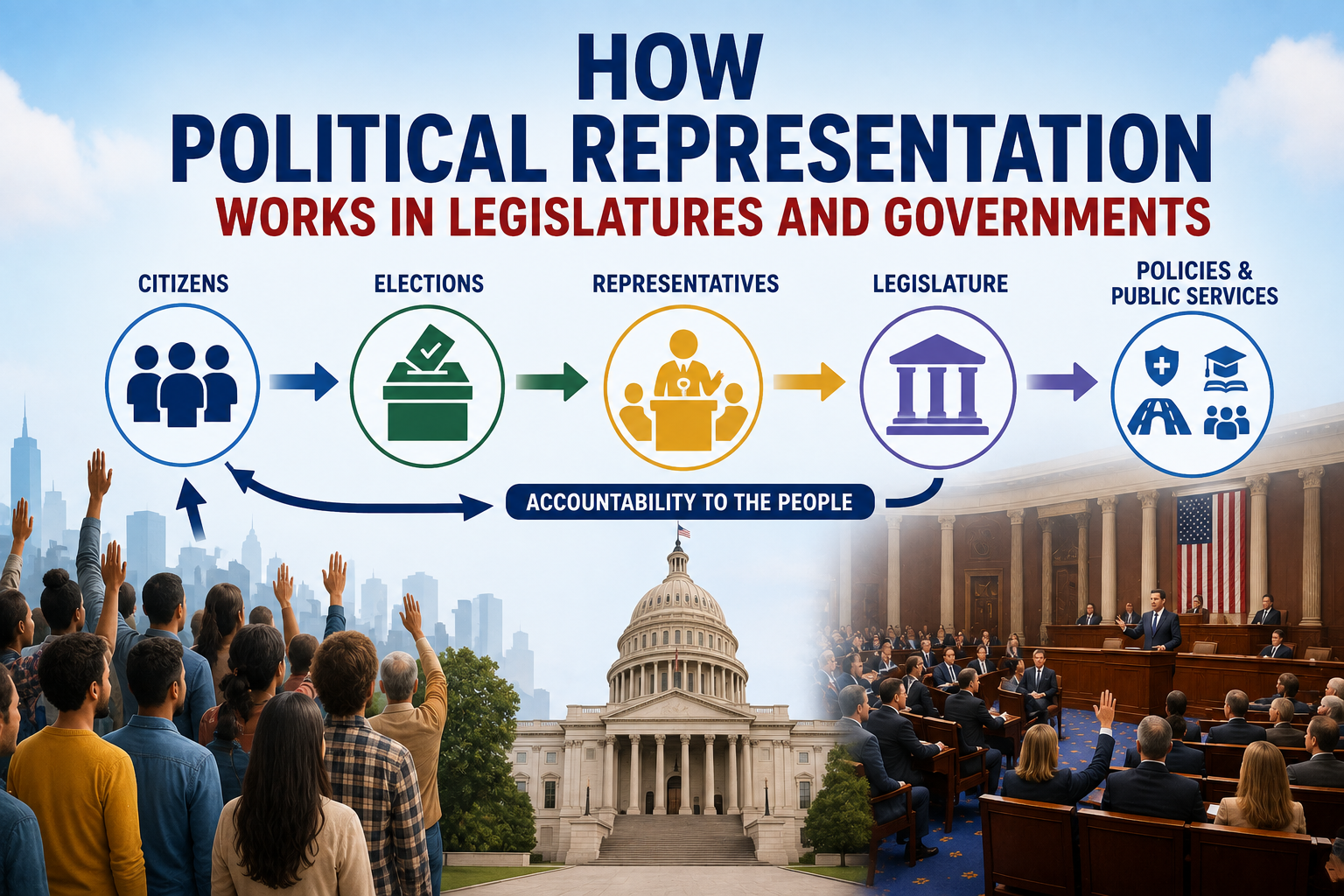
Citizens do not have to be government officials or policy experts to participate in policymaking.
Possible forms of participation include:
- Voting
- Public consultations
- Community meetings
- Written submissions
- Civic organizations
- Advocacy
- Public hearings
- Contacting elected representatives
- Participating in local government processes
- Contributing to research and public discussions
Meaningful participation can provide policymakers with information about how policies affect people in practice.
The Role of Political Parties
Political parties can influence public policy by developing platforms, proposing legislation, organizing voters, and forming governments or coalitions.
Parties often group individual policy proposals into broader ideological or strategic frameworks.
However, party platforms are not necessarily equivalent to enacted policy.
There can be substantial differences between:
Campaign promise → legislative proposal → enacted policy → implemented program → measurable outcome
Understanding this chain is essential when evaluating political claims.
The Role of Interest Groups
Interest groups organize around particular interests or causes and seek to influence public decisions.
They may represent:
- Businesses
- Workers
- Professional groups
- Environmental organizations
- Consumer interests
- Community organizations
- Civil society groups
Interest groups can contribute valuable expertise and represent legitimate interests.
At the same time, policymakers must consider whether some groups have significantly greater access, funding, or political influence than others.
Public Policy and the Media
Media organizations influence policymaking indirectly by informing the public and drawing attention to particular issues.
Media coverage can affect:
- Public awareness
- Political agendas
- Perceptions of policy performance
- Public debate
- Government accountability
However, citizens should distinguish between reporting, commentary, advocacy, and political messaging.
Evaluating the underlying evidence is particularly important when policy issues are controversial.
The Role of Research Institutions
Universities, think tanks, research organizations, and statistical agencies can contribute evidence to policymaking.
Their work may include:
- Collecting data
- Conducting surveys
- Evaluating programs
- Modeling policy outcomes
- Comparing different interventions
- Identifying emerging problems
Strong policy research should clearly explain its methodology, assumptions, limitations, and sources of funding where relevant.
Policy Trade-Offs
Most significant policy decisions involve trade-offs.
A government may want to achieve several goals simultaneously, but those goals can conflict.
For example:
- Higher public spending may improve services but increase fiscal pressure.
- Stricter regulations may improve safety but increase compliance costs.
- Faster development may create jobs but increase environmental pressure.
- Lower taxes may increase disposable income but reduce government revenue.
Recognizing trade-offs does not mean that all policy choices are equally good. It means that policymakers should explain what they are prioritizing and what costs or risks accompany those choices.
Short-Term Versus Long-Term Policy
Some policies produce immediate results, while others require years to show their effects.
Infrastructure, education, public health, environmental protection, and institutional reforms can have long time horizons.
A government focused exclusively on short-term outcomes may underinvest in areas where benefits appear later.
Long-term policymaking therefore requires:
- Consistent planning
- Reliable institutions
- Stable funding
- Monitoring
- Willingness to revise ineffective programs
Policy Innovation and Pilot Programs
Governments sometimes test new approaches before implementing them on a larger scale.
Pilot programs can help answer questions such as:
- Is the intervention practical?
- Can agencies deliver it?
- Do people use it?
- What unexpected problems emerge?
- Are the results promising enough to justify expansion?
A pilot does not guarantee that a program will work at national scale. Conditions can change dramatically when a small experiment becomes a large public program.
Comparing Policies Across Countries
International comparisons can provide useful insights, but policymakers should be cautious about copying policies from another country.
Countries differ in:
- Institutions
- Economic structures
- Demographics
- Legal systems
- Geography
- Culture
- Administrative capacity
- Existing infrastructure
A policy that performs well in one setting may produce different results elsewhere.
The most useful international comparisons identify why an intervention worked, not simply whether it worked.
Common Public Policymaking Mistakes
Defining the problem too narrowly
A narrow definition can lead policymakers toward solutions that address symptoms rather than underlying causes.
Ignoring implementation
A policy that looks excellent on paper may fail if institutions cannot deliver it.
Relying on insufficient evidence
Anecdotes can be useful for identifying issues but are not always sufficient for determining their scale or cause.
Ignoring unintended consequences
People respond to incentives, and policies can create behaviors policymakers did not anticipate.
Treating average results as universal
A policy may benefit one population while creating costs for another.
Failing to evaluate outcomes
Without evaluation, ineffective programs can continue simply because they already exist.
Confusing political popularity with policy effectiveness
Popular policies are not automatically effective, and technically effective policies may require better public communication or political support.
How Citizens Can Evaluate Public Policy
Anyone can develop better policy literacy by asking a few basic questions.
1. What problem is the policy addressing?
If the problem is unclear, it becomes difficult to evaluate the proposed solution.
2. What evidence supports the approach?
Look for credible research, transparent data, and independent evaluation.
3. What exactly will the government do?
Separate broad political language from specific policy mechanisms.
4. Who pays?
Consider taxpayers, businesses, consumers, government agencies, or other groups.
5. Who benefits?
Identify the intended beneficiaries and consider whether benefits are distributed evenly.
6. What could go wrong?
Look for unintended incentives, administrative barriers, or implementation risks.
7. How will success be measured?
A policy should ideally have measurable objectives.
8. What happens if it does not work?
Good policymaking includes mechanisms for review, adjustment, or termination when appropriate.
Public Policy in a Changing World
Policy challenges are becoming increasingly interconnected.
Issues such as:
- Technology
- Artificial intelligence
- Climate change
- Urbanization
- Aging populations
- Global trade
- Public health
- Digital privacy
- Cybersecurity
- Energy security
can cross traditional government boundaries.
This means modern policymaking increasingly requires cooperation among different agencies, levels of government, academic disciplines, businesses, and communities.
The Future of Policymaking
The future of public policy is likely to involve greater use of data, technology, public participation, and evidence-based evaluation.
Digital government systems can make it easier to deliver services and collect information. Data analysis can help policymakers identify patterns and assess programs. Online consultation can broaden participation.
At the same time, these developments create new questions about privacy, cybersecurity, algorithmic bias, transparency, and accountability.
Technology can improve policymaking, but it does not eliminate the need for human judgment.
A Practical Framework for Understanding Any Policy
When encountering a new policy proposal, use this framework:
Problem → Evidence → Options → Costs → Benefits → Stakeholders → Implementation → Measurement → Review
This sequence helps separate political rhetoric from the mechanics of policymaking.
For example, instead of simply asking whether a policy sounds good, ask:
- What problem is it solving?
- What evidence demonstrates that the problem exists?
- Why was this particular solution selected?
- What alternatives were considered?
- What will it cost?
- Who gains and who loses?
- Who will implement it?
- How will results be measured?
- When will the policy be reviewed?
These questions can produce a much more informed assessment.
Building Better Policy Through Better Decisions
Effective policymaking is ultimately about turning public goals into workable action while recognizing evidence, constraints, competing interests, and uncertainty.
The strongest policies are rarely the ones with the simplest slogans. They are the ones that clearly define the problem, consider credible alternatives, account for implementation, measure outcomes, and remain open to improvement.
For citizens, understanding this process provides an important advantage: it becomes easier to look beyond political promises and examine what governments actually propose, how those proposals work, who they affect, and whether they deliver the results they were intended to produce.
Public policy is not something that happens only inside government buildings. It is a continuous process shaped by institutions, communities, evidence, political choices, and public participation. Understanding that process is one of the foundations of informed citizenship.


2 Comments
Micle harison
June 7, 2019Lorem ipsum dolor sit amet, usu ut perfecto postulant deterruisset, libris causae volutpat at est, ius id modus laoreet urbanitas. Mel ei delenit dolores.
John Doe
June 7, 2019Some consultants are employed indirectly by the client via a consultancy staffing company.