
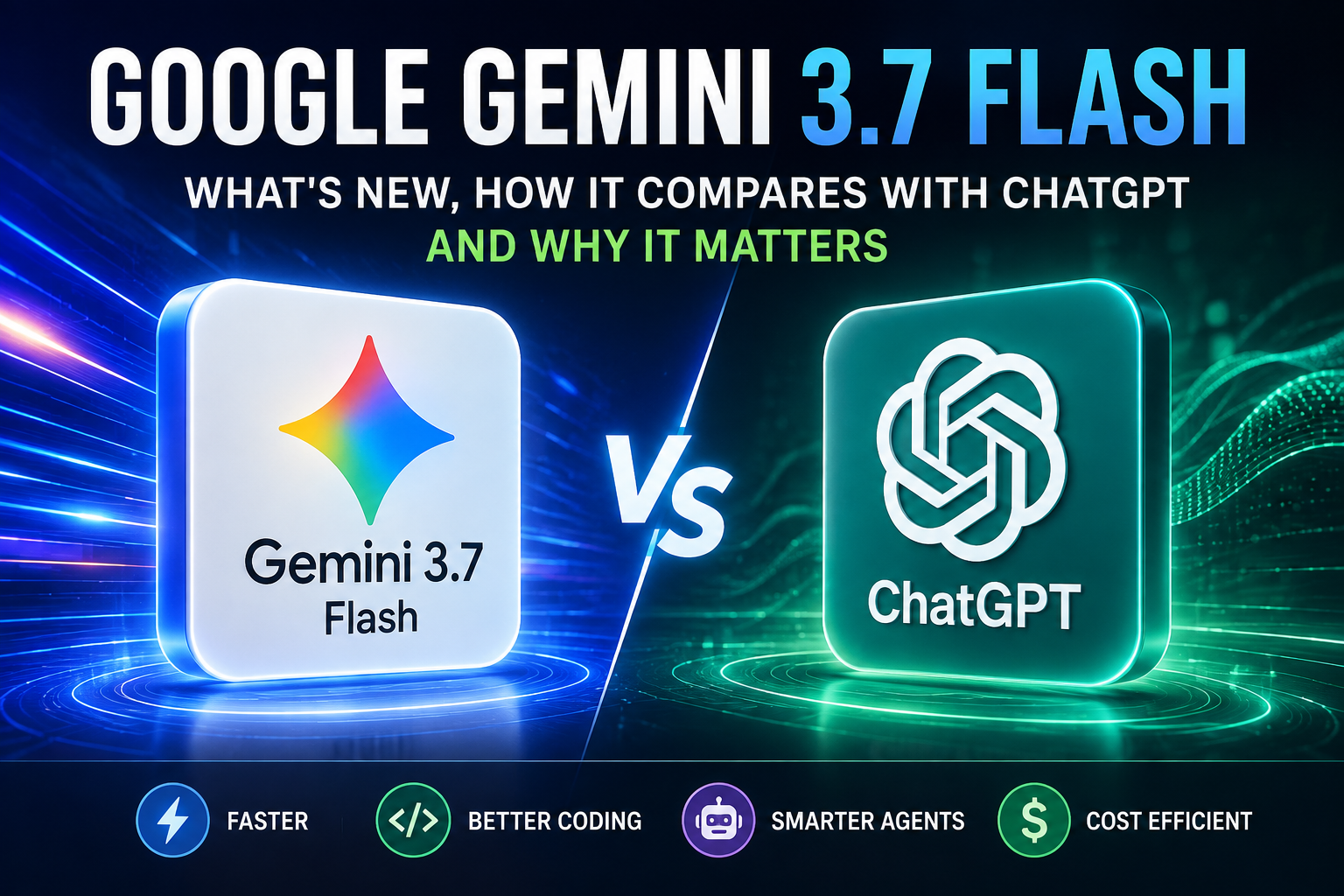
Google Gemini 3.7 Flash: What’s New, How It Compares With ChatGPT and Why It Matters
Google has released Gemini 3.7 Flash, a new model designed to handle coding, software engineering, knowledge work and AI-agent workflows with a stronger emphasis on speed, accuracy and cost efficiency.
Announced on August 13, 2026, Gemini 3.7 Flash arrives only three weeks after Gemini 3.6 Flash and is positioned by Google as its most capable “workhorse” model yet for coding and agents. (blog.google)
The launch matters because the competition among AI companies is increasingly moving beyond simple chatbot answers. Google, OpenAI and other major AI labs are competing to build systems that can reason through complicated tasks, use tools, work with files and software, write code and complete multi-step jobs with less human supervision.
Here’s what Gemini 3.7 Flash brings to the table—and how its approach compares with today’s ChatGPT.
What Is Gemini 3.7 Flash?
Gemini 3.7 Flash is Google’s latest high-efficiency model in the Gemini family. Rather than positioning it purely as a lightweight chatbot, Google describes it as an agentic workhorse designed for complex workflows.
That distinction is important.
Traditional AI assistants generally operate like this:
User asks → AI responds → user asks again → AI responds
Agentic systems aim for something closer to:
User gives a goal → AI plans → AI uses tools → AI checks progress → AI adjusts → AI completes the task
Google says Gemini 3.7 Flash is specifically designed for that second category, with improvements in software engineering, web development, knowledge-intensive work and enterprise workflow automation. (blog.google)
The model is available through Google’s developer ecosystem, including the Gemini API, Google AI Studio, Google Antigravity and Android Studio. Enterprise customers can access it through Gemini Enterprise Agent Platform and Gemini Enterprise, while consumers can encounter it through Gemini Spark for eligible Google AI Pro and Ultra subscribers. (blog.google)
What’s New in Gemini 3.7 Flash?
1. Stronger Coding Performance
One of Google’s biggest claims for Gemini 3.7 Flash is improved software engineering.
The company says the model performs better than Gemini 3.6 Flash at debugging, issue resolution and producing production-ready code.
Google reports scores of:
- 43.6% vs. 34.4% on FrontierCode 1.1
- 65.3% vs. 49.0% on DeepSWE v1.1
Those figures represent Google’s reported evaluations against Gemini 3.6 Flash, rather than a universal measurement of programming ability across every real-world task. (blog.google)
For developers, the more interesting change may be the emphasis on first-pass accuracy.
A model that produces usable code on the first attempt can be more valuable than one that produces equally impressive code but requires several rounds of corrections.
That becomes especially important when AI is operating as an autonomous coding agent.
2. Better Multi-Step Reasoning
Gemini 3.7 Flash is designed to spend more effort planning complex sequences of actions.
Google says the model better adapts when it encounters roadblocks, clarifies intent when necessary and follows instructions more faithfully. The company also says this can reduce retries and manual supervision in engineering workflows. (blog.google)
This is one of the most important changes in the new generation of AI.
The goal isn’t simply to generate a better answer.
It’s to complete a longer chain of tasks without losing track of the objective.
That could mean analyzing a codebase, identifying a problem, changing multiple files, testing the changes and correcting errors without requiring the developer to manually direct every step.
3. More Capable Web Development
Gemini 3.7 Flash also targets web development.
Google says it can produce more functional layouts and feature-complete applications with fewer prompts. It also highlights improved adherence to reference designs, including screenshots, images and complete design systems. (blog.google)
Google reports a 1,588 Elo rating on WebDev Arena, compared with 1,538 for Gemini 3.6 Flash. (blog.google)
That makes the model particularly interesting for developers building websites and applications through natural-language instructions.
Instead of asking an AI to generate a small component and then manually assembling everything, users can increasingly describe the desired result at a higher level.
Gemini 3.7 Flash Has a One-Million-Token Context Window
For developers working with large projects, context capacity is another major feature.
Google Cloud lists Gemini 3.7 Flash with a 1,048,576-token context window and a maximum output of 65,536 tokens. (Google Cloud Documentation)
The model supports text and image input, as well as audio and video input, and includes capabilities such as structured output, function calling, code execution and retrieval-augmented generation. Google Cloud also lists Google Search and Google Maps grounding and preview support for computer use. (Google Cloud Documentation)
That combination makes Gemini 3.7 Flash more than a text-generation model.
It is increasingly becoming an interface between users and software tools.
Gemini 3.7 Flash Pricing Is a Major Part of the Story
Performance is only half the AI-model competition.
The other half is economics.
Google says Gemini 3.7 Flash is being offered at an introductory price of:
- $0.75 per 1 million input tokens
- $3.75 per 1 million output tokens
The introductory pricing runs through the end of 2026. Google says that beginning January 1, 2027, those prices will increase to $1.50 per million input tokens and $7.50 per million output tokens. (blog.google)
For developers running AI agents at scale, token costs can become a significant operating expense.
An agent may make dozens or hundreds of model calls during a complicated workflow. Lower inference costs can therefore make previously impractical applications economically viable.
That’s why Google’s positioning of Gemini 3.7 Flash as a workhorse is significant.
It doesn’t necessarily need to be the absolute smartest model available.
It needs to be smart enough, fast enough and inexpensive enough to run repeatedly.
Gemini 3.7 Flash vs ChatGPT
Comparing Gemini 3.7 Flash with ChatGPT requires an important qualification: Gemini 3.7 Flash is a specific model, while ChatGPT is a complete AI product that can use different models and tools.
As of August 2026, OpenAI’s current ChatGPT ecosystem includes the GPT-5.5 generation and newer GPT-5.6 systems. OpenAI describes GPT-5.5 as its next-generation model for real work, including agentic coding, knowledge work and scientific research. (OpenAI)
OpenAI has also been expanding ChatGPT beyond conventional conversation. Its newer Work experience can use connected apps and files, break down complex objectives and work toward completed deliverables. (OpenAI)
So the real comparison is less:
Gemini vs. ChatGPT
and more:
Google’s agent ecosystem vs. OpenAI’s agent ecosystem.
At a Glance
| Area | Gemini 3.7 Flash | ChatGPT |
|---|---|---|
| Primary strength | Coding and agent workflows | Broad AI assistant and knowledge work |
| Speed/efficiency focus | Very strong | Strong |
| Coding | Strong emphasis | Strong emphasis |
| Agentic workflows | Core design goal | Major product focus |
| Multimodal input | Text, images, audio, video | Broad multimodal capabilities |
| Long context | 1M-token context listed by Google Cloud | Depends on model/product configuration |
| Tool use | Function calling, code execution, grounding and computer-use preview | Broad tool and app ecosystem |
| Enterprise workflows | Gemini Enterprise ecosystem | ChatGPT Work and enterprise ecosystem |
| Developer ecosystem | Gemini API, AI Studio, Antigravity, Android Studio | API, Codex and ChatGPT ecosystem |
| Consumer assistant | Gemini | ChatGPT |
The table shouldn’t be interpreted as a universal winner.
AI performance varies considerably depending on the specific task, model configuration, tools, prompts and product environment.
Where Gemini 3.7 Flash Could Have an Advantage
Coding Agents
Gemini 3.7 Flash is explicitly optimized around software engineering and agent workflows.
Google’s reported improvements in debugging, long-horizon coding and first-pass accuracy suggest that developers who spend significant time working with AI coding agents may find the new model particularly interesting. (blog.google)
Google Ecosystem Integration
Google also has an enormous software ecosystem around Gemini.
The model can be used through Google AI Studio, Google Cloud, Android Studio and Google’s agent-development tools. Gemini 3.7 Flash also powers Gemini Spark for eligible users. (blog.google)
That gives Google a significant strategic advantage:
Search + Workspace + Android + Cloud + Gemini
can become a deeply integrated AI environment.
High-Volume AI Applications
The pricing structure may be particularly attractive to companies running large numbers of AI requests.
For example, an application that uses an AI agent to repeatedly inspect documents, call tools, write code or process customer requests could benefit significantly from lower inference costs.
Where ChatGPT Remains Extremely Competitive
OpenAI is pursuing a somewhat broader vision for ChatGPT.
The company has been turning ChatGPT from a conversational interface into an environment where AI can perform increasingly complex tasks.
OpenAI’s GPT-5.5 launch emphasizes agentic coding, knowledge work and scientific research, while newer ChatGPT Work capabilities are designed to take objectives across apps and files and turn them into finished outputs. (OpenAI)
OpenAI has also continued improving GPT-5.5 Instant for everyday use, with updates aimed at better understanding user goals, following complex instructions and maintaining context across conversations. (OpenAI)
That means ChatGPT’s competitive advantage isn’t necessarily one individual benchmark.
It’s the entire product experience around the model.
The Bigger Battle Is Becoming AI Agents
The Gemini 3.7 Flash launch points to a broader change happening throughout the AI industry.
The first generation of consumer AI was largely about:
“Ask me something.”
The next generation is increasingly about:
“Give me something to accomplish.”
That difference sounds subtle, but it changes everything.
An AI agent may need to:
- Understand the user’s objective.
- Break the objective into smaller tasks.
- Decide which tools are required.
- Retrieve information.
- Execute actions.
- Inspect the results.
- Detect errors.
- Try again.
- Deliver the finished result.
The quality of such a system therefore depends on more than raw intelligence.
It depends on planning, tool use, memory, reliability, context management and cost.
Gemini 3.7 Flash’s design reflects this shift.
Why Gemini 3.7 Flash Matters for Businesses
The most important audience for Gemini 3.7 Flash may not be ordinary chatbot users.
It could be businesses building AI-powered software.
Imagine an internal company agent that can:
- Read thousands of documents
- Search company information
- Analyze spreadsheets
- Write and test code
- Update project records
- Generate reports
- Interact with business applications
- Escalate difficult decisions to humans
The economic value of that system depends partly on how reliably it completes tasks.
If an agent fails frequently, humans have to intervene.
If it succeeds more often, the organization can automate more of the workflow.
Google specifically highlights improved performance in enterprise workflow automation and reports a 30.4% result on AutomationBench compared with 17.0% for Gemini 3.6 Flash. (blog.google)
Again, these are vendor-reported benchmark results, so companies should validate them against their own workloads before making purchasing decisions.
What Gemini 3.7 Flash Means for Developers
For developers, the most interesting shift is that AI coding is moving toward higher-level software development.
Instead of:
“Write this function.”
developers can increasingly ask:
“Build this feature, connect it to the existing application, test it and fix anything that breaks.”
That requires the model to understand more context and maintain a coherent plan over multiple actions.
Gemini 3.7 Flash’s one-million-token context capacity, code execution, function calling and computer-use capabilities are all relevant to that direction. (Google Cloud Documentation)
But developers should still treat autonomous coding as a productivity tool rather than a substitute for engineering judgment.
Generated code needs testing, security review and human verification—particularly when it touches authentication, payments, personal data or production infrastructure.
What About Ordinary Gemini Users?
The answer is more complicated.
Google’s headline improvements are heavily focused on coding and agents, but Gemini 3.7 Flash is also being used in Gemini Spark, Google’s personal AI-agent experience for eligible Google AI Pro and Ultra subscribers. (blog.google)
Google says Spark can use the model for multi-skill workflows involving Google Workspace, including consolidating files, drafting emails and updating status documents. (blog.google)
That represents an important transition from chatbot to assistant.
Instead of simply answering:
“How should I organize this project?”
the future assistant could potentially organize the files, prepare the documentation and update the relevant work materials.
Is Gemini 3.7 Flash Better Than ChatGPT?
There isn’t a responsible one-word answer.
For coding-heavy agent workflows, Gemini 3.7 Flash is clearly a model worth testing. Google has specifically optimized it for that workload and reports substantial gains over its predecessor. (blog.google)
For general-purpose AI assistance, ChatGPT remains highly competitive, particularly because OpenAI continues to combine increasingly capable models with tools, memory, connected applications and agentic workflows. (OpenAI)
The better choice ultimately depends on what you’re trying to accomplish.
Choose Gemini 3.7 Flash if you prioritize:
- AI-assisted software development
- Coding agents
- Long-running workflows
- Tool calling
- Google ecosystem integration
- High-volume inference
- Large-context applications
Consider ChatGPT if you prioritize:
- Broad everyday assistance
- Knowledge work
- Writing and research
- Coding through the broader OpenAI ecosystem
- Connected workflows and files
- General-purpose conversational assistance
For serious professional use, testing both against your own real workloads is more meaningful than relying on benchmark tables alone.
The Real Significance of Gemini 3.7 Flash
Gemini 3.7 Flash is important not simply because Google released another AI model.
It’s important because it demonstrates where the AI market is heading.
The competition is increasingly about AI that can do work, rather than AI that can merely talk about work.
Google is pushing Gemini toward coding agents, enterprise automation and personal agents. OpenAI is pushing ChatGPT toward agentic work, coding and computer-based tasks. Both companies are moving in roughly the same strategic direction while taking different routes to get there. (blog.google)
The winner may ultimately be determined less by who has the highest benchmark score and more by who can deliver the best combination of:
intelligence + reliability + speed + tools + ecosystem + cost.
And that is why Gemini 3.7 Flash could prove to be more than another incremental model release.
It is another sign that the next phase of the AI race is moving from chatbots that answer questions to agents that actually get things done.




2 Comments
Micle harison
June 7, 2019Lorem ipsum dolor sit amet, usu ut perfecto postulant deterruisset, libris causae volutpat at est, ius id modus laoreet urbanitas. Mel ei delenit dolores.
John Doe
June 7, 2019Some consultants are employed indirectly by the client via a consultancy staffing company.