
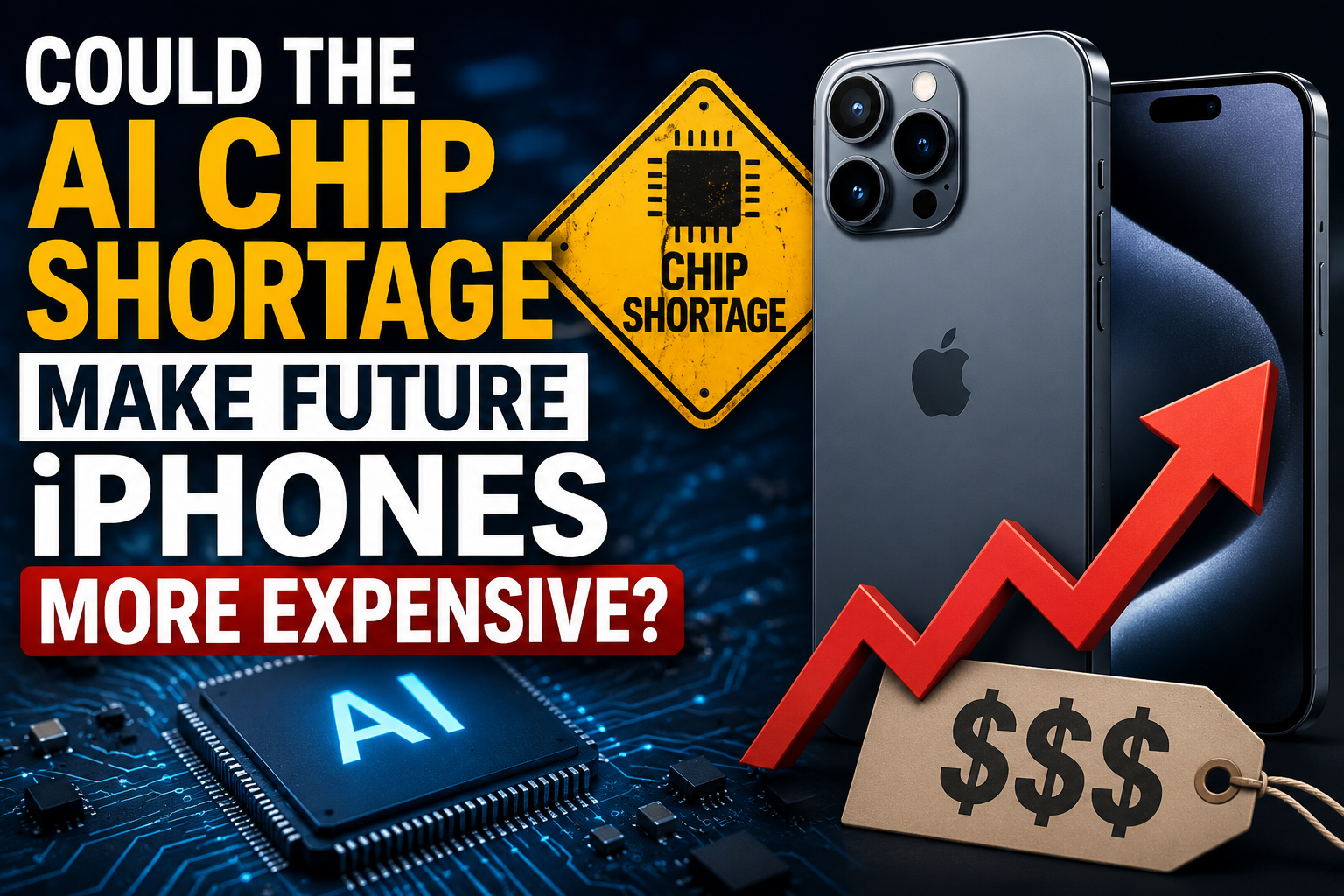
Could the AI Chip Shortage Make Future iPhones More Expensive?
The artificial intelligence boom is creating a problem far beyond data centers.
As technology companies pour billions of dollars into AI infrastructure, demand for memory chips used by servers is putting pressure on the broader semiconductor supply chain. Smartphone manufacturers are increasingly competing for components that were once easier to secure, raising an uncomfortable question for consumers: could the AI boom ultimately make future iPhones more expensive?
For Apple, the answer is increasingly looking like yes.
Apple CEO Tim Cook said in June that price increases across the company’s products were becoming unavoidable because of sharply higher memory and storage costs. He did not specify which products would become more expensive or exactly when those increases would take effect.
That leaves the iPhone — Apple’s most important consumer product — directly in the spotlight.
The Shortage Is Really About Memory
It is useful to distinguish between an “AI chip shortage” and what is happening in the memory market.
The explosion in AI computing has created enormous demand for high-bandwidth memory (HBM) and other components used in AI servers. Semiconductor manufacturers have responded by directing more capacity toward these higher-value products.
That can reduce the amount of manufacturing capacity available for conventional DRAM and NAND flash memory used in smartphones, computers and other consumer electronics.
Industry estimates earlier this year pointed to exceptionally sharp increases in conventional DRAM and NAND contract prices as suppliers struggled to keep pace with demand.
For smartphone makers, memory is particularly important because modern phones increasingly ship with larger amounts of RAM and storage.
The result is a supply squeeze that connects the booming AI infrastructure market with everyday consumer electronics.
Why Apple Can’t Simply Absorb the Higher Costs Forever
Apple has enormous purchasing power and typically negotiates component prices aggressively.
That gives the company advantages over smaller smartphone manufacturers. Apple can secure supplies in advance, negotiate long-term contracts and use its enormous scale to spread component costs across hundreds of millions of devices.
But those advantages have limits.
If memory prices remain substantially higher for an extended period, Apple eventually has to decide whether to:
- Absorb the additional cost
- Reduce margins
- Change component configurations
- Negotiate with alternative suppliers
- Increase product prices
- Combine several of these strategies
Apple has already signaled that completely absorbing the increases isn’t sustainable.
Cook said the company had been attempting to shield customers from higher memory costs but that the situation had become unsustainable, making price increases unavoidable.
That doesn’t necessarily mean every iPhone will suddenly become hundreds of dollars more expensive.
It does mean consumers should take the possibility of higher launch prices seriously.
The iPhone 18 Could Become an Important Test
The upcoming iPhone generation is receiving particular attention because Apple’s supply chain is entering another major product cycle while memory prices remain elevated.
Reports have indicated that Apple is facing challenges securing enough DRAM for future iPhone production. One report said processor wafers for the iPhone 18 Pro were reportedly waiting for packaging because of difficulties obtaining sufficient memory components.
Apple is also reportedly testing memory supplied by China’s ChangXin Memory Technologies, or CXMT, as it looks for additional sources amid the global supply crunch. Reuters reported that the discussions are preliminary and that regulatory issues could complicate the company’s ability to use the Chinese supplier more broadly.
The significance goes beyond one supplier.
It illustrates how seriously smartphone manufacturers are treating the memory shortage.
Why AI Is Competing With Your Smartphone
The connection can seem strange.
A person buying an iPhone isn’t competing directly with someone using ChatGPT or another AI service.
But both depend on the same global semiconductor manufacturing ecosystem.
AI companies are building enormous data centers containing large numbers of advanced processors and memory components. The economics of those systems can make AI-related hardware extremely attractive to semiconductor manufacturers.
When manufacturers prioritize the most profitable components, capacity doesn’t automatically expand overnight for every other type of memory.
Building and qualifying new semiconductor manufacturing capacity takes years and requires enormous capital investment.
That is why an increase in AI demand can eventually show up in the cost structure of products that have nothing to do with running an AI model.
Could Apple Raise iPhone Prices?
Yes — and there are already strong indications that Apple is considering or implementing higher prices across its product portfolio.
But exactly how much an iPhone could increase remains uncertain.
Apple has not publicly announced a specific memory-related price increase for each upcoming iPhone model.
Several factors will determine the final price.
Memory Costs
This is the most obvious factor.
If DRAM and storage prices remain elevated, the cost of producing a phone increases.
Apple’s Margins
Apple could absorb part of the increase rather than passing the entire cost to customers.
That would protect consumers but reduce Apple’s profitability.
Product Mix
Apple could make higher storage tiers more expensive while keeping entry-level models closer to existing prices.
That would allow the company to preserve a relatively accessible starting price while increasing the average selling price.
Consumer Demand
Apple also has to consider how sensitive customers are to price increases.
If a substantially more expensive iPhone reduces demand, the additional revenue from higher prices could be offset by lower sales.
Competition
Apple competes with Samsung, Google and numerous Chinese smartphone manufacturers.
If competitors maintain lower prices, Apple has another reason to be cautious about aggressive increases.
Consumers Could See More Than a Simple Price Increase
A higher-cost smartphone doesn’t necessarily have to appear as a dramatically higher sticker price.
Manufacturers have other ways to manage rising component costs.
For example, a company could:
- Increase the price of higher-storage configurations
- Keep the entry model’s price stable while reducing discounts
- Change memory configurations
- Offer fewer promotions
- Adjust trade-in incentives
- Increase prices on premium models
- Introduce new features while raising the overall price
From a consumer’s perspective, the result could therefore be an increase in the effective cost of upgrading even if the advertised starting price changes only modestly.
The Bigger Problem for Smartphone Buyers
The concern isn’t limited to Apple.
If the memory shortage continues, smartphone manufacturers across the industry could face higher component costs.
That could affect:
- Android phones
- Tablets
- Laptops
- Gaming devices
- Smart home products
- Servers
- Other consumer electronics
Smaller manufacturers may actually face greater pressure than Apple because they generally have less purchasing power and fewer options for securing long-term component supplies.
The result could be a broader increase in electronics prices rather than an Apple-specific phenomenon.
Why Apple Is Still Better Positioned Than Many Rivals
Apple’s scale gives it several advantages during a supply crunch.
The company can negotiate large-volume contracts and has considerable influence over its supply chain. It can also potentially absorb some additional costs for longer than smaller competitors.
Apple’s ability to plan component purchases far in advance can also reduce its immediate exposure to spot-market prices.
But its enormous sales volume creates another challenge.
Apple sells hundreds of millions of devices across its product ecosystem. Even a relatively small increase in component cost becomes significant when multiplied across that volume.
That makes memory pricing an increasingly important issue for Apple’s financial and product decisions.
Could Higher iPhone Prices Become Permanent?
This is one of the biggest questions for consumers.
A temporary component shortage doesn’t necessarily mean permanently higher smartphone prices.
Semiconductor markets are cyclical. Manufacturers eventually add capacity, supply conditions can improve and demand can shift.
But there is a possibility that some price increases could remain even after component costs stabilize.
Once manufacturers establish new product price points, they don’t necessarily reverse them immediately when individual input costs fall.
That means consumers shouldn’t assume that a temporary memory shortage automatically guarantees cheaper iPhones later.
What Could Bring Prices Back Down?
Several developments could ease pressure.
Additional semiconductor manufacturing capacity would help increase memory supply. A slowdown in AI infrastructure spending could also reduce demand for memory components.
More efficient AI systems could have a similar effect if they reduce the amount of hardware required to deliver AI services.
Alternative suppliers could also give smartphone manufacturers more negotiating power.
Apple’s reported exploration of CXMT is one example of how companies are looking for additional sources, although geopolitical and regulatory considerations could limit how useful those alternatives become.
Meaningful new capacity, however, is not something the industry can create instantly.
What iPhone Buyers Should Do
Consumers who are considering an upgrade don’t necessarily need to rush out and buy a phone because of the memory shortage.
Instead, the sensible approach is to consider the timing of your own upgrade.
If your current phone works well, keeping it for another year could be financially reasonable.
If you already planned to upgrade soon, however, it may be worth comparing the total cost of ownership rather than focusing exclusively on the headline price.
Look at:
- The phone’s purchase price
- Storage capacity
- Trade-in value
- Financing costs
- Expected years of software support
- Repair costs
- Battery replacement options
- Carrier promotions
A $100 increase in the purchase price may matter less than choosing a phone that lasts several additional years.
The AI Boom Could Reach Your Wallet in Unexpected Ways
The most interesting part of the current semiconductor squeeze is how indirectly AI demand can affect ordinary consumers.
People don’t need to operate an AI data center to feel the consequences of the AI investment boom.
The competition for chips and memory can affect the cost of smartphones, computers and other electronics sitting in consumers’ shopping carts.
For Apple, the pressure is already becoming difficult to ignore. The company has acknowledged that higher memory and storage costs are pushing prices upward, while reports indicate it is exploring additional suppliers and dealing with supply constraints ahead of future iPhone production.
Whether that ultimately translates into a significantly more expensive iPhone will depend on how long the memory crunch lasts, how much Apple chooses to absorb and how aggressively competitors respond.
But one thing is becoming increasingly clear: the economics of the AI boom are no longer confined to data centers. They are beginning to influence the price of the technology consumers use every day.



2 Comments
Micle harison
June 7, 2019Lorem ipsum dolor sit amet, usu ut perfecto postulant deterruisset, libris causae volutpat at est, ius id modus laoreet urbanitas. Mel ei delenit dolores.
John Doe
June 7, 2019Some consultants are employed indirectly by the client via a consultancy staffing company.