
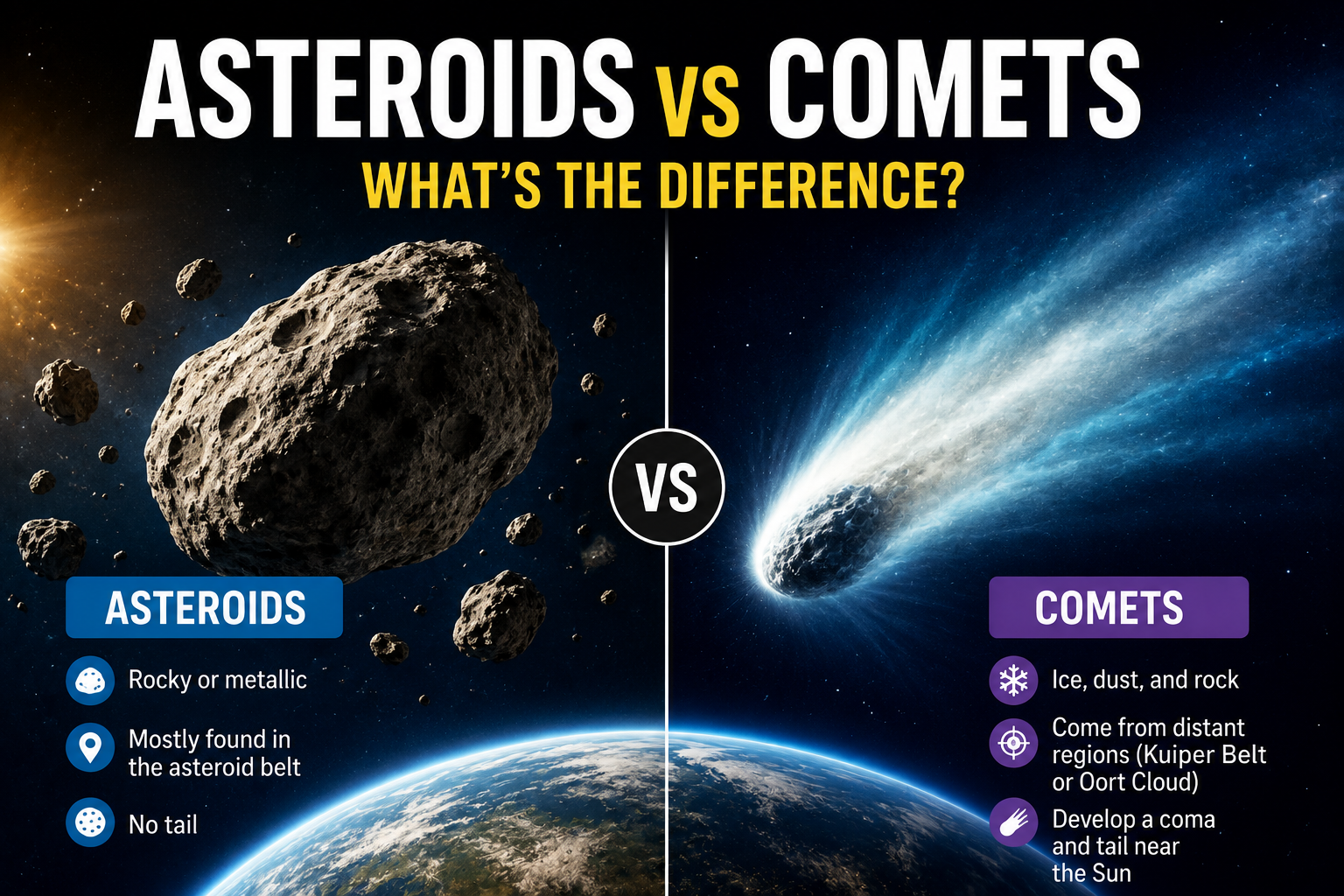
What Is the Difference Between Asteroids and Comets?
Asteroids and comets are two of the most fascinating objects in our solar system. Both travel through space, orbit the Sun and are remnants of the material that helped form the solar system billions of years ago.
Despite these similarities, asteroids and comets are quite different. Their composition, appearance, origins and behavior around the Sun help scientists distinguish one from the other.
Understanding these differences also helps explain how the solar system formed and why some space objects can occasionally come close to Earth.
What Is an Asteroid?
An asteroid is a rocky or metallic object that orbits the Sun. Most are irregularly shaped, although some can become relatively round when they are large enough for gravity to reshape them.
Many asteroids are found in the asteroid belt, a region between the orbits of Mars and Jupiter containing millions of rocky bodies.
Asteroids can range dramatically in size. Some are only a few meters across, while others are hundreds of kilometers wide.
Unlike planets, asteroids have not cleared their orbital neighborhoods of other objects. They are therefore classified as small bodies of the solar system rather than planets.
What Is a Comet?
A comet is an icy body made from a mixture of frozen gases, dust and rocky material. Comets are sometimes described as “dirty snowballs,” although their actual composition is more complex.
Many comets originate in the colder outer regions of the solar system, including areas associated with the Kuiper Belt and the distant Oort Cloud.
A comet can look very different when it is far from the Sun compared with when it approaches the inner solar system.
As sunlight heats an approaching comet, some of its frozen material turns directly into gas. This creates a surrounding cloud called a coma. Solar radiation and the solar wind can then help produce the characteristic tail that makes comets so recognizable.
Asteroids vs. Comets at a Glance
| Feature | Asteroids | Comets |
|---|---|---|
| Main composition | Rock and metal | Ice, dust and rocky material |
| Typical origin | Mostly inner solar system regions | Mostly colder outer solar system regions |
| Appearance near the Sun | Usually remains relatively rocky and inactive | Can develop a coma and tail |
| Common location | Many are in the asteroid belt | Many come from the Kuiper Belt or Oort Cloud |
| Tail | Generally absent | Can develop one when close to the Sun |
| Orbit | Often relatively less elongated | Many have highly elongated orbits |
| Main materials | Silicates and metals | Frozen gases, dust and rock |
The most important difference is composition. Asteroids are predominantly rocky or metallic, while comets contain substantial amounts of ice mixed with dust and rock.
Why Do Comets Have Tails?
A comet’s tail is one of its most recognizable features, but it does not appear simply because the comet is moving through space.
When a comet travels toward the Sun, increasing solar heat causes ice on or near its surface to turn into gas. Escaping gas can carry dust away from the comet, creating a diffuse atmosphere around its solid nucleus.
Solar radiation and the solar wind then interact with this material.
A comet can develop two major types of tails:
- Dust tail: Made primarily of dust pushed away from the comet by sunlight. It often appears curved.
- Ion tail: Made of electrically charged gas influenced strongly by the solar wind. It generally points away from the Sun.
Interestingly, a comet’s tail does not necessarily point directly behind it along its path of travel. The direction is largely determined by the influence of sunlight and the solar wind.
Do Asteroids Ever Have Tails?
Although asteroids generally do not develop the dramatic tails associated with comets, the distinction is not always completely straightforward.
Scientists have identified objects that display comet-like activity despite having asteroid-like characteristics. These are sometimes called active asteroids.
An object may release dust for several reasons, including heating by the Sun, rotational effects or collisions.
This means the boundary between asteroids and comets is more complicated than simply saying “rocks are asteroids and ice is a comet.” Space objects can have diverse compositions and behaviors.
Where Are Asteroids Found?
The largest concentration of known asteroids is located in the main asteroid belt between Mars and Jupiter.
The asteroid belt is not a densely packed field of rocks like it is sometimes portrayed in movies. The objects are separated by enormous distances.
Asteroids can also be found elsewhere. Some travel on orbits that bring them into the inner solar system, including near-Earth asteroids.
Scientists closely study these objects because understanding their orbits helps researchers assess whether any could pose a future impact risk.
Where Do Comets Come From?
Many short-period comets are associated with the Kuiper Belt, a region beyond Neptune containing numerous icy bodies.
Long-period comets can originate much farther away in the Oort Cloud, a theoretical spherical reservoir of icy objects surrounding the solar system.
Gravitational interactions can disturb the orbits of these objects and send some of them toward the inner solar system.
When one of these icy bodies approaches the Sun closely enough, it can become visibly active and develop a coma and tail.
Are Asteroids and Comets Dangerous?
Most asteroids and comets pose no threat to Earth.
Space is enormous, and the vast majority of these objects remain far from our planet. However, a relatively small number have orbits that bring them close to Earth.
Scientists therefore track near-Earth objects, which include both asteroids and comets whose trajectories can bring them into Earth’s vicinity.
Tracking these objects allows researchers to calculate their orbits and improve assessments of potential impact risks.
Asteroid impacts have occurred throughout Earth’s history. One of the best-known examples is the large impact associated with the extinction of the non-avian dinosaurs about 66 million years ago.
What Can Asteroids and Comets Tell Scientists?
Asteroids and comets are important scientific time capsules.
The solar system formed from a disk of gas and dust more than four billion years ago. Many small bodies preserve material from this early period that was incorporated into planets and other larger objects.
Studying asteroids can provide information about the rocky and metallic materials that existed in the early solar system.
Comets are especially interesting because their icy components can preserve volatile materials from the colder regions where they formed.
Scientists have also studied samples from asteroids and analyzed material associated with comets to learn more about the chemical ingredients present during the solar system’s formation.
Could Comets Have Helped Bring Water to Earth?
The origins of Earth’s water are an important area of planetary science.
Comets contain water ice, so scientists have long considered whether impacts from comets could have contributed water to the young Earth.
However, the story is not as simple as saying that comets delivered all of Earth’s water. Researchers study the chemical signatures of water and other materials in different solar system bodies to determine how much various sources may have contributed.
Asteroids and other primitive bodies are also considered important candidates in discussions about the delivery of water and volatile materials to the early Earth.
Asteroids and Comets Are Solar System Time Capsules
The difference between asteroids and comets ultimately comes down to more than appearance.
Asteroids are generally rocky or metallic bodies, while comets contain significant amounts of ice mixed with dust and rocky material. When comets approach the Sun, their volatile materials can produce a coma and spectacular tails. Asteroids generally remain inactive, although some can display unusual dust-producing activity.
Both types of objects are valuable to scientists because they preserve clues about the conditions that existed when the solar system was young.
By studying these relatively small bodies, researchers can learn more about where planets came from, how Earth’s ingredients were assembled and how our planetary neighborhood evolved over billions of years.


2 Comments
Micle harison
June 7, 2019Lorem ipsum dolor sit amet, usu ut perfecto postulant deterruisset, libris causae volutpat at est, ius id modus laoreet urbanitas. Mel ei delenit dolores.
John Doe
June 7, 2019Some consultants are employed indirectly by the client via a consultancy staffing company.