
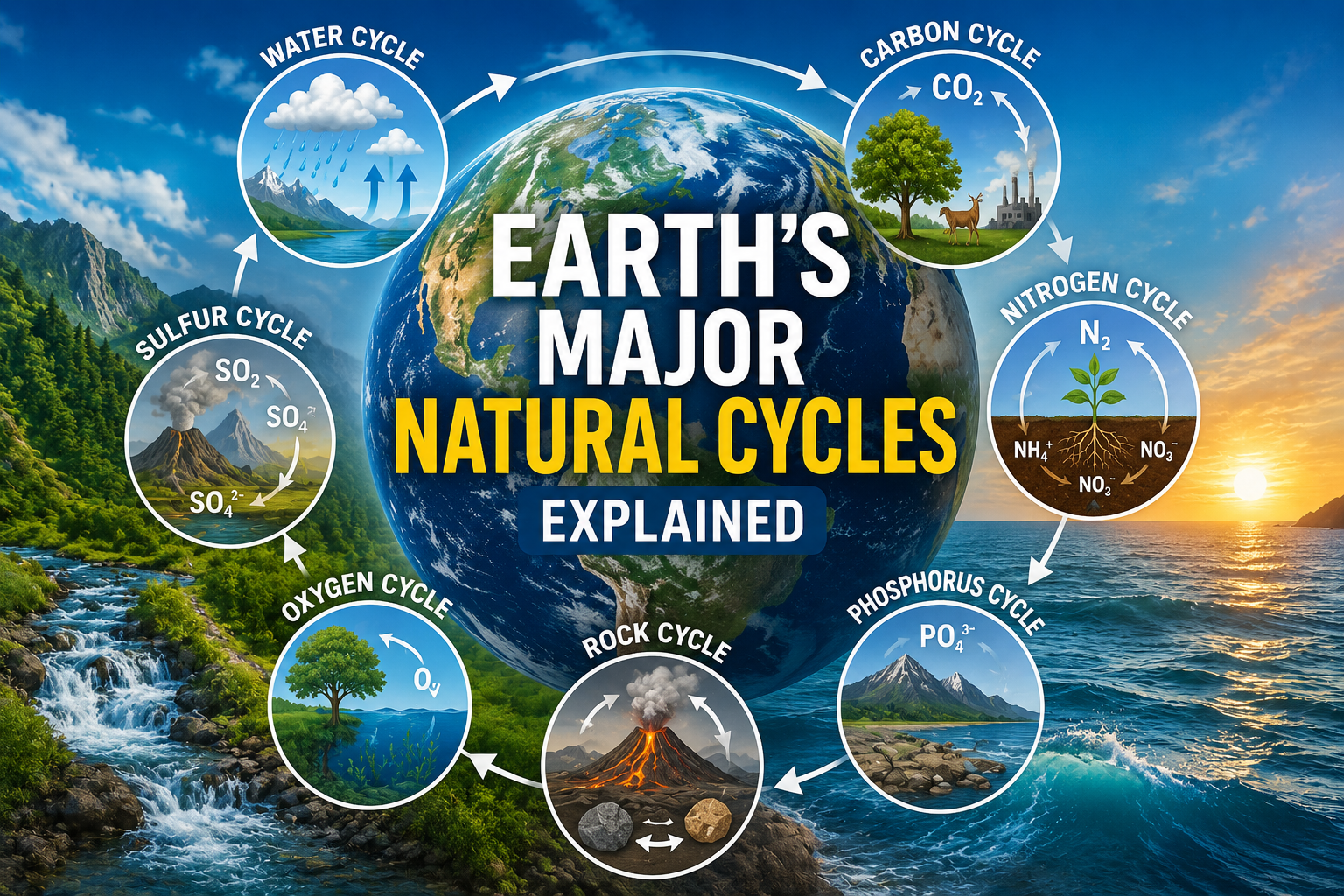
Earth’s Major Natural Cycles Explained
Earth may look like a collection of separate systems—oceans, forests, rocks, air, living organisms and frozen landscapes—but beneath the surface, these systems are constantly connected.
Water moves between the atmosphere and oceans. Carbon travels through plants, animals, soils and the atmosphere. Rocks are broken down, transported and eventually transformed into new rocks. Nitrogen moves between the atmosphere, soil and living organisms. Even Earth’s climate is influenced by long-running cycles involving energy, gases, oceans and ice.
These natural cycles help keep the planet functioning. They also explain why changes in one part of the Earth system can eventually affect many others.
Understanding these cycles provides a useful foundation for understanding climate, ecosystems, agriculture, weather, geology and the availability of essential resources.
What Is a Natural Cycle?
A natural cycle is a continuing process in which a substance, element or form of energy moves through different parts of the Earth system.
The movement may occur between:
- The atmosphere
- Oceans and other bodies of water
- Soil
- Rocks and sediments
- Plants and animals
- Microorganisms
- Earth’s interior
Some cycles operate relatively quickly. Water can evaporate from an ocean, form clouds and return as precipitation within days.
Others operate over thousands, millions or even billions of years. Carbon can remain stored in rocks for millions of years, while the formation and destruction of mountains can take enormous periods of geological time.
These cycles are not perfectly circular or uniform. They are interconnected systems with many pathways, feedbacks and interruptions.
The Water Cycle
The water cycle is one of the most familiar natural cycles and one of the most important for life.
Earth’s water is constantly moving between the atmosphere, land, oceans, glaciers, rivers, lakes, groundwater and living organisms.
How the Water Cycle Works
The cycle begins in many places at once.
Solar energy causes water at Earth’s surface to evaporate. Plants also release water vapor through transpiration, a process collectively known as evapotranspiration.
As moist air rises and cools, water vapor can condense into tiny droplets or ice crystals, forming clouds.
Eventually, water returns to the surface through precipitation, including:
- Rain
- Snow
- Sleet
- Hail
Some precipitation flows across the surface into streams and rivers. Some infiltrates the soil and becomes groundwater. Some is temporarily stored in glaciers, snowpack, lakes and vegetation.
Eventually, much of the water makes its way back toward the oceans, where the process begins again.
Why the Water Cycle Matters
The water cycle distributes freshwater around the planet and supports:
- Drinking-water supplies
- Agriculture
- Forests and grasslands
- Rivers and wetlands
- Aquatic ecosystems
- Weather and climate
- Soil moisture
Changes in temperature can influence evaporation, precipitation patterns, snow and ice storage, and the amount of water available in different regions.
The Carbon Cycle
The carbon cycle describes how carbon moves between Earth’s atmosphere, oceans, living organisms, soils, sediments and rocks.
Carbon is fundamental to life because it forms the structural basis of many biological molecules.
Photosynthesis Moves Carbon Into Living Systems
Plants, algae and certain microorganisms absorb carbon dioxide from the atmosphere or water during photosynthesis.
Using energy from sunlight, they convert carbon dioxide and water into organic compounds while releasing oxygen.
That carbon can then move through food webs when animals consume plants or other organisms.
Respiration Returns Carbon
Plants, animals and microorganisms release carbon dioxide through cellular respiration.
When organisms die, decomposers break down their remains. Some of the carbon returns to the atmosphere, while some becomes incorporated into soils and sediments.
Oceans Store Enormous Amounts of Carbon
The oceans absorb carbon dioxide from the atmosphere and also release it back.
Marine organisms incorporate carbon into biological material and, in some cases, shells and other structures that can eventually become sediments.
Rocks Provide Long-Term Carbon Storage
Some carbon becomes trapped in carbonate rocks or organic sediments over geological timescales.
Volcanic activity, weathering and other geological processes can eventually return some of this carbon to the atmosphere or oceans.
Why the Carbon Cycle Matters
The carbon cycle is closely connected to Earth’s climate because carbon dioxide is a greenhouse gas.
Human activities, particularly the burning of fossil fuels and changes in land use, have altered the movement of carbon between Earth’s reservoirs.
That makes the carbon cycle central to understanding modern climate change.
The Nitrogen Cycle
Nitrogen makes up a large portion of Earth’s atmosphere, but most organisms cannot directly use atmospheric nitrogen gas.
The nitrogen cycle transforms nitrogen into forms that plants and other organisms can use.
Nitrogen Fixation
Certain microorganisms can convert atmospheric nitrogen into compounds that can enter biological systems.
This process is called nitrogen fixation.
Lightning can also contribute to nitrogen fixation by producing nitrogen compounds that enter ecosystems through precipitation.
Nitrification
Soil microorganisms convert ammonia and related compounds into nitrite and nitrate.
Plants can absorb nitrogen in forms such as nitrate and ammonium and use it to build proteins and other important biological molecules.
Nitrogen Moves Through Food Webs
Animals obtain nitrogen by consuming plants or other organisms.
When organisms produce waste or die, nitrogen-containing compounds return to the soil.
Denitrification
Other microorganisms convert nitrogen compounds back into nitrogen gas, returning nitrogen to the atmosphere.
Why the Nitrogen Cycle Matters
Nitrogen is essential for:
- Proteins
- DNA and RNA
- Plant growth
- Soil fertility
- Ecosystem productivity
Agriculture has significantly changed the global nitrogen cycle through the widespread use of nitrogen fertilizers.
Excess nitrogen entering waterways can contribute to problems such as eutrophication, in which excessive nutrients stimulate algal growth and can reduce oxygen levels in aquatic environments.
The Phosphorus Cycle
The phosphorus cycle differs from cycles such as the carbon and nitrogen cycles because phosphorus has no major gaseous phase under normal natural conditions.
Instead, phosphorus primarily moves through rocks, soil, water and living organisms. Weathering gradually breaks down phosphorus-containing rocks, releasing phosphorus into soils and waterways.
Plants absorb available phosphorus. Animals obtain it by eating plants or other organisms.
When organisms die or produce waste, phosphorus can return to the soil.
Some phosphorus eventually enters rivers and oceans, where it can become incorporated into sediments. Over geological timescales, geological uplift can expose these materials again to weathering.
Why Phosphorus Matters
Phosphorus is important for:
- DNA and RNA
- Cell membranes
- Energy transfer within cells
- Root development
- Plant growth
- Ecosystem productivity
Because phosphorus is often a limiting nutrient, changes in its availability can have significant effects on ecosystems.
The Oxygen Cycle
The oxygen cycle describes the movement of oxygen among the atmosphere, oceans, living organisms and Earth’s surface.
Oxygen is continuously produced and consumed through biological, chemical and geological processes.
Photosynthesis is one of the major natural processes that produces molecular oxygen.
Plants, algae and cyanobacteria use sunlight to produce organic material and release oxygen.
At the same time, organisms consume oxygen through respiration.
Oxygen is also involved in:
- Decomposition
- Combustion
- Oxidation of minerals
- Chemical reactions in oceans and soils
The oxygen cycle is closely connected to the carbon cycle because photosynthesis and respiration influence both oxygen and carbon dioxide.
The Rock Cycle
Not all natural cycles involve biological nutrients.
The rock cycle describes how rocks are formed, broken down and transformed over geological time. There are three broad categories of rock:
- Igneous rocks
- Sedimentary rocks
- Metamorphic rocks
Igneous Rocks
Igneous rocks form when molten rock cools and solidifies.
This can happen beneath Earth’s surface or after volcanic material reaches the surface.
Sedimentary Rocks
Weathering and erosion break existing rocks into sediments.
These sediments can be transported, deposited and eventually compacted or cemented into sedimentary rock.
Metamorphic Rocks
Existing rocks can be altered by heat, pressure or chemically active fluids without completely melting.
The resulting rocks are called metamorphic rocks.
Melting and Uplift
Rocks can eventually melt and become magma again.
Meanwhile, tectonic forces can push rocks toward the surface, exposing them to weathering and erosion.
The result is a constantly changing geological system.
The Rock Cycle and Plate Tectonics
The rock cycle is strongly connected to plate tectonics.
Earth’s crust and uppermost mantle are divided into moving plates. Their movement contributes to:
- Mountain building
- Volcanic activity
- Earthquakes
- Ocean-basin formation
- Subduction
- Recycling of crustal material
At subduction zones, one tectonic plate can descend beneath another. Materials are carried deep into Earth, where heat and pressure contribute to geological transformation.
At other locations, magma rises and creates new crust.
This means Earth’s surface is not static. Over geological time, continents and ocean basins can change dramatically.
The Sulfur Cycle
The sulfur cycle moves sulfur through rocks, soils, water, the atmosphere and living organisms.
Sulfur is an important component of certain amino acids and proteins.
Natural sulfur enters ecosystems through processes including:
- Weathering of rocks
- Volcanic activity
- Decomposition
- Ocean processes
Microorganisms play an important role by converting sulfur between different chemical forms.
Human activities, particularly the burning of sulfur-containing fossil fuels, have historically added substantial amounts of sulfur compounds to the atmosphere.
These emissions can contribute to acid deposition, although pollution controls have reduced sulfur emissions substantially in many regions.
The Water, Carbon and Nutrient Cycles Are Connected
One of the most important ideas in Earth science is that natural cycles do not operate independently.
Consider a forest.
Rain provides water to the ecosystem.
Trees absorb water through their roots.
They take carbon dioxide from the atmosphere during photosynthesis.
Plants require nitrogen and phosphorus to grow.
Animals consume vegetation and move nutrients through the food web.
When plants and animals die, decomposers return nutrients to the soil.
Water carries dissolved substances through soil and waterways.
Some carbon becomes stored in vegetation and soil.
Eventually, carbon returns to the atmosphere through respiration and decomposition.
A change in one part of the system can therefore influence several other cycles.
How the Cycles Interact With Climate
Earth’s natural cycles are fundamental to the climate system.
The water cycle influences clouds, precipitation, humidity and energy movement.
The carbon cycle influences atmospheric concentrations of greenhouse gases.
The nitrogen cycle affects ecosystems and can influence emissions of nitrogen-containing greenhouse gases.
The cryosphere—Earth’s frozen water—also interacts with the water and climate systems.
Snow and ice can reflect incoming sunlight, while melting changes water storage and contributes to changes in sea level.
These interactions create feedbacks.
Some feedbacks can amplify an initial change, while others can partially counteract it.
Understanding these feedbacks is one of the most important challenges in climate science.
How Human Activity Is Changing Natural Cycles
Natural cycles have always changed over time, but human activity has significantly altered the speed and scale of several processes.
Fossil Fuel Use
Burning coal, oil and natural gas transfers carbon that was stored underground for geological periods into the atmosphere relatively quickly.
Deforestation
Removing forests changes carbon storage, water movement, soil processes and local ecosystems.
Agriculture
Agriculture affects the carbon, nitrogen, phosphorus and water cycles through:
- Fertilizer use
- Irrigation
- Livestock production
- Soil disturbance
- Land conversion
Urbanization
Cities replace natural surfaces with roads, buildings and other infrastructure.
This can change rainfall runoff, groundwater recharge, evaporation and local temperatures.
Industrial Activity
Mining, manufacturing and energy production can move large quantities of materials between geological and biological reservoirs.
The key issue is not simply that humans interact with natural cycles. Humans have become a powerful force capable of changing the rates at which materials move through these systems.
Why Natural Cycles Matter to Everyday Life
These cycles may sound like distant scientific concepts, but they influence ordinary decisions and conditions.
Food Production
Agriculture depends heavily on water, nitrogen, phosphorus, carbon and healthy soils.
Drinking Water
The water cycle determines how freshwater is replenished and distributed.
Weather
The movement of water and energy through the atmosphere influences weather patterns.
Ecosystems
Plants and animals depend on nutrient cycling to obtain essential elements.
Climate
Carbon and other cycles influence the composition of Earth’s atmosphere and the planet’s energy balance.
Natural Resources
The rock cycle helps explain how geological resources form and are redistributed over immense timescales.
Why These Cycles Take Different Amounts of Time
One of the most fascinating aspects of Earth’s cycles is their enormous range of timescales.
A water molecule may move through the atmosphere in a matter of days.
Carbon can circulate through vegetation and the atmosphere relatively quickly, while other carbon remains locked inside rocks for millions of years.
Phosphorus can move through an ecosystem over years or decades but may remain in ocean sediments for geological periods.
Rocks can be transformed through the rock cycle over millions of years.
This means Earth operates simultaneously on fast cycles and slow cycles.
Understanding those different timescales is crucial when assessing environmental change.
Natural Cycles Are Earth’s Recycling Systems
Earth does not continually receive fresh supplies of every essential element. Instead, many materials are repeatedly recycled.
Water is circulated.
Carbon moves among reservoirs.
Nitrogen is transformed by microorganisms.
Phosphorus moves between rocks, soil, water and organisms.
Rocks are weathered, buried, transformed and eventually exposed again.
These processes allow ecosystems to function despite the finite amount of many essential materials available on the planet.
The cycles are not perfect circles. They are better understood as complex networks of movement and transformation involving many reservoirs and pathways.
Earth’s Cycles Show How Connected the Planet Really Is
The water falling as rain today, the carbon stored in a forest, the nitrogen supporting a crop and the minerals locked inside a mountain may appear unrelated. In reality, they are components of a deeply interconnected Earth system.
The major natural cycles—water, carbon, nitrogen, phosphorus, oxygen, sulfur and the rock cycle—continuously move materials through the atmosphere, oceans, land, rocks and living organisms.
Human activities can accelerate, redirect or interrupt parts of these cycles, sometimes creating effects far beyond the original point of change.
That is why understanding Earth’s natural cycles is more than an academic exercise. It provides a framework for understanding how ecosystems work, why resources are distributed as they are, how climate responds to change, and why actions in one part of the planet can ultimately affect systems thousands of kilometers away.


2 Comments
Micle harison
June 7, 2019Lorem ipsum dolor sit amet, usu ut perfecto postulant deterruisset, libris causae volutpat at est, ius id modus laoreet urbanitas. Mel ei delenit dolores.
John Doe
June 7, 2019Some consultants are employed indirectly by the client via a consultancy staffing company.