
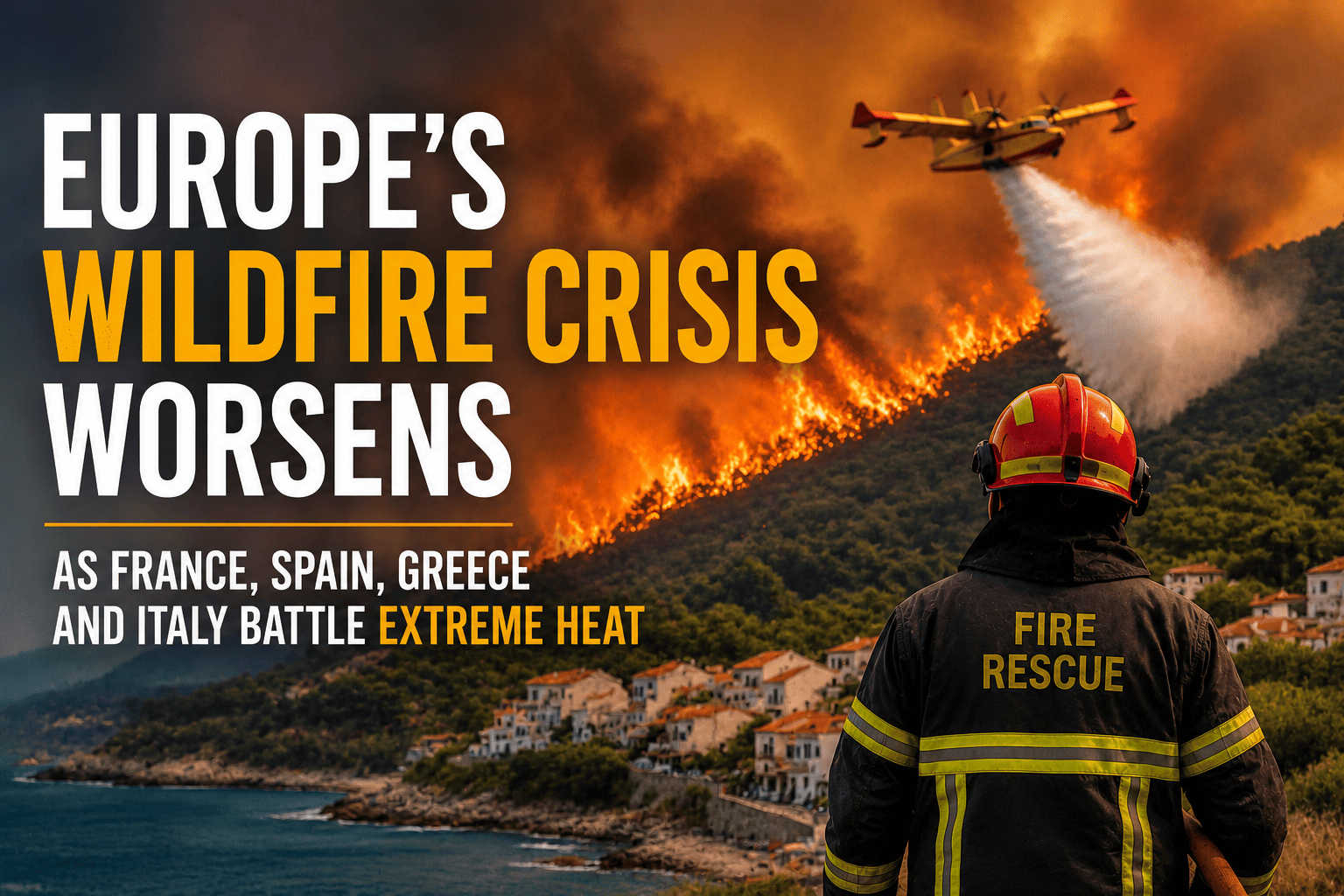
Europe’s Wildfire Crisis Worsens as France, Spain, Greece and Italy Battle Extreme Heat
The skies over southern Europe have turned an unsettling shade of orange once again.
From the forests of southern France to the mountains of Spain, from the rugged hillsides of Greece to the countryside of Italy, firefighters are battling an unforgiving combination of record-breaking temperatures, fierce winds, and bone-dry landscapes that have transformed vast stretches of the Mediterranean into tinderboxes.
Entire communities have been evacuated. Popular tourist destinations have closed. Thick smoke has drifted hundreds of kilometers across national borders, while thousands of firefighters, supported by aircraft from across Europe, continue an exhausting race to contain dozens of fast-moving wildfires.
What was initially viewed as a severe fire season has rapidly evolved into a continent-wide emergency.
As Europe experiences another intense summer heatwave, the wildfire crisis is no longer confined to one country. It has become a shared European challenge—one that is testing emergency response systems, threatening local economies, and reigniting debate over how climate change is reshaping life across the continent.
With weather forecasts predicting little immediate relief, authorities warn that the coming days could determine whether the fires are brought under control or expand into one of Europe’s most destructive wildfire seasons in recent memory.
A Mediterranean Region Under Siege
Wildfires have long been part of the Mediterranean climate.
Every summer, countries including:
- Spain
- France
- Greece
- Portugal
- Italy
prepare for elevated fire risks.
This year, however, experts say conditions have become unusually severe.
Weeks of extreme heat have dried forests, grasslands, and farmland to dangerous levels.
When combined with powerful seasonal winds, even relatively small fires have spread rapidly across thousands of hectares, overwhelming firefighting resources in several regions.
Authorities say many fires have behaved unpredictably, creating multiple fronts and changing direction within hours, forcing emergency crews to continuously revise evacuation plans.
For firefighters working on the front lines, every shift in weather creates new risks.
France Battles Massive Forest Fires
Southern France has experienced some of its largest wildfires in years.
Several communities have been evacuated as flames advanced toward residential neighborhoods, vineyards, and protected natural areas.
Firefighters have deployed helicopters and water-bombing aircraft to slow the spread while ground crews construct firebreaks around vulnerable communities.
Transportation networks have also faced disruptions, with temporary road closures and interruptions to regional rail services as emergency responders prioritize public safety.
Officials continue urging residents to follow evacuation orders immediately, emphasizing that changing winds can rapidly alter fire behavior.
Spain Faces Renewed Fire Threats
Spain remains one of Europe’s most wildfire-prone countries, and this summer has once again highlighted that vulnerability.
Large fires have burned through forested areas and rural communities, fueled by prolonged drought and soaring daytime temperatures.
Emergency services have worked around the clock to protect villages, agricultural land, and critical infrastructure.
Several regions have activated emergency response plans as authorities monitor additional hotspots that could expand if temperatures continue rising.
Spain’s firefighting agencies have also coordinated closely with neighboring countries, sharing information and resources through European emergency mechanisms.
Greece Returns to the Front Line
Few European countries have experienced as many devastating wildfire seasons in recent years as Greece.
After enduring multiple catastrophic summers, Greek authorities entered this year’s fire season with expanded aerial firefighting capabilities and improved emergency planning.
Despite those preparations, extreme heat has once again produced dangerous conditions across several regions.
Officials remain concerned that strong winds could quickly transform isolated fires into major emergencies.
Many communities remain on high alert as firefighters patrol vulnerable forests and mountainous terrain where access remains difficult.
Italy Confronts Rising Temperatures
Italy has also experienced a surge in wildfire activity as temperatures climb across central and southern regions.
Authorities have increased surveillance of national parks, forests, and agricultural areas while emergency crews respond rapidly to new outbreaks.
The combination of dry vegetation and prolonged heat has heightened concerns that fires could spread into densely populated areas if weather conditions deteriorate further.
Civil protection agencies continue encouraging residents to avoid activities that could accidentally ignite fires during periods of elevated risk.
Why Europe’s Fires Are Becoming More Dangerous
Wildfires require three essential ingredients:
- Heat
- Dry fuel
- An ignition source
This summer has delivered all three in abundance.
Record Heat
Large parts of southern Europe have experienced temperatures well above seasonal averages.
Extended heatwaves rapidly remove moisture from vegetation, turning forests into highly combustible fuel.
Prolonged Drought
Many affected regions received below-average rainfall during previous months.
Dry soil and stressed vegetation create ideal conditions for fast-moving fires.
Strong Winds
Wind supplies oxygen to flames while carrying burning embers far ahead of the main fire.
This allows entirely new fires to ignite kilometers away from existing fire fronts, making containment significantly more difficult.
Climate Change Moves Back Into Focus
Although scientists caution that no individual wildfire can be attributed solely to climate change, research consistently shows that rising global temperatures increase the likelihood of extreme fire weather.
Higher temperatures accelerate evaporation.
Longer heatwaves dry forests more quickly.
Changing rainfall patterns reduce natural moisture levels.
Collectively, these conditions lengthen wildfire seasons while increasing the intensity of major fires.
Climate experts warn that southern Europe is particularly vulnerable because warming trends are occurring alongside increasingly frequent periods of prolonged drought.
For policymakers, this year’s wildfire crisis is likely to intensify discussions surrounding climate adaptation, forest management, and long-term disaster preparedness.
Tourism Faces Another Difficult Summer
The timing of the fires presents another economic challenge.
Summer represents the busiest tourism season across much of southern Europe.
Millions of visitors travel annually to Mediterranean beaches, mountain resorts, vineyards, and historic villages.
Wildfires have disrupted:
- Holiday travel
- Hiking trails
- National parks
- Campsites
- Rural tourism
- Outdoor festivals
Several hotels and vacation properties have reported cancellations as travelers reconsider plans due to wildfire risks and declining air quality.
For many local businesses that rely heavily on seasonal tourism, prolonged fire activity could significantly affect annual revenues.
The Economic Impact Extends Across Europe
The cost of the fires reaches far beyond the immediate damage.
Property Losses
Homes, farms, commercial buildings, and public infrastructure have already suffered significant destruction in multiple countries.
Insurance claims are expected to rise substantially as damage assessments continue.
Agriculture
Wildfires threaten some of Europe’s most productive agricultural regions, including:
- Vineyards
- Olive groves
- Fruit orchards
- Livestock farms
- Grain fields
For many farming communities, rebuilding may take years.
Transportation and Utilities
Road closures, rail disruptions, and temporary power outages have affected several fire-impacted areas.
Emergency crews continue working to restore services while prioritizing public safety.
Environmental Damage Beyond the Flames
The visible destruction tells only part of the story.
Wildfires produce long-lasting environmental consequences.
Wildlife Habitat Destruction
Thousands of hectares of forest provide habitat for birds, mammals, reptiles, and countless insect species.
Many animals struggle to escape rapidly advancing fires, while surviving populations often face long-term habitat loss.
Air Pollution
Smoke generated by major wildfires can travel hundreds—or even thousands—of kilometers.
Poor air quality affects nearby communities while also reaching neighboring countries.
Health officials have advised vulnerable populations—including children, older adults, and individuals with respiratory conditions—to remain indoors during periods of heavy smoke.
Carbon Emissions
Ironically, wildfires also contribute to climate change.
As forests burn, vast amounts of stored carbon dioxide are released into the atmosphere, further increasing greenhouse gas concentrations.
Europe Responds Together
One of the defining characteristics of this wildfire season has been unprecedented international cooperation.
Countries across Europe have increasingly shared:
- Firefighting aircraft
- Helicopters
- Emergency personnel
- Satellite monitoring
- Weather forecasting technology
- Specialized equipment
Through coordinated European emergency response programs, countries experiencing fewer active fires have assisted those facing the greatest pressure.
The growing cooperation reflects recognition that climate-driven disasters no longer respect national borders.
What Happens Next?
Weather remains the single most important factor.
Firefighters hope for:
- Cooler temperatures
- Higher humidity
- Reduced wind speeds
- Meaningful rainfall
Unfortunately, meteorologists warn that forecasts remain uncertain.
Even after flames are contained, hidden hotspots can continue smoldering for days before reigniting under favorable conditions.
Recovery efforts are expected to continue long after active firefighting ends.
Communities will face rebuilding homes, restoring forests, repairing infrastructure, and reviewing emergency planning before next summer arrives.
A Defining Climate Challenge for Europe
This year’s wildfire emergency has become far more than a seasonal disaster.
It represents one of Europe’s clearest demonstrations of how extreme weather, climate change, and environmental management have become deeply interconnected.
Governments are expected to revisit policies involving:
- Forest management
- Urban planning
- Emergency warning systems
- Evacuation procedures
- Climate resilience investments
- Cross-border disaster cooperation
Many experts argue that preventing future catastrophes will require as much investment in preparation as in emergency response.
Final Thoughts
Europe’s wildfire crisis has evolved into one of the defining global environmental stories of the year.
With France, Spain, Greece, and Italy simultaneously confronting dangerous fire conditions, the continent faces a challenge that extends well beyond burning forests. The crisis threatens communities, tourism, agriculture, biodiversity, and economic stability while highlighting the growing influence of extreme weather on everyday life.
For now, thousands of firefighters remain on the front lines, working tirelessly to protect lives and property as temperatures remain dangerously high.
Whether the coming days bring cooler weather or renewed fire activity, one conclusion has already become impossible to ignore:
Europe’s wildfire seasons are becoming longer, larger, and more destructive—and preparing for this new reality may prove just as important as fighting the fires themselves.




2 Comments
Micle harison
June 7, 2019Lorem ipsum dolor sit amet, usu ut perfecto postulant deterruisset, libris causae volutpat at est, ius id modus laoreet urbanitas. Mel ei delenit dolores.
John Doe
June 7, 2019Some consultants are employed indirectly by the client via a consultancy staffing company.