
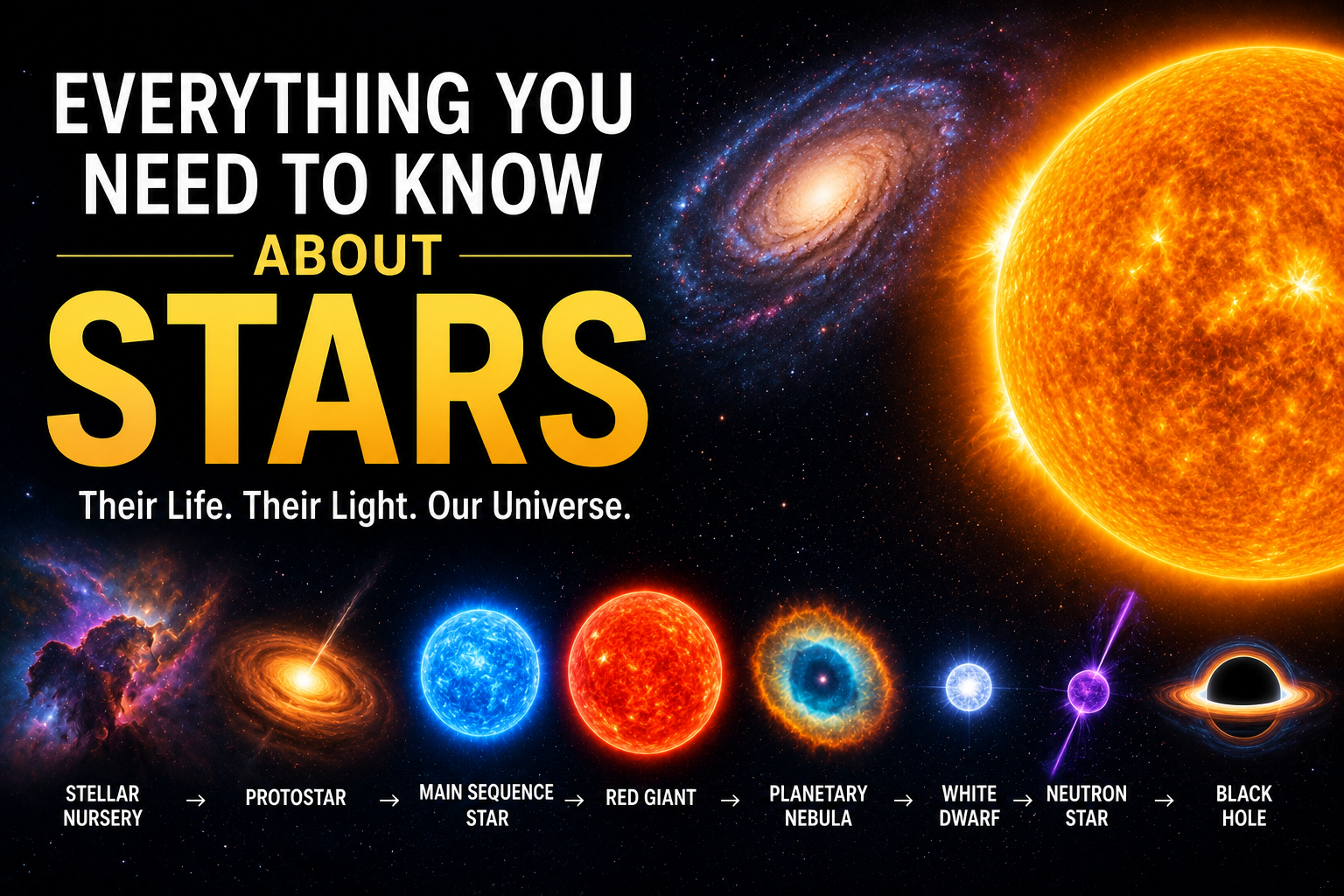
Everything You Need to Know About Stars
Stars are among the most familiar objects in the night sky, yet each one is a vast and complex physical system. They form from enormous clouds of gas and dust, produce energy through nuclear fusion, evolve over millions or billions of years, and eventually reach very different endings depending largely on their mass.
Our own Sun is a star, but it is only one of hundreds of billions believed to exist in the Milky Way. Beyond our galaxy are countless other galaxies, each containing their own populations of stars.
Understanding stars provides a foundation for understanding much of the universe itself. Their light helps astronomers study distant galaxies, their explosions create many of the elements found in planets and living things, and their life cycles reveal how the cosmos changes over time.
What Is a Star?
A star is a massive, luminous sphere of plasma held together by gravity.
Stars are composed primarily of hydrogen and helium, although they also contain smaller amounts of heavier elements. Their enormous gravitational pressure creates extremely high temperatures and densities in their interiors.
Under these conditions, nuclear fusion can occur.
In most stars like the Sun, hydrogen nuclei combine through a series of nuclear reactions to form helium. A small amount of mass is converted into energy during this process, producing the radiation and heat that make stars shine.
The balance between gravity and the energy generated inside a star is central to its stability.
How Do Stars Form?
Stars begin their lives inside enormous clouds of cold gas and dust called molecular clouds.
These clouds contain material that can remain relatively stable for long periods. However, gravity can cause parts of a cloud to collapse when conditions become favorable.
As a region collapses:
- Gas and dust move toward the center.
- The material becomes increasingly dense.
- The collapsing region heats up.
- A developing object called a protostar forms.
- Eventually, temperatures and pressures become high enough for nuclear fusion to begin.
Once sustained hydrogen fusion starts in the core, the object becomes a true star and enters the main stage of its life.
Star formation can occur in groups, meaning many stars can be born from the same molecular cloud.
What Makes Stars Shine?
Stars shine because of the energy produced inside their cores.
In a Sun-like star, hydrogen is converted into helium through nuclear fusion. The energy produced during this process eventually travels outward and escapes into space as electromagnetic radiation.
That radiation can include visible light, infrared radiation, ultraviolet radiation and other forms of electromagnetic energy.
The light we see from a star therefore provides information about conditions deep inside an object that may be many light-years away.
Astronomers can study this light to determine properties such as a star’s temperature, chemical composition, motion and sometimes its age.
Why Are Stars Different Colors?
Stars are not all the same color because they have different surface temperatures.
Generally:
- Red stars have cooler surfaces.
- Orange and yellow stars have intermediate temperatures.
- White stars are hotter.
- Blue stars have extremely hot surfaces.
The Sun appears yellowish or white from Earth depending on atmospheric conditions and viewing circumstances. Its surface temperature is roughly 5,500 degrees Celsius.
Color is therefore an important clue for astronomers studying stars.
However, a star’s color is only one part of its story. Two stars with similar colors can still differ significantly in mass, size, age and chemical composition.
The Main Types of Stars
Astronomers classify stars in several ways, including by temperature, luminosity, mass and evolutionary stage.
One widely used classification system divides stars into spectral classes:
O, B, A, F, G, K and M
These classes run broadly from the hottest stars to the coolest.
O-Type Stars
O-type stars are extremely hot and massive. They appear blue or blue-white and can produce enormous amounts of ultraviolet radiation.
They are relatively rare compared with cooler stars and generally have short lifetimes because they consume their nuclear fuel at very high rates.
B-Type Stars
B-type stars are also very hot and luminous. They appear blue-white and are substantially more massive and hotter than stars such as the Sun.
A-Type Stars
A-type stars are generally white or bluish-white. Some well-known bright stars belong to this category.
F-Type Stars
F-type stars have yellow-white appearances and are cooler than A-type stars.
G-Type Stars
The Sun is a G-type main-sequence star.
G-type stars are generally yellowish-white and have surface temperatures lower than hotter O-, B- and A-type stars.
K-Type Stars
K-type stars are cooler than the Sun and generally appear orange or orange-yellow.
They are often considered interesting targets in the search for potentially habitable planets because some K-type stars can remain stable for very long periods.
M-Type Stars
M-type stars are the coolest and most common class of ordinary stars. They are often called red dwarfs.
They are much smaller and cooler than the Sun and can have extremely long lifetimes.
What Is a Main-Sequence Star?
The main sequence is the longest-lasting and most common stage of stellar evolution.
During this period, a star primarily converts hydrogen into helium in its core.
Stars on the main sequence can have dramatically different properties. A massive blue star and a smaller red dwarf may both be main-sequence stars while differing enormously in temperature, brightness and lifespan.
The Sun is currently a main-sequence star.
Astronomers use a diagram called the Hertzsprung-Russell diagram to compare stars according to properties such as luminosity and temperature. The main sequence forms a prominent band across this diagram.
How Long Do Stars Live?
A star’s lifetime depends heavily on its mass.
This produces an important rule in stellar astronomy:
More massive stars generally live shorter lives than less massive stars.
Massive stars have greater gravitational pressure and much hotter cores. They can therefore burn through their nuclear fuel at extraordinary rates.
Some massive stars may exist for only millions of years.
Smaller stars consume their fuel much more slowly and can remain active for billions or even trillions of years.
Red dwarfs, for example, are expected to have exceptionally long lifetimes compared with stars like the Sun.
What Happens When a Star Ages?
Stars do not remain unchanged forever.
Eventually, the hydrogen available for fusion in a star’s core becomes depleted. What happens next depends largely on the star’s initial mass.
A star like the Sun eventually expands into a red giant.
More massive stars can undergo increasingly complex stages of nuclear fusion and eventually experience catastrophic stellar explosions.
This means that a star’s mass largely determines its evolutionary path.
What Is a Red Giant?
When a Sun-like star exhausts the hydrogen available for core fusion, its internal structure changes.
The core contracts while hydrogen continues to fuse in a surrounding shell. The outer layers expand dramatically, causing the star to become much larger.
The star enters the red giant stage.
Despite the name, a red giant is not necessarily red in the everyday sense. Its cooler surface gives it a reddish or orange appearance compared with hotter stars.
Eventually, a Sun-like star sheds its outer layers and leaves behind its dense core.
What Is a White Dwarf?
A white dwarf is the compact remnant left behind after a low- or intermediate-mass star has exhausted its nuclear fuel and expelled its outer layers.
White dwarfs are extremely dense. A large amount of stellar material can be compressed into an object roughly comparable in size to Earth.
Unlike ordinary main-sequence stars, white dwarfs no longer generate energy through sustained hydrogen fusion in their cores.
Instead, they gradually cool over extremely long periods.
What Happens to Massive Stars?
Massive stars have much more dramatic endings.
After exhausting their available nuclear fuel, a sufficiently massive star can collapse under its own gravity.
This can trigger a supernova, an enormous stellar explosion.
Supernovae can briefly become extraordinarily bright and release vast amounts of energy into space.
They also play an important role in distributing heavier elements throughout the universe.
What Are Neutron Stars?
Some massive stars leave behind extremely compact remnants called neutron stars.
A neutron star can contain more mass than the Sun while occupying a region only roughly the size of a city.
These objects have extraordinary densities and can possess extremely powerful magnetic fields.
Some neutron stars rotate rapidly and emit beams of radiation. When such a beam periodically points toward Earth, astronomers can detect pulses, producing what is known as a pulsar.
What Are Black Holes?
The most massive stellar remnants can collapse even further, potentially forming black holes.
A black hole is an object whose gravitational field is so strong that, within its event horizon, nothing—including light—can escape.
Not every black hole forms in exactly the same way, but the collapse of a sufficiently massive star can create a stellar-mass black hole.
Astronomers cannot directly see a black hole itself in the conventional sense. Instead, they can observe its effects on nearby matter, light and other objects.
Why Are Supernovae Important?
Supernovae are among the most powerful events associated with stellar evolution.
Their importance goes beyond their brightness.
The universe began primarily with hydrogen and helium, along with small amounts of other light elements. Many heavier elements were produced later through stellar processes and explosive events.
When stars evolve and die, they can release material into space.
That material can eventually become part of new stars, planets and other astronomical objects.
In this sense, generations of stars help enrich the universe with the ingredients needed to build increasingly complex structures.
How Far Away Are Stars?
Stars are extremely distant from Earth.
The nearest star beyond the Sun is Proxima Centauri, located a little more than four light-years away.
A light-year is a unit of distance, not time. It represents the distance light travels through space in one year.
Because light travels at a finite speed, looking at distant stars also means looking into the past.
If a star is 100 light-years away, the light reaching Earth today began its journey approximately 100 years ago.
Astronomy is therefore, in a very real sense, a way of observing cosmic history.
Why Do Stars Appear to Twinkle?
Stars can appear to twinkle because their light passes through Earth’s atmosphere.
As starlight travels through different layers of moving air, it can be refracted slightly in changing directions. This produces the apparent fluctuations in brightness and position that we perceive as twinkling.
Planets often appear steadier because they are much closer to Earth and appear as tiny disks rather than effectively point-like sources of light.
The atmosphere is also one reason astronomers place observatories in space or at high-altitude locations.
How Do Astronomers Study Stars?
Astronomers use much more than visible-light telescopes to study stars.
Different wavelengths reveal different physical processes.
Scientists observe stars using:
- Radio telescopes
- Infrared telescopes
- Optical telescopes
- Ultraviolet observatories
- X-ray telescopes
- Gamma-ray observatories
Astronomers can also analyze stellar spectra.
When starlight passes through a spectrograph, it can be separated into its component wavelengths. Dark or bright spectral lines provide clues about the elements present in the star.
This technique allows scientists to determine chemical composition and other properties without physically visiting the star.
What Are Binary Stars?
Not every star exists alone.
A binary star system contains two stars gravitationally bound to one another.
Some binary systems are particularly valuable to astronomers because observing the orbital motion of the stars can help scientists determine their masses.
There are also systems containing three or more gravitationally associated stars.
Star systems therefore range from isolated stars to complex stellar populations containing many interacting objects.
Do All Stars Have Planets?
No.
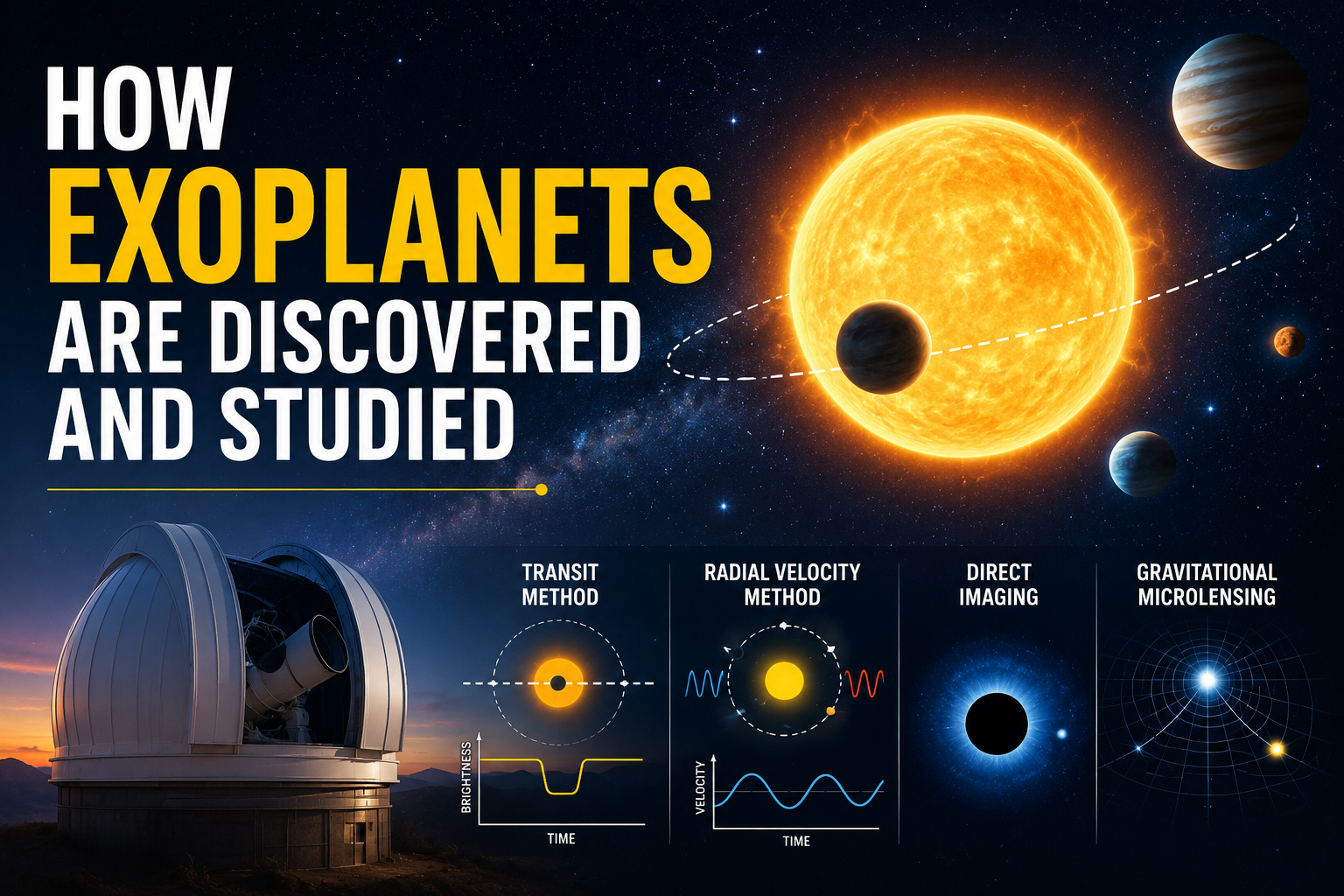
However, astronomers have discovered thousands of confirmed planets orbiting stars beyond the Sun, known as exoplanets.
Some planetary systems contain multiple planets, while others have very different configurations from our own Solar System.
Scientists search for exoplanets using several methods.
One important technique is the transit method, in which astronomers look for a small dip in a star’s brightness when a planet passes between the star and Earth.
Another is the radial velocity method, which detects tiny movements of a star caused by the gravitational influence of an orbiting planet.
Studying planets around other stars helps scientists understand how planetary systems form and evolve.
Why Are Stars Important to the Universe?
Stars are fundamental building blocks of galaxies.
They influence their surroundings through light, radiation, stellar winds and, eventually, the material they return to space.
Their birth and death are connected to the evolution of galaxies and the creation and distribution of many chemical elements.
Stars also provide astronomers with natural laboratories for studying physics under conditions that cannot easily be reproduced on Earth.
By studying stars, scientists can investigate nuclear fusion, gravity, magnetism, radiation, matter and the evolution of the universe.
The Sun Is a Star
Because the Sun dominates Earth’s sky, it can be easy to think of it as fundamentally different from other stars.
It is not.
The Sun is an ordinary star in many respects. It is a medium-sized, middle-aged star compared with the enormous range of stars found throughout the universe.
Its relative proximity allows scientists to study it in much greater detail than distant stars.
Research on the Sun also helps astronomers understand other stars and the physical processes that take place inside them.
Are Stars Really Pointing Light in the Sky?
To the naked eye, stars appear as tiny points.
In reality, even relatively ordinary stars are enormous compared with Earth.
Their apparent small size is primarily a consequence of distance.
The same basic principle applies when viewing distant galaxies. Objects that are physically enormous can appear tiny because they are extraordinarily far away.
Modern telescopes allow astronomers to study details that cannot be seen with the naked eye.
Why Stars Matter for Understanding Our Origins
The atoms that make up Earth and living organisms have a cosmic history.
Hydrogen was produced in the early universe, while many heavier elements were produced through stellar processes and other cosmic events.
When stars lived and died, they contributed material to the surrounding space.
That material could later become incorporated into new generations of stars and planetary systems.
In that sense, studying stars is also a way of studying the origins of the material that makes up our planet and ourselves.
The Night Sky Is a Record of Stellar History
Every visible star represents a different point in cosmic history.
Some stars are relatively young. Others have existed for billions of years. Some may have already changed dramatically or even ceased to exist, while their ancient light continues traveling toward Earth.
The stars we see therefore tell a much larger story than their appearance suggests.
They reveal how matter gathers under gravity, how nuclear fusion powers the universe, how galaxies evolve and how generations of stars recycle material through cosmic time.
From the smallest red dwarf to the most massive stars that end in spectacular explosions, stars are fundamental to understanding the universe—and the story of our own cosmic origins.



2 Comments
Micle harison
June 7, 2019Lorem ipsum dolor sit amet, usu ut perfecto postulant deterruisset, libris causae volutpat at est, ius id modus laoreet urbanitas. Mel ei delenit dolores.
John Doe
June 7, 2019Some consultants are employed indirectly by the client via a consultancy staffing company.