
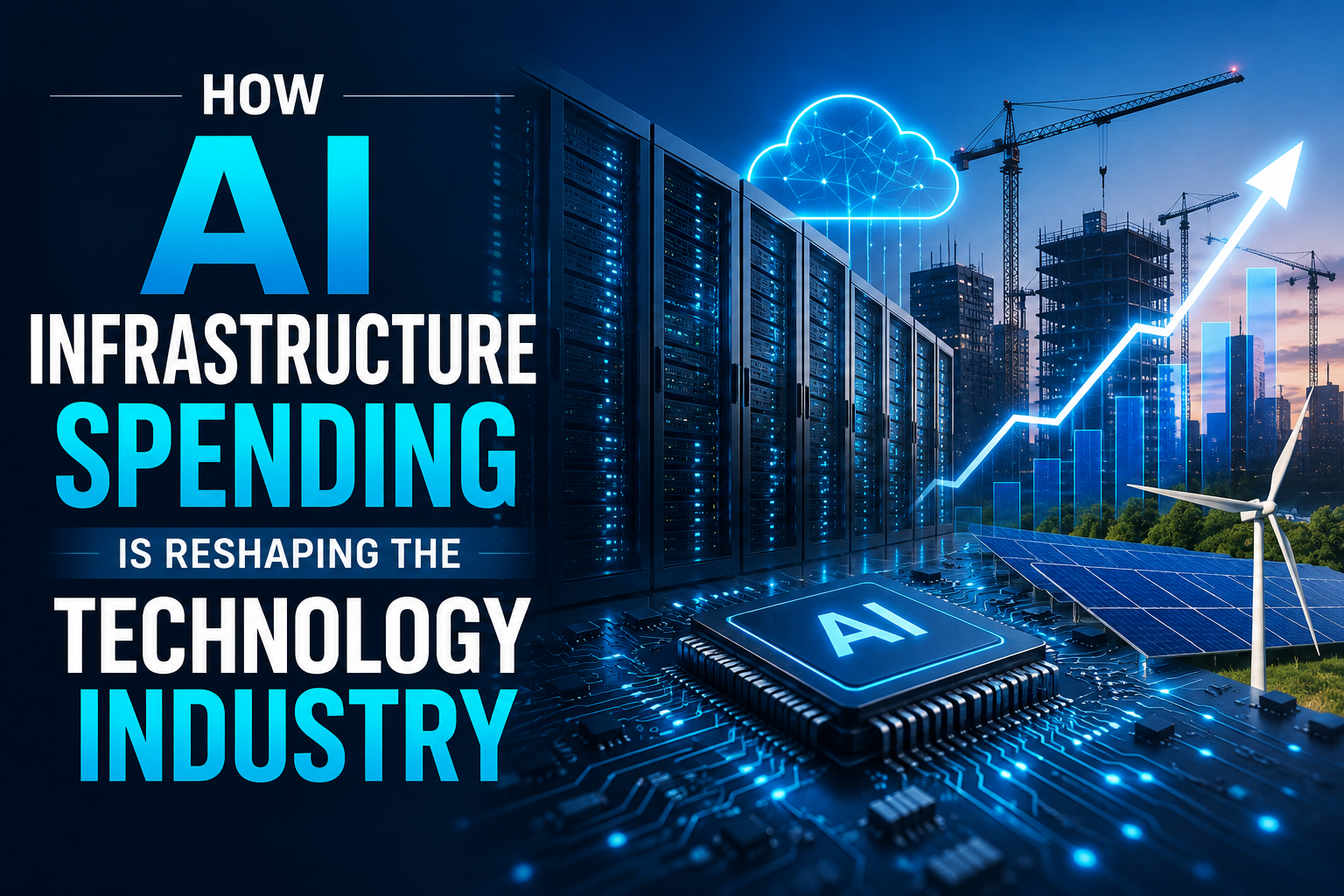
How AI Infrastructure Spending Is Reshaping the Technology Industry
Artificial intelligence has rapidly evolved from an emerging technology into one of the world’s most significant investment priorities. While much of the public attention focuses on AI chatbots, image generators, and intelligent assistants, the foundation enabling these innovations lies in an unprecedented wave of infrastructure spending. Technology companies, cloud providers, semiconductor manufacturers, and governments are investing hundreds of billions of dollars in data centers, advanced processors, networking equipment, and energy infrastructure to meet the growing demands of AI.
This surge in infrastructure investment is transforming the technology industry, creating new opportunities across hardware, software, cloud computing, cybersecurity, and energy while reshaping competitive dynamics among the world’s largest technology companies.
What Is AI Infrastructure?
AI infrastructure refers to the collection of hardware, software, networking systems, storage solutions, and facilities required to develop, train, deploy, and operate artificial intelligence models.
Unlike traditional computing workloads, modern AI systems require enormous computational power to process vast datasets and perform complex calculations. Building and maintaining this infrastructure requires significant capital investment and ongoing innovation.
Core components of AI infrastructure include:
- High-performance graphics processing units (GPUs)
- AI accelerators and specialized processors
- Large-scale data centers
- High-speed networking equipment
- Cloud computing platforms
- Data storage systems
- Cooling technologies
- Reliable energy supplies
Together, these technologies form the backbone of today’s AI ecosystem.
Why AI Infrastructure Spending Is Accelerating
The rapid adoption of generative AI has dramatically increased demand for computing resources. Training large language models, running AI-powered applications, and supporting millions of users simultaneously require significantly more computing capacity than many traditional software services.
Several factors are driving increased investment:
Growing Enterprise AI Adoption
Businesses across industries are integrating AI into customer service, software development, healthcare, finance, manufacturing, and logistics. As enterprise adoption expands, demand for scalable AI infrastructure continues to grow.
Increasing Model Complexity
AI models are becoming larger and more sophisticated, often requiring billions—or even trillions—of parameters. These advanced systems demand powerful computing clusters capable of handling massive workloads.
Expanding Cloud AI Services
Cloud providers continue expanding AI-focused services, allowing organizations to access advanced computing resources without building their own infrastructure from scratch.
Global AI Competition
Governments and technology companies increasingly view AI infrastructure as a strategic investment, supporting innovation, economic growth, and national competitiveness.
Data Centers Become Strategic Assets
Modern AI relies heavily on large-scale data centers equipped with thousands of specialized processors working together.
Unlike conventional data centers designed primarily for storage and web hosting, AI facilities require:
- High-density computing environments
- Advanced liquid or hybrid cooling systems
- Ultra-fast networking
- Massive electrical capacity
- Sophisticated workload management
- Enhanced physical and cybersecurity protections
As AI workloads continue growing, data center construction has accelerated across multiple regions, making these facilities some of the most valuable assets in the digital economy.
Semiconductor Demand Continues to Rise
Advanced semiconductors remain at the heart of AI infrastructure.
Graphics processing units, custom AI chips, and specialized accelerators perform the complex mathematical operations required for machine learning. As organizations expand AI deployments, demand for high-performance processors continues increasing throughout the semiconductor supply chain.
This trend has also encouraged investments in:
- Chip manufacturing
- Advanced packaging technologies
- Semiconductor research
- Supply chain diversification
- Memory technologies
- Chip design software
The result is a broader transformation of the global semiconductor industry.
Cloud Computing Enters a New Growth Phase
Cloud computing providers are investing heavily in AI infrastructure to support customers developing and deploying intelligent applications.
Many organizations prefer cloud-based AI services because they offer:
- Scalable computing resources
- Flexible pricing models
- Global availability
- Integrated AI development tools
- Managed infrastructure
- Faster deployment
This shift enables businesses of all sizes to adopt AI without investing in expensive on-premises hardware.
Networking Infrastructure Gains Importance
Training and operating advanced AI models require moving enormous amounts of data between processors at extremely high speeds.
As a result, demand has grown for:
- High-bandwidth networking
- Optical interconnects
- Advanced switches
- Low-latency communication systems
- AI networking software
- Distributed computing technologies
Efficient networking has become nearly as important as processing power itself in supporting next-generation AI workloads.
Energy Becomes a Critical AI Resource
One of the less visible consequences of AI expansion is the growing demand for electricity.
Large AI data centers consume substantial amounts of power, increasing interest in:
- Renewable energy projects
- Energy-efficient processors
- Advanced cooling technologies
- Grid modernization
- Battery storage
- Sustainable data center design
Technology companies are increasingly pursuing strategies that balance computational growth with environmental sustainability and operational efficiency.
AI Infrastructure Creates Opportunities Beyond Technology
The effects of AI infrastructure spending extend well beyond the technology sector.
Industries benefiting from increased investment include:
- Construction
- Utilities
- Electrical equipment manufacturing
- Industrial automation
- Real estate
- Telecommunications
- Logistics
- Cybersecurity
- Engineering services
- Renewable energy
This broad economic impact demonstrates how AI has become a catalyst for investment across multiple sectors.
Challenges Facing AI Infrastructure Expansion
Despite rapid growth, several challenges remain.
Rising Capital Costs
Building advanced AI infrastructure requires enormous financial investment, making it difficult for smaller organizations to compete at scale.
Power Constraints
Many regions face limitations in electrical capacity, slowing data center expansion and increasing pressure on energy infrastructure.
Supply Chain Pressures
Strong demand for specialized processors and networking equipment can create supply bottlenecks and longer deployment timelines.
Skilled Workforce Needs
Expanding AI infrastructure requires engineers, data center specialists, cybersecurity professionals, and semiconductor experts, increasing competition for highly skilled talent.
Environmental Considerations
Organizations continue exploring ways to improve energy efficiency while reducing the environmental impact of large-scale AI operations.
The Future of AI Infrastructure
Industry analysts expect AI infrastructure investment to remain a major driver of technology spending for years to come.
Future developments are likely to include:
- More efficient AI processors
- Expanded cloud infrastructure
- Greater adoption of custom AI chips
- Improved networking technologies
- Sustainable data center innovations
- Edge AI computing
- Increased automation of infrastructure management
- Continued integration of artificial intelligence into enterprise operations
As AI applications become more deeply embedded in everyday business processes, the supporting infrastructure will continue evolving alongside them.
Final Thoughts
Artificial intelligence is reshaping far more than software—it is transforming the entire technology ecosystem. Massive investments in processors, cloud platforms, networking, data centers, and energy infrastructure are laying the foundation for the next generation of digital innovation.
While AI-powered applications capture public attention, it is the infrastructure behind the scenes that enables these breakthroughs to scale. As organizations continue investing in the technologies that power artificial intelligence, AI infrastructure spending is likely to remain one of the defining forces shaping the future of the global technology industry.





2 Comments
Micle harison
June 7, 2019Lorem ipsum dolor sit amet, usu ut perfecto postulant deterruisset, libris causae volutpat at est, ius id modus laoreet urbanitas. Mel ei delenit dolores.
John Doe
June 7, 2019Some consultants are employed indirectly by the client via a consultancy staffing company.