
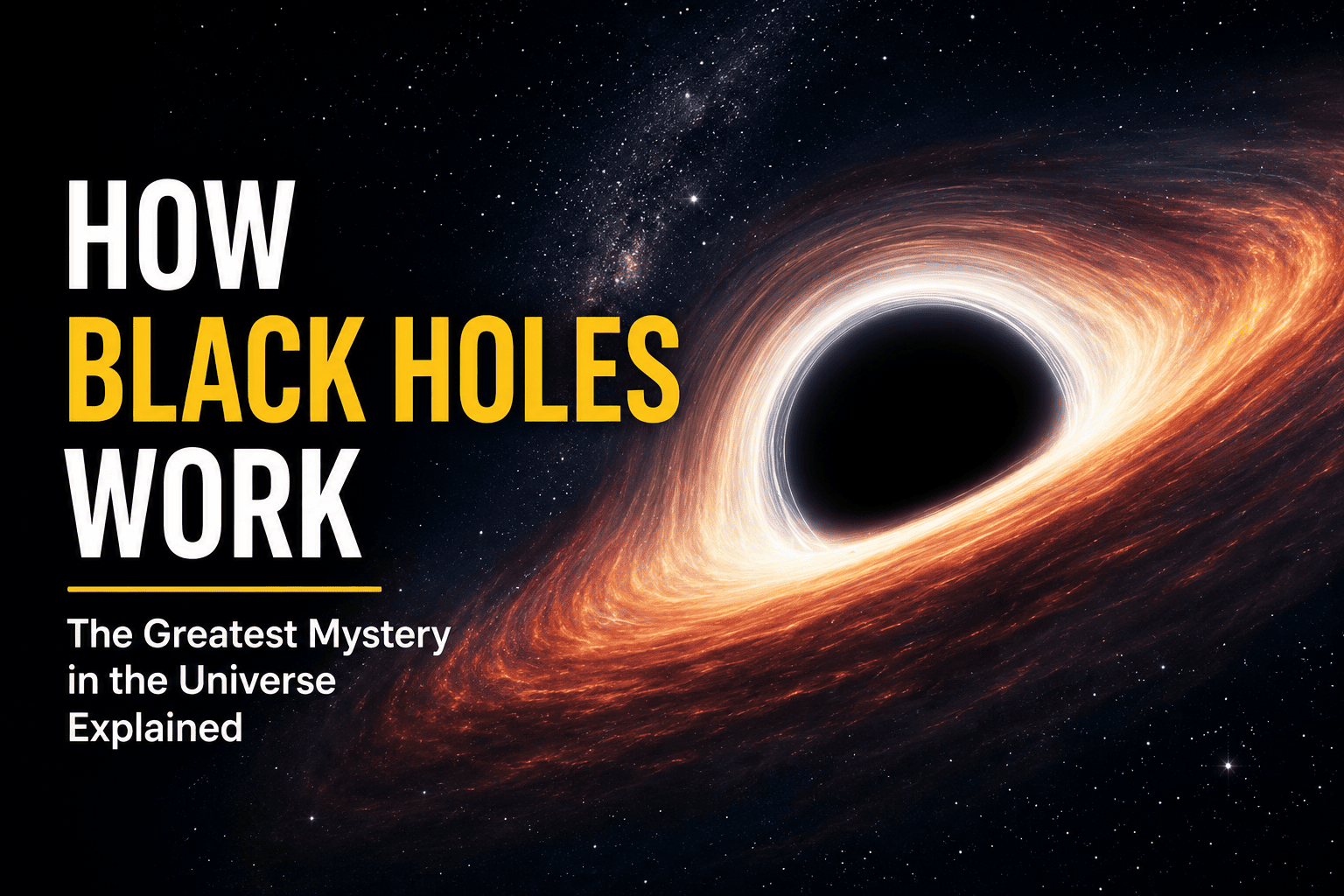
How Black Holes Work: The Greatest Mystery in the Universe Explained
Imagine an object so powerful that not even light—the fastest thing in the universe—can escape its gravitational pull.
An object that bends space and time, distorts reality, and challenges nearly everything scientists know about physics.
This isn’t science fiction.
It’s a black hole.
For decades, black holes have fascinated scientists, inspired blockbuster movies, and captured the imagination of anyone who has ever looked up at the night sky. Once considered nothing more than a mathematical curiosity, black holes are now known to exist throughout the universe, including one lurking at the very center of our own Milky Way galaxy.
Yet despite decades of research and remarkable technological advances, black holes remain among the greatest mysteries in modern science.
- How do they form?
- Can anything escape them?
- Do they destroy information forever?
- Could they eventually reveal the long-sought connection between Einstein’s theory of relativity and quantum mechanics?
Let’s journey into one of the most extraordinary phenomena the universe has ever produced.
What Is a Black Hole?
A black hole is a region of space where gravity becomes so intense that nothing—not even light—can escape once it crosses a certain boundary.
Contrary to popular belief, a black hole is not an enormous cosmic vacuum cleaner that sucks up everything around it.
Instead, it behaves much like any other massive object.
If our Sun were magically replaced by a black hole of exactly the same mass, Earth would continue orbiting in almost exactly the same way.
The difference is that there would no longer be sunlight.
Black holes are dangerous only if something ventures too close.
Why Is It Called a Black Hole?
The name is surprisingly descriptive.
- It is black because no light escapes.
- It is a hole because anything crossing its boundary cannot return.
Since telescopes detect objects using light, black holes themselves cannot be seen directly.
Scientists instead detect their effects on nearby stars, gas, and light.
Ironically, some of the brightest objects in the universe are created by matter falling into black holes.
How Do Black Holes Form?
Most black holes begin their lives as extremely massive stars.
Stars exist because two enormous forces constantly compete.
- Gravity pulls inward.
- Nuclear fusion pushes outward.
As long as fusion continues, these forces remain balanced.
Eventually, however, the star runs out of nuclear fuel.
Without enough outward pressure, gravity wins.
The core collapses in an unimaginably violent event.
If the remaining core is massive enough, it compresses into a black hole.
The outer layers explode outward in a spectacular supernova, scattering heavy elements across space.
Many of the atoms that make up planets—and even our own bodies—were forged inside ancient stars that ended their lives this way.
The Event Horizon: The Point of No Return
Perhaps the most famous part of a black hole is its event horizon.
This invisible boundary marks the point where escape becomes impossible.
Cross the event horizon, and every possible path through space leads deeper into the black hole.
It isn’t a physical surface.
- No wall.
- No barrier.
- No glowing edge.
An astronaut crossing it might not notice anything unusual at that exact moment—especially if the black hole is extremely large.
The real danger lies in what happens afterward.
The Singularity: Where Physics Breaks Down
At the center of every classical black hole lies what physicists call a singularity.
According to Einstein’s equations, this is a point where matter is compressed into an infinitely small space with seemingly infinite density.
Here, gravity becomes so extreme that our current understanding of physics no longer works.
This is one reason black holes remain such an active area of research.
Scientists believe the singularity signals not that nature becomes impossible, but that our theories are incomplete.
To understand what truly happens there, humanity likely needs a successful theory of quantum gravity—one that combines quantum mechanics with general relativity.
Einstein Predicted Black Holes Before Anyone Saw One
In 1915, Albert Einstein introduced his revolutionary theory of general relativity.
Instead of viewing gravity as a force, Einstein described it as the curvature of space and time caused by mass.
Imagine placing a heavy bowling ball on a stretched rubber sheet.
The sheet bends.
Smaller objects rolling nearby naturally move toward the depression.
Massive objects bend spacetime in a similar way.
Soon after Einstein published his equations, physicists realized they predicted something astonishing:
Objects could become so dense that spacetime itself would collapse inward.
At first, even Einstein doubted such objects could exist.
Today, thousands of black holes have been identified across the universe.
Different Types of Black Holes
Stellar Black Holes
These form when massive stars collapse after exhausting their nuclear fuel.
They typically contain between a few and several dozen times the mass of our Sun.
Intermediate-Mass Black Holes
These are much rarer and remain less understood.
They may form through repeated mergers of smaller black holes or within dense star clusters.
Supermassive Black Holes
The giants of the universe.
These monsters contain millions—or even billions—of solar masses.
Almost every large galaxy appears to host one at its center.
Our own galaxy contains Sagittarius A*, a supermassive black hole approximately four million times the mass of the Sun.
Scientists still debate exactly how these enormous objects formed so early in cosmic history.
Primordial Black Holes (Hypothetical)
Some researchers propose that tiny black holes may have formed shortly after the Big Bang.
Although none have been confirmed, they remain an intriguing possibility and have even been suggested as one potential explanation for dark matter.
What Happens If You Fall Into a Black Hole?
This question has fascinated scientists and storytellers alike.
The answer depends on the size of the black hole.
For smaller black holes, gravity changes dramatically over short distances.
If someone fell feet-first, gravity would pull much harder on their feet than on their head.
This difference, called a tidal force, would stretch the person into an extremely thin shape.
Physicists humorously call this process spaghettification.
For supermassive black holes, however, the event horizon is much farther from the central singularity.
An astronaut could theoretically cross it without immediately noticing anything unusual.
The journey inward would still end at the singularity—but the initial experience might be surprisingly uneventful.
Can Anything Escape a Black Hole?
According to classical physics:
No.
Once something passes beyond the event horizon, escape becomes impossible.
However, quantum mechanics introduced an extraordinary twist.
In the 1970s, physicist Stephen Hawking proposed that black holes are not completely black.
Instead, tiny quantum effects near the event horizon allow them to emit radiation.
This phenomenon became known as Hawking radiation.
Over unimaginable periods of time, Hawking radiation suggests black holes slowly lose energy.
Eventually, they may evaporate entirely.
No black hole has yet been observed evaporating, but Hawking’s theory remains one of modern physics’ most influential ideas.
How Scientists Actually Detect Black Holes
Scientists detect black holes by observing their effects on nearby objects.
Watching Nearby Stars
If a visible star orbits something invisible yet incredibly massive, a black hole becomes the leading explanation.
X-Ray Emissions
Gas spiraling toward a black hole becomes extremely hot.
Before crossing the event horizon, it forms an accretion disk that emits intense X-rays detectable from Earth.
Gravitational Waves
In 2015, scientists made history by directly detecting gravitational waves produced by two merging black holes.
The discovery confirmed another prediction made by Einstein a century earlier and opened an entirely new way of observing the universe.
Direct Imaging
In 2019, the Event Horizon Telescope collaboration released humanity’s first-ever image of a black hole’s shadow.
The image showed the supermassive black hole in the galaxy M87.
In 2022, astronomers followed it with an image of Sagittarius A* at the center of the Milky Way.
These achievements transformed black holes from theoretical objects into directly observed cosmic phenomena.
Black Holes and Time
One of the strangest consequences of Einstein’s theory involves time itself.
Gravity affects time.
Near an extremely massive object, time passes more slowly compared to regions farther away.
This effect, known as gravitational time dilation, becomes especially dramatic near black holes.
For someone observing from a safe distance, a falling astronaut would appear to move increasingly slowly near the event horizon.
To the astronaut, however, time would continue normally.
Both perspectives are correct according to relativity.
Do Black Holes Destroy Information?
This question lies at the heart of one of physics’ greatest debates.
Quantum mechanics suggests information cannot simply disappear.
Yet classical black holes appear to erase everything that falls inside them.
This conflict became known as the black hole information paradox.
Resolving it could help scientists develop a unified theory combining quantum physics and gravity.
Some researchers believe information escapes through subtle quantum processes.
Others argue it remains encoded on the event horizon itself.
The debate continues.
Could Black Holes Lead to Other Universes?
Science fiction often portrays black holes as gateways to distant galaxies or parallel universes.
Some theoretical models explore ideas involving wormholes, hypothetical tunnels through spacetime.
However, no observational evidence currently supports the existence of stable, traversable wormholes.
For now, these ideas remain fascinating mathematical possibilities rather than established science.
Why Black Holes Matter
Studying black holes isn’t simply about satisfying curiosity.
They help scientists answer some of the deepest questions in physics.
Research into black holes may improve our understanding of:
- Gravity
- Space and time
- Quantum mechanics
- Galaxy formation
- Dark matter
- The origins of the universe
In many ways, black holes serve as natural laboratories where the laws of physics are pushed to their absolute limits.
The Future of Black Hole Research
Astronomy is entering a remarkable era.
New telescopes, more sensitive gravitational-wave observatories, and powerful computer simulations are allowing scientists to study black holes in unprecedented detail.
Future missions may reveal:
- How supermassive black holes formed
- Whether intermediate-mass black holes truly exist
- How black holes influence galaxy evolution
- Whether Hawking radiation can eventually be confirmed
- How gravity behaves under the most extreme conditions imaginable
Each discovery brings us closer to understanding some of the universe’s oldest secrets.
Final Thoughts
Black holes are among the most extraordinary objects ever discovered.
Born from dying stars and capable of bending space, time, and even light itself, they challenge our deepest assumptions about how the universe works.
They remind us that the cosmos is far stranger than everyday experience suggests.
More importantly, they reveal how much remains unknown.
Every observation, every gravitational wave detection, and every new image captured by modern telescopes adds another piece to a puzzle that scientists have spent more than a century trying to solve.
Black holes are not simply cosmic monsters waiting to consume everything around them.
They are gateways to understanding the fundamental laws of nature.
And as our technology continues to improve, these mysterious giants may eventually unlock answers to questions humanity has been asking since the dawn of science itself.



2 Comments
Micle harison
June 7, 2019Lorem ipsum dolor sit amet, usu ut perfecto postulant deterruisset, libris causae volutpat at est, ius id modus laoreet urbanitas. Mel ei delenit dolores.
John Doe
June 7, 2019Some consultants are employed indirectly by the client via a consultancy staffing company.