
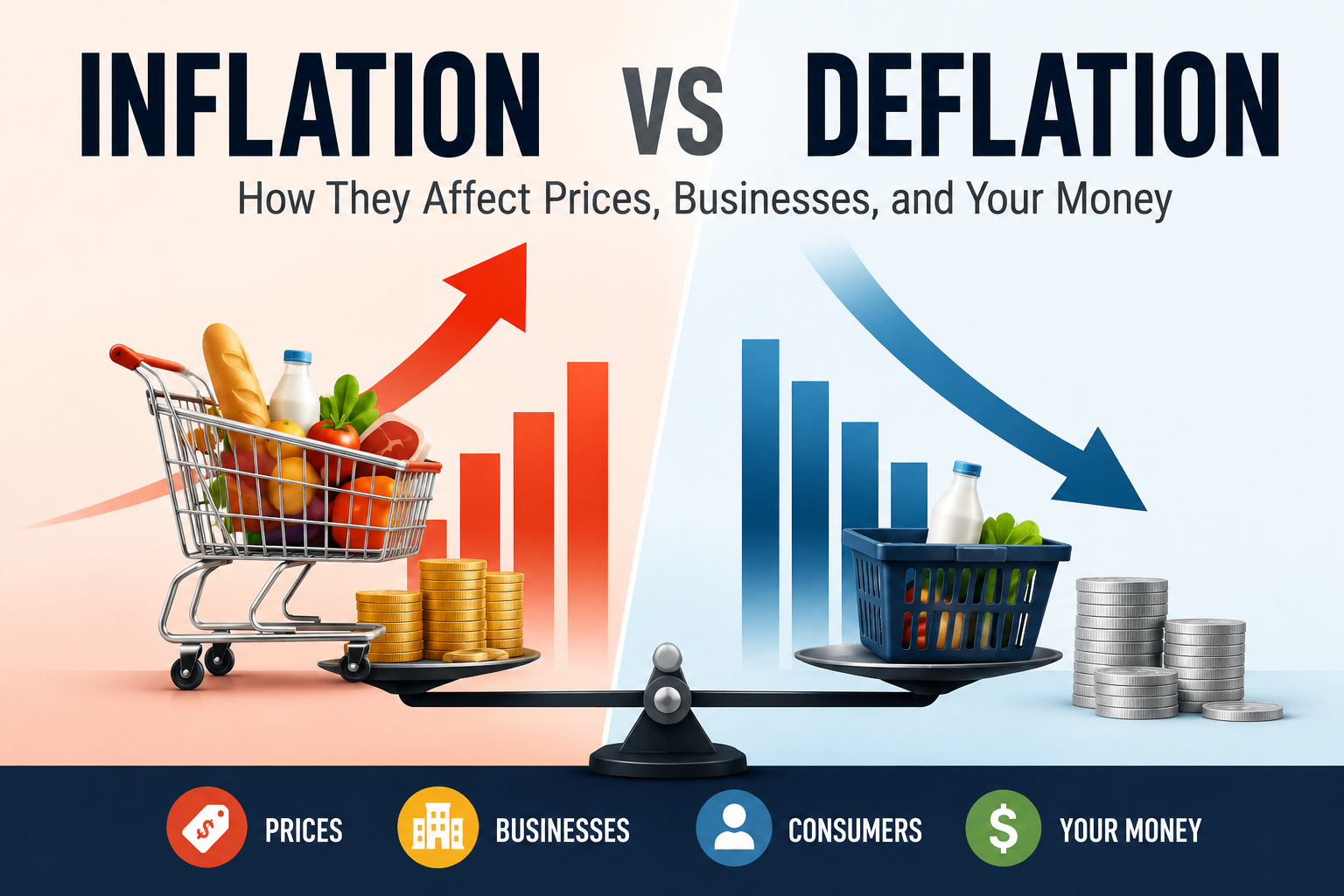
Inflation vs Deflation: How They Affect Prices, Businesses, and Your Money
Imagine walking into your favorite grocery store.
Last year, a shopping cart full of essentials cost $100.
Today, the exact same items cost $108.
Most people recognize this as inflation—the gradual rise in prices over time.
Now imagine the opposite.
The same shopping cart that cost $100 last year now costs $94.
At first glance, this sounds like great news. Lower prices mean consumers save money, right?
Not necessarily.
While inflation often grabs headlines because it makes everyday life more expensive, deflation—a sustained decline in prices—can be just as dangerous, if not more so. Throughout history, both inflation and deflation have shaped economies, influenced elections, affected businesses, and determined the financial well-being of millions of people.
Understanding the difference between these two economic forces isn’t just for economists or investors. Whether you’re managing a household budget, running a business, saving for retirement, or investing in the stock market, inflation and deflation affect nearly every financial decision you make.
So what exactly are inflation and deflation? Why do they happen? And how can they influence everything from the price of your morning coffee to the value of your savings?
Let’s break it down.
What Is Inflation?
Inflation is the general increase in the prices of goods and services over time, reducing the purchasing power of money.
In simple terms:
When inflation rises, each dollar buys slightly less than it did before.
Examples
- A loaf of bread that cost $2.50 last year may cost $2.70 today.
- A gallon of gasoline might increase from $3.50 to $3.85.
- Rent, healthcare, and education expenses may gradually become more expensive.
Moderate inflation is considered normal in most healthy economies.
Many central banks actually aim for low, stable inflation because it encourages spending, investment, and economic growth.
What Is Deflation?
Deflation is the general decline in the prices of goods and services across an economy.
Unlike temporary sales or seasonal discounts, deflation affects prices broadly and can persist for months or even years.
Examples
- Cars becoming cheaper year after year
- Falling home prices
- Declining wages
- Reduced prices across retail stores
Although lower prices may seem beneficial, widespread deflation often signals weakening economic activity.
Consumers begin delaying purchases because they expect prices to fall even further.
Businesses earn less revenue.
Companies reduce hiring or lay off workers.
Economic growth slows.
Inflation vs Deflation: The Key Differences
| Inflation | Deflation |
|---|---|
| Prices rise | Prices fall |
| Purchasing power declines | Purchasing power increases temporarily |
| Businesses often earn more revenue | Businesses often earn less revenue |
| Moderate inflation supports growth | Persistent deflation often slows growth |
| Borrowers benefit because debt becomes easier to repay in real terms | Debt becomes more expensive in real terms |
| Central banks may raise interest rates | Central banks often lower interest rates |
Although they move in opposite directions, both extremes can create economic instability.
What Causes Inflation?
Inflation doesn’t occur for just one reason.
Economists generally identify three major causes.
1. Demand-Pull Inflation
This happens when consumers spend faster than businesses can produce goods and services.
Imagine demand for smartphones suddenly doubles.
Manufacturers cannot produce enough devices quickly.
Prices rise because more people are competing for limited products.
Common during periods of:
- Strong economic growth
- Rising employment
- High consumer confidence
2. Cost-Push Inflation
Sometimes prices increase because producing goods becomes more expensive.
Businesses face higher costs for:
- Raw materials
- Energy
- Transportation
- Labor
Rather than absorbing those costs, companies often pass them on to consumers.
For example, rising oil prices can increase transportation expenses, making everything from groceries to furniture more expensive.
3. Monetary Inflation
Inflation may also occur when the money supply grows significantly faster than economic output.
If more money circulates while production remains relatively unchanged, more dollars compete for the same quantity of goods and services.
Historically, excessive money creation has contributed to severe inflation in several countries.
What Causes Deflation?
Deflation usually develops during periods of weak economic activity.
Falling Consumer Demand
When households reduce spending, businesses often lower prices to attract customers.
Declining Business Investment
If companies become pessimistic about future growth, they may cut production and investment.
This reduces employment and further weakens demand.
Financial Crises
Banking crises often reduce lending.
Less borrowing means less spending by households and businesses.
Demand weakens.
Prices fall.
Technological Progress
Not all price declines are harmful.
Technology often makes products cheaper by increasing productivity.
Examples include:
- Televisions
- Computers
- Smartphones
These products have become significantly more powerful while often becoming less expensive over time.
This type of price reduction differs from economy-wide deflation.
How Inflation Affects Consumers
Inflation touches nearly every aspect of daily life.
Higher Living Costs
Households spend more on essentials such as:
- Food
- Housing
- Utilities
- Transportation
- Healthcare
If wages fail to keep pace, purchasing power declines.
Reduced Savings Value
Money sitting in low-interest savings accounts gradually loses purchasing power during inflation.
For example:
Suppose you keep $10,000 in a savings account earning 2% annually while inflation averages 4%.
Your account balance increases.
However, your money buys less than it did before.
This is why investors often seek assets capable of outpacing inflation over long periods.
Borrowers Often Benefit
Inflation reduces the real value of fixed-rate debt.
Imagine taking out a $250,000 mortgage.
If your salary rises over time while monthly payments remain fixed, repaying the loan generally becomes easier.
How Deflation Affects Consumers
Deflation initially appears positive because prices decline.
However, long-lasting deflation often creates unintended consequences.
Delayed Spending
Consumers postpone purchases.
Why buy today if prices may be lower next month?
This reduces business sales.
Employment Risks
Lower business revenue frequently leads to:
- Hiring freezes
- Wage reductions
- Layoffs
Job insecurity further reduces consumer spending.
Debt Becomes More Expensive
Although loan balances remain unchanged, incomes may fall during deflation.
This increases the real burden of debt.
Borrowers effectively repay loans with “more valuable” dollars.
How Inflation Impacts Businesses
Businesses experience both opportunities and challenges.
Higher Revenue
Companies may generate more revenue simply because prices increase.
However, higher sales revenue does not always mean higher profits.
Rising Operating Costs
Businesses often pay more for:
- Inventory
- Shipping
- Rent
- Utilities
- Employee wages
Profit margins can shrink if companies cannot raise prices enough.
Pricing Challenges
Businesses must carefully balance profitability with customer affordability.
Frequent price increases may reduce demand.
How Deflation Impacts Businesses
Persistent deflation creates even greater challenges.
Lower Revenue
Companies earn less for each product sold.
Even stable sales volumes may produce lower income.
Reduced Investment
Businesses often postpone:
- Expansion
- Hiring
- Equipment purchases
Economic activity slows further.
Increased Bankruptcy Risk
Declining revenue combined with fixed debt payments can place enormous pressure on financially weaker companies.
The Role of Central Banks
Central banks play a crucial role in managing inflation and deflation.
Interest Rates
- Higher interest rates generally reduce borrowing and spending, helping slow inflation.
- Lower interest rates encourage borrowing, investment, and economic activity during periods of weak demand.
Money Supply
Central banks can influence the amount of money circulating throughout the economy through various monetary policy tools.
The objective is usually to maintain stable prices while supporting sustainable economic growth.
Which Is Worse: Inflation or Deflation?
Economists often debate this question.
Moderate Inflation
Usually considered healthy.
It encourages:
- Spending
- Investment
- Business expansion
High Inflation
Can:
- Reduce purchasing power
- Create uncertainty
- Increase living costs
- Hurt fixed-income households
Persistent Deflation
May appear attractive initially but often leads to:
- Lower wages
- Higher unemployment
- Reduced business investment
- Slower economic growth
For this reason, many economists consider prolonged deflation more difficult to reverse than moderate inflation.
Protecting Yourself From Inflation
Individuals can reduce inflation’s impact by:
- Building an emergency fund
- Investing for long-term growth
- Avoiding unnecessary high-interest debt
- Increasing valuable job skills
- Reviewing household budgets regularly
Diversification can also help reduce financial risk during changing economic conditions.
Preparing for Deflation
During deflationary periods, financial stability becomes especially important.
Strategies include:
- Maintaining emergency savings
- Limiting excessive debt
- Preserving cash flow
- Investing cautiously
- Focusing on financially strong businesses if investing
Because employment uncertainty often increases, having a financial cushion becomes even more valuable.
Historical Examples
Inflation
Many countries experienced elevated inflation following periods of:
- Supply chain disruptions
- Strong consumer demand
- Rising energy costs
These episodes highlighted how quickly prices can affect household budgets.
Deflation
Japan experienced extended periods of low inflation and deflation beginning in the 1990s.
Economic growth slowed, consumer spending weakened, and policymakers spent years attempting to stimulate demand.
The experience remains one of the world’s most studied examples of prolonged deflation.
The Bottom Line
Inflation and deflation may seem like opposites—and they are—but both have profound effects on the economy.
Inflation gradually reduces the purchasing power of money, making everyday goods and services more expensive.
Deflation lowers prices, but if it becomes widespread and persistent, it can discourage spending, weaken businesses, increase unemployment, and slow economic growth.
Neither condition is inherently “good” or “bad” in every circumstance.
The real challenge lies in maintaining balance.
Stable, predictable prices allow consumers to plan confidently, businesses to invest, and economies to grow sustainably.
For individuals, understanding inflation and deflation is more than an economics lesson—it’s a practical life skill.
From deciding when to save, spend, borrow, or invest, these powerful economic forces influence nearly every financial decision you’ll make.
The more you understand them, the better equipped you’ll be to protect your money, adapt to changing economic conditions, and make smarter long-term financial choices.


2 Comments
Micle harison
June 7, 2019Lorem ipsum dolor sit amet, usu ut perfecto postulant deterruisset, libris causae volutpat at est, ius id modus laoreet urbanitas. Mel ei delenit dolores.
John Doe
June 7, 2019Some consultants are employed indirectly by the client via a consultancy staffing company.