
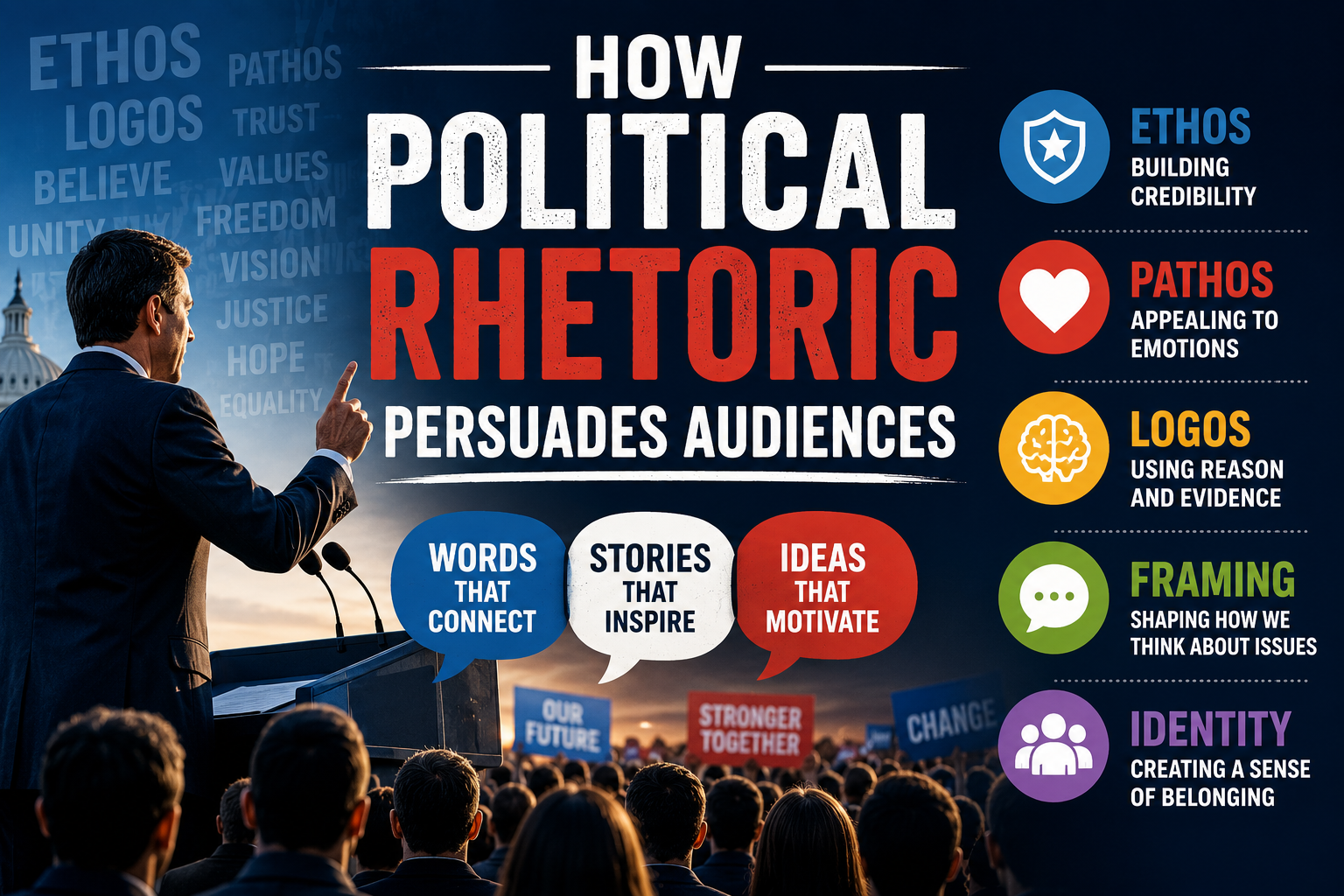
How Political Rhetoric Persuades Audiences
Political rhetoric is often treated as the language of speeches, campaign slogans, and parliamentary debates. But persuasion in politics is much broader. It includes the words politicians choose, the stories they tell, the problems they emphasize, the identities they appeal to, and even the way they frame an issue before an audience has decided what to think about it.
From election campaigns to public policy debates, political rhetoric can influence how people understand complex issues and evaluate competing ideas. Understanding how it works can help audiences become more informed listeners, recognize persuasive techniques, and distinguish between a compelling argument and a well-supported one.
What Is Political Rhetoric?
Political rhetoric is the strategic use of language and communication to influence how people think, feel, or act about political issues.
It can appear in:
- Political speeches
- Election campaigns
- Parliamentary debates
- Interviews and press conferences
- Political advertising
- Opinion articles
- Social media posts
- Public demonstrations
- Policy announcements
- Debates between candidates or political parties
Political rhetoric does not necessarily mean deception. Persuasion is a normal part of democratic communication. Politicians need to explain policies, defend decisions, criticize alternatives, and convince citizens that their proposals deserve support.
The important question is not simply whether a message is persuasive, but how it achieves persuasion and whether the claims behind it are credible.
Why Political Language Is So Powerful
Politics involves complicated subjects such as taxation, healthcare, education, national security, economic policy, immigration, environmental protection, and government spending.
Most people do not have the time or specialist knowledge to examine every aspect of these subjects themselves. Political communication therefore provides shortcuts for understanding complicated questions.
A politician might turn a detailed policy debate into a simple question of fairness, freedom, security, opportunity, or responsibility.
That simplification can make political issues easier to understand, but it can also leave out important information.
Effective political rhetoric works partly because it connects abstract policies to ideas that audiences already understand and care about.
The Three Classical Foundations of Persuasion
Many political communication techniques can be understood through three classical rhetorical concepts: ethos, pathos, and logos.
Ethos: Establishing Credibility
Ethos concerns the perceived character and credibility of the speaker.
A political figure may attempt to establish ethos by emphasizing:
- Professional experience
- Personal background
- Knowledge of an issue
- Leadership experience
- Connection to ordinary citizens
- Commitment to particular values
- Evidence of previous achievements
For example, a politician discussing education might emphasize experience as a teacher, policymaker, parent, or education administrator.
The underlying message is: I understand this issue, and you should trust my judgment.
However, credibility should not automatically be confused with correctness. A speaker can have relevant experience and still make a weak or inaccurate argument.
Pathos: Appealing to Emotion
Pathos involves emotional persuasion.
Political communication frequently appeals to emotions such as:
- Hope
- Fear
- Anger
- Pride
- Compassion
- Anxiety
- Frustration
- Patriotism
- Optimism
Emotional appeals can make political messages memorable because people do not process political information through facts and statistics alone.
A speech describing the experiences of a struggling family, for example, can make an economic issue feel more immediate than a page of statistics.
Emotional storytelling is not inherently manipulative. The concern arises when emotion replaces evidence or is deliberately used to obscure important facts.
Logos: Using Reason and Evidence
Logos refers to logical reasoning and evidence.
Political arguments can use:
- Statistics
- Historical examples
- Economic data
- Research findings
- Comparisons
- Cause-and-effect reasoning
- Policy analysis
- Concrete examples
A politician might argue that a particular policy will produce a desired result and then provide evidence supporting that claim.
For audiences, the key question is whether the evidence actually supports the conclusion.
A statistic can sound authoritative while being irrelevant, incomplete, or presented without necessary context.
The Power of Framing
One of the most important features of political rhetoric is framing.
Framing means presenting an issue from a particular perspective so that certain aspects become more prominent than others.
Consider a debate about government spending.
One speaker might describe a proposal as an investment in public services.
Another might describe the same proposal as an increase in government expenditure.
The underlying policy may be similar, but the language encourages audiences to interpret it differently.
Framing can influence which questions people ask.
Instead of asking, “Should this policy exist?” an audience may begin by asking, “How much will this investment cost?” Alternatively, the conversation might begin with, “How many people will benefit?”
The frame affects the starting point of the debate.
Political Stories Are Easier to Remember
Humans naturally respond to stories.
Political communication therefore often turns complicated issues into narratives involving:
- A problem
- A cause
- People affected by the problem
- A proposed solution
- A vision of the future
A campaign might portray a country as facing a particular challenge and present its candidate as the person capable of solving it.
Stories can be more memorable than isolated facts because they give information a structure.
However, real political problems are rarely as simple as political narratives suggest. Economic conditions, social problems, and international events usually have multiple causes and competing explanations.
The Use of Repetition
Repetition is another powerful rhetorical technique.
A phrase, slogan, policy message, or central theme may appear repeatedly throughout a campaign or political communication strategy.
Repeated messages can become familiar, and familiarity can make an idea easier to recognize and remember.
Politicians may repeat:
- Campaign slogans
- Key policy promises
- Descriptions of opponents
- Particular statistics
- National priorities
- Short memorable phrases
The effectiveness of repetition is one reason political campaigns often focus on a small number of central messages rather than attempting to communicate every policy detail at once.
For audiences, repetition should not be mistaken for evidence. A claim does not become more accurate simply because it is repeated frequently.
Contrast and Political Opponents
Political rhetoric often becomes more persuasive by creating contrasts.
A speaker may present politics as a choice between:
- Change and continuity
- Security and uncertainty
- Higher and lower taxes
- Government action and government restraint
- Individual responsibility and collective responsibility
- Short-term costs and long-term benefits
Opponents may also be characterized in particular ways.
A political campaign might portray an opposing party as inexperienced, irresponsible, disconnected, extreme, ineffective, or unwilling to act.
Such descriptions can simplify political competition into a contest between competing identities.
The danger is that complex political disagreements can become reduced to labels rather than substantive arguments.
Inclusive Language Creates Group Identity
Words such as “we,” “our,” and “us” can create a sense of shared identity.
Political speakers may use inclusive language to suggest that the audience and speaker belong to the same community and share common interests.
The rhetorical effect can be powerful:
“We can solve this together.”
The statement does more than propose a solution. It creates a relationship between the speaker and the audience.
Political rhetoric can also define an opposing group through language such as “they,” “their,” or “those people.”
This distinction between “us” and “them” can strengthen group loyalty, but it can also deepen political polarization when opponents are portrayed as fundamentally hostile or illegitimate.
The Role of Political Slogans
A slogan compresses a larger political message into a short and memorable phrase.
Good slogans are usually:
- Brief
- Easy to repeat
- Emotionally meaningful
- Connected to a central campaign theme
- Simple enough to remember
A slogan does not need to explain an entire policy platform. Its purpose is often to create an association with a candidate, movement, or political idea.
That makes slogans particularly useful in environments where audiences encounter thousands of competing messages.
Rhetorical Questions and Implied Answers
Political speakers frequently use rhetorical questions.
For example:
“How much longer can families be expected to cope with rising costs?”
The speaker may not actually be requesting an answer.
Instead, the question encourages the audience to accept an implied premise: that current conditions are unacceptable and that action is necessary.
Rhetorical questions can make speeches sound conversational while guiding audiences toward a particular conclusion.
Metaphors Make Abstract Politics Concrete
Political concepts can be difficult to visualize.
Metaphors help turn abstract ideas into familiar images.
A politician might describe:
- The economy as a machine
- Government as a vehicle
- A political movement as a journey
- A crisis as a storm
- Reform as rebuilding
- A country as a family
Metaphors can make complex subjects easier to understand, but they also influence interpretation.
If political reform is described as “repairing a broken system,” audiences may naturally expect a practical rebuilding process. If the same reform is described as “tearing down the system,” it may appear more radical.
Why Fear and Hope Work Differently
Fear and hope are among the strongest emotional forces in political communication.
Fear-based rhetoric emphasizes potential threats and negative consequences.
Hope-based rhetoric focuses on possibilities and desired outcomes.
Both can motivate political behavior.
Fear may encourage people to protect what they value, while hope can encourage them to support change.
Effective political campaigns sometimes combine both:
- Identify a serious problem.
- Explain why it matters.
- Present a possible solution.
- Give the audience confidence that improvement is achievable.
For citizens, it is useful to ask whether the emotional intensity of a message is proportional to the evidence supporting its claims.
The Importance of Timing
The same political message can have different effects depending on when it is delivered.
A policy announcement during an economic crisis, for example, may be interpreted differently from the same announcement during a period of economic stability.
Political speakers therefore pay attention to the wider context surrounding a message.
Timing can influence:
- What people are already worried about
- Which issues dominate public discussion
- How audiences interpret new information
- Whether a message feels urgent
- Which political comparisons seem relevant
Rhetoric does not operate in isolation. It interacts with the social and political environment in which audiences encounter it.
How Political Rhetoric Shapes Public Debate
Political rhetoric can influence more than individual opinions. It can shape the boundaries of public discussion.
When politicians, journalists, activists, and citizens repeatedly use particular terms to describe an issue, those terms can become part of the broader political vocabulary.
This can affect:
- Which problems receive attention
- Which solutions appear reasonable
- How political groups understand themselves
- How opponents are characterized
- Which policy questions dominate public debate
In this way, rhetoric can influence not only what people think about, but sometimes how they think about it.
Political Rhetoric in the Digital Age
Social media has changed the environment in which political persuasion takes place.
Traditional political speeches could last many minutes. Online political communication often has to compete for attention in seconds.
As a result, digital political rhetoric frequently relies on:
- Short videos
- Memes
- Headlines
- Short statements
- Infographics
- Viral phrases
- Emotional clips
- Shareable quotations
This environment rewards messages that are easy to understand and distribute.
However, simplicity can come at the expense of nuance. A complicated policy question may be reduced to a sentence or image that communicates an emotional position without providing enough information to evaluate it.
How Audiences Can Evaluate Political Messages
Understanding rhetoric does not require rejecting persuasive communication. Instead, audiences can learn to separate persuasion from evidence.
When encountering a political claim, consider asking:
What exactly is being claimed?
Try to identify the specific statement rather than reacting only to its emotional presentation.
What evidence supports it?
Look for data, research, official documents, or other credible evidence.
What information is missing?
Ask whether important qualifications, opposing evidence, or alternative explanations have been left out.
How is the issue being framed?
Consider whether different language could describe the same situation.
Is emotion replacing evidence?
Strong emotional language can be legitimate, but it should not substitute for factual support.
Who benefits from this interpretation?
Consider the interests and objectives of the person or organization delivering the message.
Can the claim be independently checked?
Important factual claims should ideally be compared with reliable sources outside the original political message.
Persuasion Does Not Equal Truth
One of the most important lessons in understanding political rhetoric is that persuasiveness and accuracy are different qualities.
A confident speaker can make a weak argument sound convincing. A complicated but accurate explanation may be less emotionally appealing than a simple political slogan.
That is why effective political literacy involves more than recognizing persuasive techniques.
It requires evaluating evidence, understanding context, comparing competing explanations, and remaining willing to revise an opinion when stronger information becomes available.
Why Understanding Rhetoric Matters
Political rhetoric is an unavoidable part of democratic life. Politicians need to persuade voters, governments need to explain decisions, opposition groups need to criticize policies, and citizens need to communicate their priorities.
The goal should not be to eliminate persuasion from politics. Instead, understanding how persuasion works gives audiences greater control over how they respond to political messages.
When people recognize framing, emotional appeals, repetition, storytelling, group identity, rhetorical questions, and selective presentation of information, they can pause before accepting a message at face value.
That pause is valuable.
It creates space to ask the most important political question of all: Is this argument convincing because it is well supported, or because it has been communicated effectively?


2 Comments
Micle harison
June 7, 2019Lorem ipsum dolor sit amet, usu ut perfecto postulant deterruisset, libris causae volutpat at est, ius id modus laoreet urbanitas. Mel ei delenit dolores.
John Doe
June 7, 2019Some consultants are employed indirectly by the client via a consultancy staffing company.