
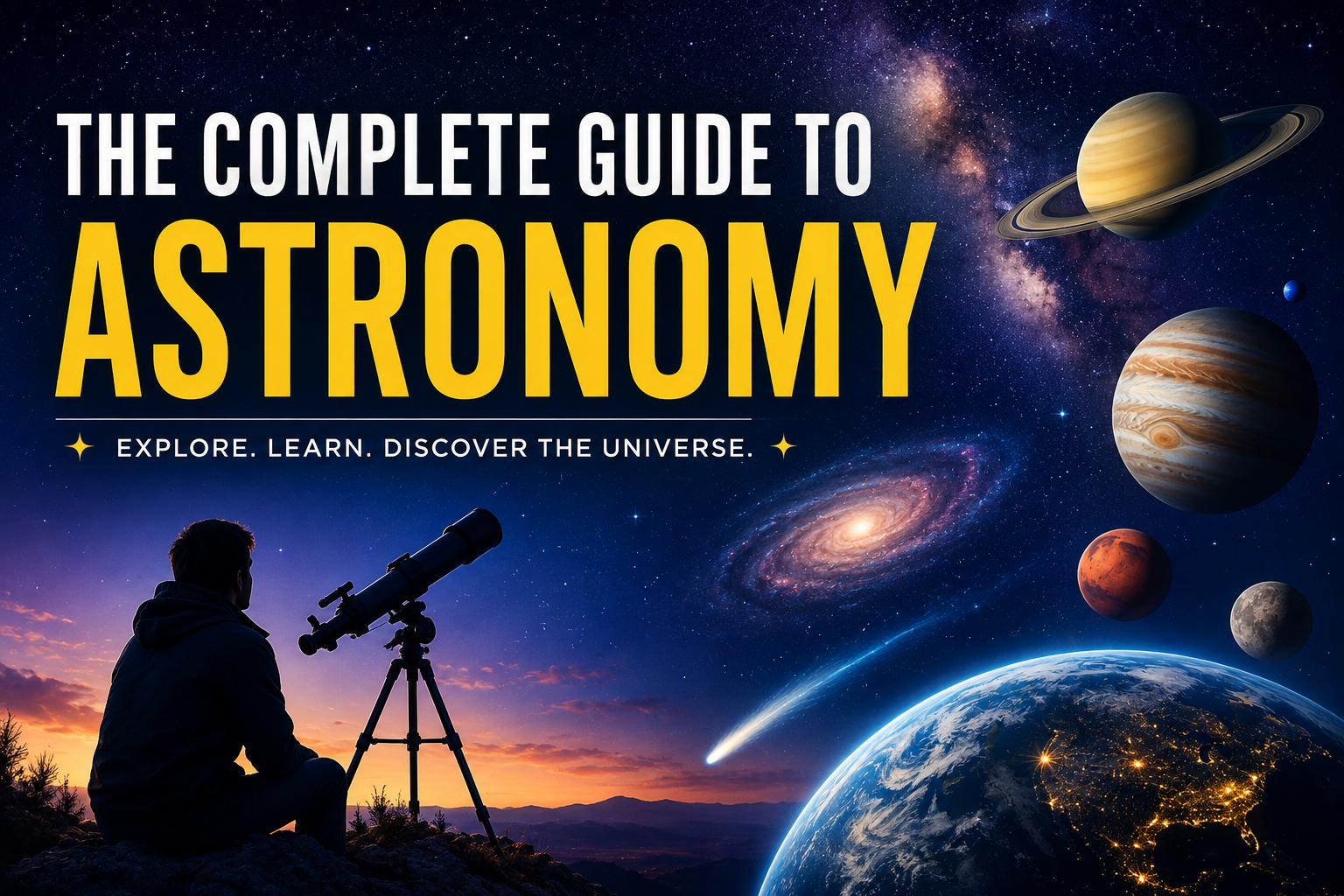
The Complete Guide to Astronomy
For thousands of years, humanity has looked toward the night sky with curiosity and wonder. Ancient civilizations used the stars to navigate oceans, track seasons, and develop calendars, while modern astronomers use powerful telescopes and advanced technology to study distant galaxies, black holes, exoplanets, and the origins of the universe itself.
Astronomy is one of the oldest sciences and continues to be one of the fastest-evolving fields of research. Every new discovery helps answer fundamental questions about our place in the cosmos while inspiring future generations to explore the universe.
This guide explains what astronomy is, its major branches, the objects it studies, modern observational tools, recent discoveries, and the exciting future of space science.
What Is Astronomy?
Astronomy is the scientific study of celestial objects, space, and the universe beyond Earth’s atmosphere.
Astronomers study:
- Stars
- Planets
- Moons
- Asteroids
- Comets
- Galaxies
- Nebulas
- Black holes
- Exoplanets
- The universe itself
Unlike astrology, which is a belief system, astronomy is a science based on observation, mathematics, and physics.
Why Astronomy Matters
Astronomy has transformed our understanding of the universe and driven countless technological advances.
Studying astronomy helps scientists:
- Understand the origins of the universe
- Explore planetary systems
- Discover potentially habitable worlds
- Improve space exploration
- Advance physics
- Predict celestial events
- Develop new technologies
- Inspire scientific curiosity
Many technologies used in everyday life, including satellite communications and GPS systems, have benefited from advances in space science.
Major Branches of Astronomy
Astronomy includes several specialized fields of study.
Planetary Astronomy
Planetary astronomers study planets, moons, dwarf planets, asteroids, and comets throughout the Solar System and beyond.
Stellar Astronomy
This branch focuses on stars, including how they form, evolve, and eventually die.
Galactic Astronomy
Galactic astronomy examines the structure, evolution, and behavior of galaxies such as the Milky Way.
Cosmology
Cosmology studies the origin, evolution, structure, and future of the universe as a whole.
Exoplanet Science
Astronomers search for and study planets orbiting stars outside our Solar System.
Radio Astronomy
Using radio telescopes, scientists observe celestial objects that emit radio waves, revealing phenomena invisible to optical telescopes.
The Solar System
Our Solar System consists of the Sun and everything held in its gravitational pull.
Major components include:
- The Sun
- Eight planets
- Dwarf planets
- Moons
- Asteroids
- Comets
- Meteoroids
- The Kuiper Belt
- The Oort Cloud
Each object offers valuable insights into the formation and evolution of planetary systems.
Stars
Stars are massive spheres of hot gas that produce energy through nuclear fusion.
Throughout their lifetimes, stars experience several stages:
- Stellar formation
- Main sequence
- Red giant or supergiant
- White dwarf, neutron star, or black hole
The Sun is the nearest star to Earth and the primary source of light and energy for our planet.
Galaxies
Galaxies are enormous collections of stars, gas, dust, dark matter, and planetary systems bound together by gravity.
Common galaxy types include:
- Spiral galaxies
- Elliptical galaxies
- Irregular galaxies
- Lenticular galaxies
The Milky Way, our home galaxy, contains hundreds of billions of stars.
Black Holes
Black holes are regions of space where gravity is so strong that nothing, not even light, can escape once it crosses the event horizon.
Scientists classify black holes into several types:
- Stellar black holes
- Intermediate-mass black holes
- Supermassive black holes
Nearly every large galaxy is believed to contain a supermassive black hole at its center.
Exoplanets
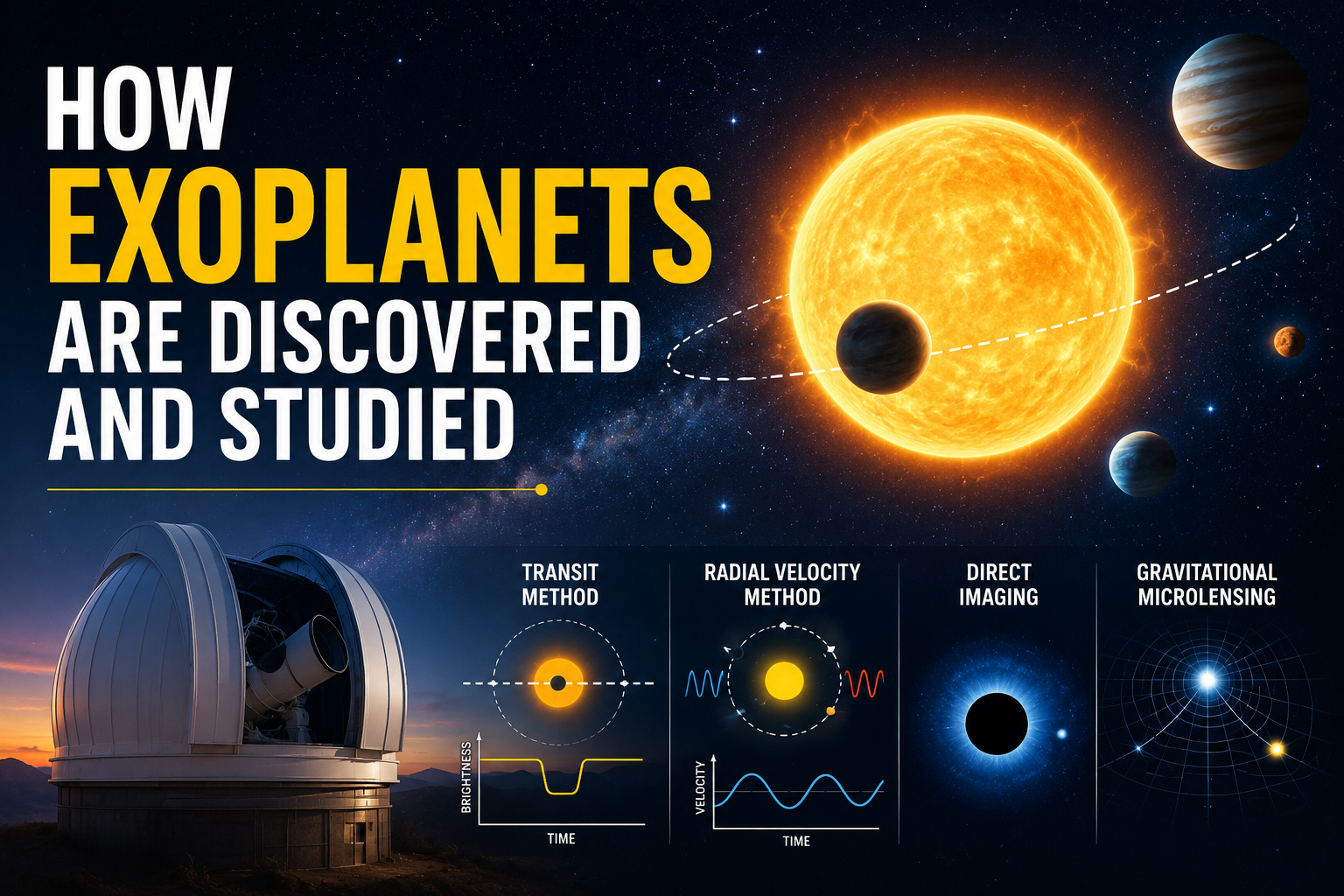
Exoplanets are planets that orbit stars outside our Solar System.
Thousands have already been discovered, ranging from rocky Earth-sized planets to massive gas giants.
Astronomers study exoplanets to better understand:
- Planet formation
- Atmospheric composition
- Habitability
- The potential for life elsewhere in the universe
Telescopes: Windows to the Universe
Modern astronomy depends on sophisticated telescopes that observe different types of light.
Major telescope types include:
- Optical telescopes
- Radio telescopes
- Infrared telescopes
- Ultraviolet telescopes
- X-ray telescopes
- Space telescopes
Each reveals different information about celestial objects.
Space Observatories
Observatories located above Earth’s atmosphere provide clearer views of the universe.
Space-based telescopes help scientists study:
- Distant galaxies
- Exoplanets
- Star formation
- Black holes
- Dark matter
- Cosmic evolution
Their observations have significantly expanded humanity’s understanding of the cosmos.
Major Discoveries in Astronomy
Astronomy has produced many groundbreaking discoveries.
Notable achievements include:
- Confirmation that Earth orbits the Sun
- Discovery of galaxies beyond the Milky Way
- Detection of exoplanets
- Observation of gravitational waves
- Imaging of black holes
- Discovery of cosmic microwave background radiation
- Evidence supporting the expanding universe
- Detection of thousands of potentially habitable planetary systems
Each discovery has helped reshape our understanding of the universe.
Challenges Facing Astronomers
Despite remarkable progress, astronomy still faces important challenges.
Scientists continue investigating:
- Dark matter
- Dark energy
- Black hole formation
- Planetary habitability
- Origins of life
- Galaxy evolution
- Cosmic inflation
- The ultimate fate of the universe
Many of these questions remain among the greatest mysteries in science.
Astronomy and Space Exploration
Astronomy and space exploration often work together.
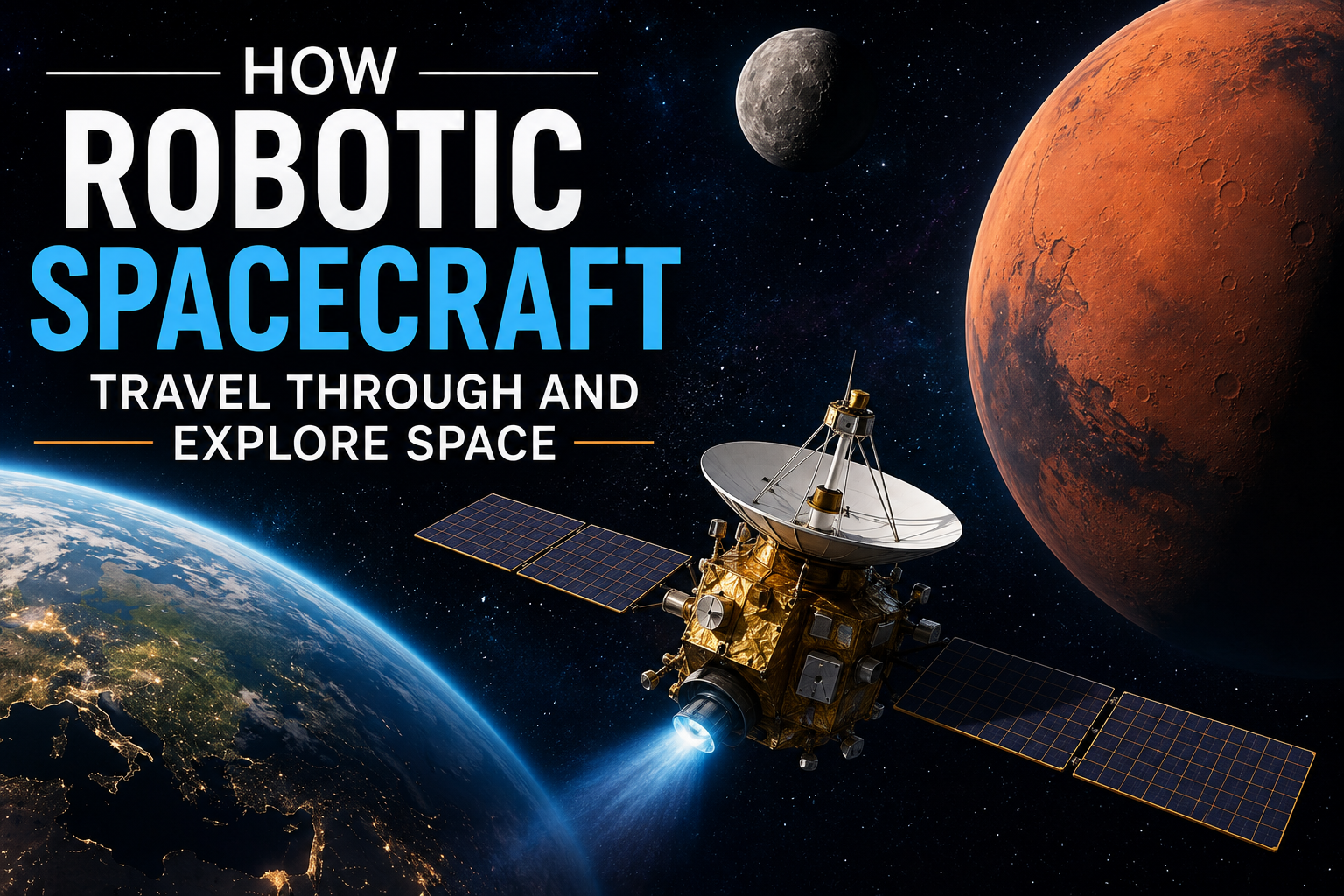
Space missions provide valuable information through:
- Planetary probes
- Orbiting telescopes
- Lunar missions
- Mars rovers
- Sample-return missions
- Deep-space spacecraft
These missions allow scientists to directly study environments that cannot be fully understood from Earth alone.
How to Get Started with Astronomy
Astronomy is accessible to people of all ages.
Beginners can explore the night sky by:
- Learning major constellations
- Observing the Moon
- Watching meteor showers
- Using binoculars
- Visiting local observatories
- Joining astronomy clubs
- Using astronomy apps
- Purchasing an entry-level telescope
Even without expensive equipment, many fascinating celestial objects are visible to the naked eye.
Common Astronomy Myths
Several misconceptions surround astronomy.
Myth: The North Star Is the Brightest Star
Polaris is useful for navigation but is not the brightest star visible from Earth.
Myth: Meteors Are Falling Stars
Meteors are small pieces of space debris burning up in Earth’s atmosphere, not actual stars.
Myth: The Dark Side of the Moon Never Receives Sunlight
Every part of the Moon experiences sunlight. The phrase “dark side” refers to the far side, which is not permanently dark.
Myth: Astronomy and Astrology Are the Same
Astronomy is a scientific discipline based on observation and evidence, while astrology is not considered a scientific field.
The Future of Astronomy
New technologies continue expanding our ability to explore the universe.
Emerging areas of research include:
- Next-generation space telescopes
- Artificial intelligence in astronomy
- Advanced radio observatories
- Planetary defense systems
- Exoplanet atmosphere analysis
- Lunar observatories
- Gravitational wave astronomy
- Deep-space exploration
Future discoveries may provide new insights into the origins of the universe and the possibility of life beyond Earth.
Final Thoughts
Astronomy offers one of humanity’s greatest opportunities to understand the universe and our place within it. By studying stars, planets, galaxies, and the fundamental laws of physics, astronomers continue uncovering remarkable discoveries that expand scientific knowledge and inspire exploration.
Whether observing the night sky with the naked eye or analyzing data from powerful space telescopes, astronomy reminds us that the universe is vast, dynamic, and filled with mysteries waiting to be explored. As technology advances and new missions venture deeper into space, the coming decades promise to reveal even more about the extraordinary cosmos we call home.


2 Comments
Micle harison
June 7, 2019Lorem ipsum dolor sit amet, usu ut perfecto postulant deterruisset, libris causae volutpat at est, ius id modus laoreet urbanitas. Mel ei delenit dolores.
John Doe
June 7, 2019Some consultants are employed indirectly by the client via a consultancy staffing company.