
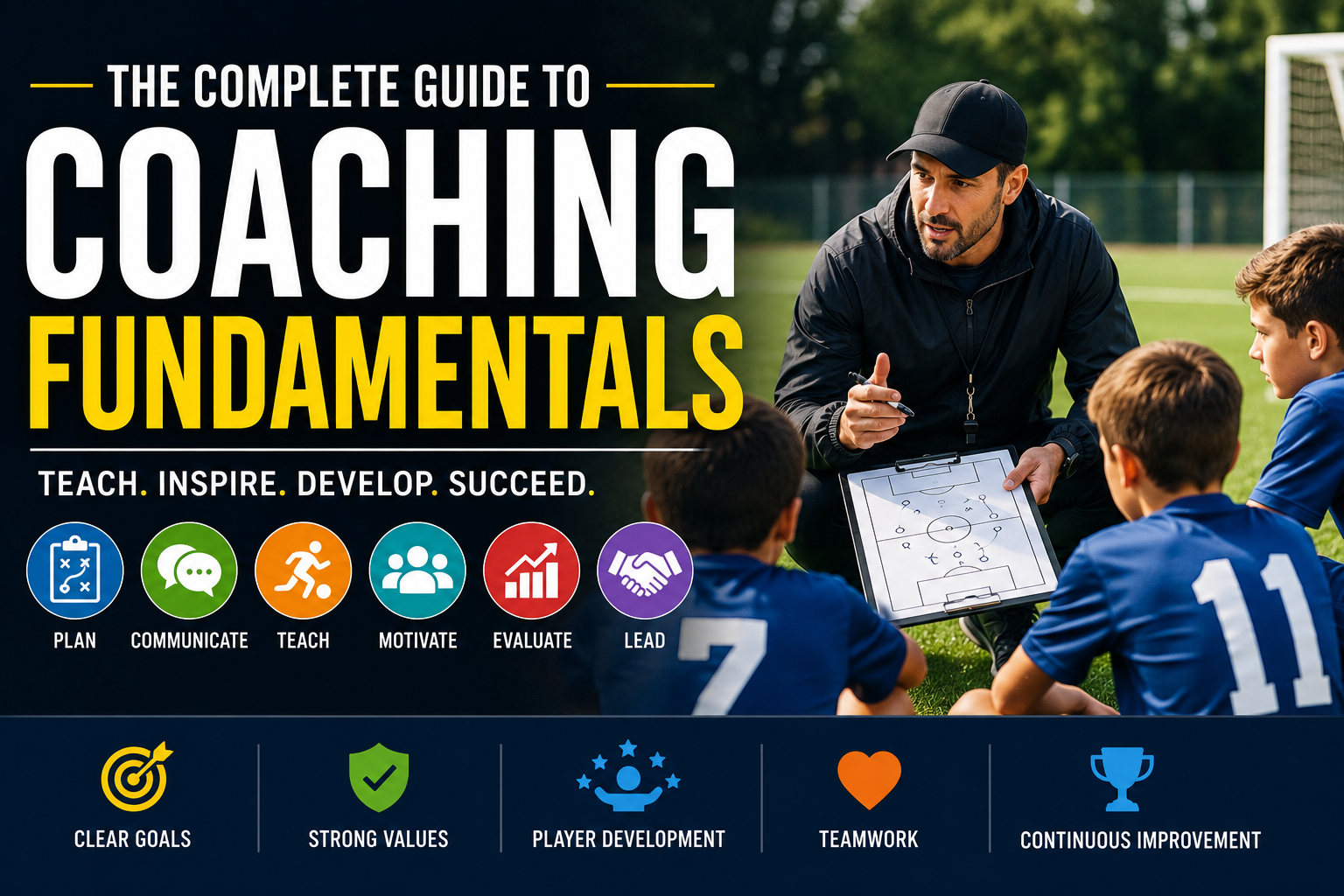
The Complete Guide to Coaching Fundamentals
Coaching is about far more than teaching athletes how to perform a skill. Effective coaches help people develop confidence, discipline, decision-making ability, teamwork, and a lasting appreciation for sport.
Whether you are coaching children for the first time, leading a school team, or developing athletes at a more competitive level, understanding the fundamentals of coaching provides a strong foundation. The best coaching approach combines technical knowledge with communication, preparation, leadership, and an understanding of the people behind the athletes.
What Are Coaching Fundamentals?
Coaching fundamentals are the core principles and practices that help a coach guide athletes effectively.
They include areas such as:
- Planning and organization
- Communication
- Skill development
- Tactical understanding
- Motivation
- Leadership
- Team building
- Performance evaluation
- Safety and injury prevention
- Athlete development
The specific techniques vary between sports, but these principles apply across almost every coaching environment.
Understanding Your Role as a Coach
A coach can have several responsibilities at once.
You may be a teacher during a technical session, a strategist during competition, a motivator when athletes are struggling, and a mentor when players need guidance away from the field.
Understanding this broader role helps coaches avoid focusing exclusively on winning.
A successful coach should aim to develop athletes who are more capable, confident, knowledgeable, and independent over time.
Build Strong Coach-Athlete Relationships
Trust is one of the foundations of effective coaching.
Athletes are more likely to respond positively to instruction when they believe their coach understands their goals and genuinely cares about their development.
Building trust does not mean lowering standards. Coaches can maintain high expectations while treating athletes with respect.
Good relationships are built through:
- Consistent communication
- Fair treatment
- Active listening
- Constructive feedback
- Clear expectations
- Reliability
- Respect for individual differences
A coach should also understand that athletes have different personalities, learning styles, motivations, and levels of experience.
Communicate Clearly and Consistently
Even excellent technical knowledge can become ineffective when communication is unclear.
Instructions should be specific and appropriate for the athlete’s level of understanding.
Instead of giving several instructions at once, focus on the most important correction first. Demonstrations, visual examples, questions, and short explanations can make technical concepts easier to understand.
Communication should also work in both directions.
Ask athletes questions such as:
- What did you see during that play?
- What do you think you could have done differently?
- What felt difficult during that drill?
- What worked well for you?
These questions encourage athletes to think rather than simply follow instructions.
Create Effective Training Sessions
A well-organized training session gives athletes a clear purpose.
Before practice begins, determine what you want athletes to learn or improve.
A basic session might include:
- Preparation and warm-up
- Technical or skill development
- Progressive drills
- Game-related activities
- Conditioning when appropriate
- Cool-down and recovery
- Brief review and feedback
The exact structure should depend on the sport, athlete age, training level, and objectives.
Avoid filling a session with drills simply because they are familiar. Every activity should have a reason for being included.
Teach Skills Progressively
Athletes generally learn more effectively when skills are introduced progressively.
Start with a manageable version of the skill, establish the basic movement or technique, and gradually increase complexity.
For example, a coach might progress from:
Basic movement → controlled practice → movement under pressure → decision-making → game application
This approach allows athletes to build confidence before dealing with more demanding situations.
Repetition is important, but repetition without purpose can become unproductive. Coaches should look for opportunities to make practice increasingly realistic.
Use Game-Based Learning
Athletes ultimately need to apply their skills in competitive situations.
For that reason, training should not consist entirely of isolated technical exercises.
Game-based activities can help athletes develop:
- Decision-making
- Spatial awareness
- Communication
- Tactical understanding
- Adaptability
- Reaction speed
- Teamwork
Small-sided games and controlled scenarios can be particularly useful because they give athletes repeated opportunities to make decisions while maintaining a manageable training environment.
Teach Decision-Making
One of the most important coaching responsibilities is helping athletes understand why they should make a particular decision.
Knowing how to perform a skill is different from knowing when to use it.
Rather than constantly telling athletes what to do, coaches can create situations that require players to evaluate options themselves.
For example, after a drill, ask an athlete why they chose a particular pass, movement, shot, or defensive action.
This encourages tactical awareness and helps athletes become better problem-solvers.
Set Clear Expectations
Athletes should understand what is expected of them.
Expectations can cover areas such as:
- Attendance
- Punctuality
- Effort
- Respect
- Team behavior
- Communication
- Equipment
- Competition conduct
Rules should be applied consistently.
When athletes understand expectations and consequences in advance, coaches can spend less time dealing with avoidable misunderstandings and more time developing the team.
Motivate Different Types of Athletes
Not every athlete is motivated by the same things.
Some athletes enjoy competition. Others are motivated by personal improvement, recognition, teamwork, or mastering new skills.
Effective coaches learn what motivates individual athletes while maintaining shared team standards.
Praise should also be meaningful.
Instead of saying only “good job,” identify what was done well:
“Your positioning was much better that time because you anticipated the play.”
Specific feedback helps athletes understand which behaviors they should repeat.
Give Constructive Feedback
Feedback should help athletes understand both what they did well and what they can improve.
A useful feedback process is:
Observe → Identify → Explain → Practice → Reassess
For example, if an athlete is struggling with a particular technique, identify the specific issue rather than criticizing the entire performance.
Feedback should focus on behaviors and decisions that athletes can control.
Avoid humiliating athletes or using mistakes as an opportunity to embarrass them. Mistakes are a natural part of learning and competition.
Develop Teamwork and Leadership
A team is more than a collection of individual athletes.
Coaches should create opportunities for athletes to communicate, support each other, solve problems, and take responsibility.
Leadership can also be developed rather than simply assigned to the most talented player.
Athletes can take responsibility for warm-ups, communication exercises, equipment, team discussions, or specific leadership roles.
These experiences can build confidence and help create a stronger team culture.
Understand Individual Athlete Development
Athletes do not develop at identical rates.
Age, experience, physical development, confidence, motivation, and previous training can all influence performance.
A coach should avoid assuming that every athlete needs the same workload or the same type of instruction.
Individual development does not necessarily mean creating completely separate programs for everyone. It means recognizing important differences and adjusting coaching when necessary.
Prioritize Safety and Well-Being
Performance should never come at the expense of athlete safety.
Coaches should understand the basic safety requirements of their sport and follow appropriate rules, procedures, and medical guidance.
Important areas include:
- Appropriate warm-ups
- Safe training environments
- Proper equipment
- Hydration
- Recovery
- Recognition of concerning symptoms
- Appropriate progression of training loads
- Emergency procedures
Coaches should also understand the limits of their expertise and involve qualified medical or other professionals when appropriate.
Learn How to Evaluate Performance
Evaluation helps coaches determine whether training is actually producing improvement.
Performance can be assessed through:
- Technical execution
- Tactical decisions
- Physical performance
- Communication
- Consistency
- Competitive behavior
- Training habits
Not every evaluation needs to involve statistics.
Observation and conversations with athletes can provide valuable information, particularly when combined with objective performance measures where appropriate.
Prepare for Competition
Good competition preparation begins well before the event.
Coaches should establish clear objectives and ensure athletes understand their responsibilities.
Preparation may include:
- Reviewing tactics
- Practicing specific scenarios
- Discussing opponents when appropriate
- Establishing routines
- Preparing equipment
- Managing logistics
- Planning substitutions or rotations
- Discussing competition expectations
The objective is not to predict everything that will happen. Instead, athletes should be prepared to adapt when circumstances change.
Manage Emotions During Competition
Coaches influence the emotional environment of a team.
A coach who constantly reacts with frustration can increase pressure on athletes. A coach who remains composed can help players focus on solving problems.
When something goes wrong, ask:
What happened? Why did it happen? What can we do next?
This approach shifts attention away from blame and toward action.
Keep Improving as a Coach
Coaching is a continuous learning process.
Even experienced coaches can improve by reviewing their sessions, studying their sport, observing other coaches, attending education programs, and seeking feedback.
After each training session or competition, consider asking:
- What worked?
- What did not work?
- Did athletes understand the objective?
- Did everyone receive meaningful opportunities to develop?
- Was the session appropriately challenging?
- What should change next time?
Regular reflection can turn everyday coaching experiences into long-term professional development.
Common Coaching Mistakes to Avoid
Even well-intentioned coaches can fall into habits that limit athlete development.
Common mistakes include:
Talking Too Much
Long explanations can reduce active practice time and make instructions harder to remember.
Focusing Only on Winning
Results matter in competitive sport, but making winning the only measure of success can undermine long-term development.
Using the Same Approach With Everyone
Different athletes may need different explanations, challenges, and forms of feedback.
Ignoring Athlete Input
Athletes can provide valuable information about what they are experiencing during training and competition.
Overtraining
More training is not automatically better. Recovery and appropriate workload management are important parts of development.
Correcting Every Mistake
Constant criticism can make athletes hesitant to experiment and learn.
Failing to Plan
Unstructured sessions can waste valuable training time and make it difficult to measure progress.
Building a Positive Coaching Culture
A strong coaching culture is created through consistent behaviors rather than motivational speeches alone.
Coaches can establish a positive environment by rewarding effort, encouraging accountability, treating athletes fairly, and making expectations clear.
The goal is to create a setting where athletes can work hard without being afraid of making mistakes.
When athletes feel respected and challenged, they are more likely to remain engaged and take ownership of their development.
The Fundamentals That Make Coaching Effective
Great coaching combines knowledge of the sport with an understanding of people.
The strongest coaches teach skills, develop decision-makers, communicate clearly, create structured training environments, protect athlete well-being, and continually evaluate their own approach.
Winning can be an important objective, particularly in competitive sport, but sustainable success comes from developing athletes and teams capable of learning, adapting, and performing under pressure.
A coach who consistently focuses on clear instruction, purposeful practice, meaningful feedback, strong relationships, and continuous improvement creates a foundation that can benefit athletes both in competition and beyond it.




2 Comments
Micle harison
June 7, 2019Lorem ipsum dolor sit amet, usu ut perfecto postulant deterruisset, libris causae volutpat at est, ius id modus laoreet urbanitas. Mel ei delenit dolores.
John Doe
June 7, 2019Some consultants are employed indirectly by the client via a consultancy staffing company.