
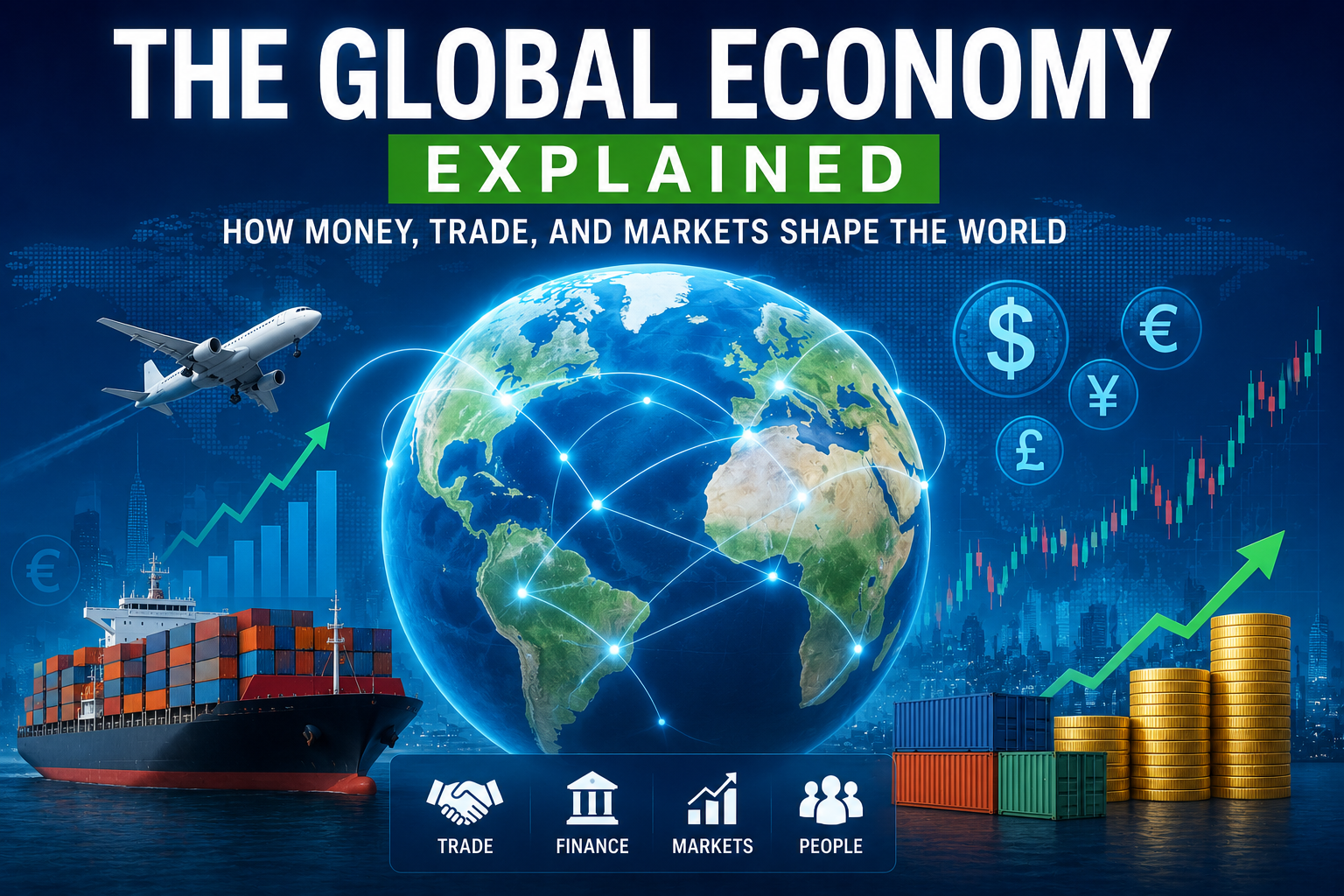
The Global Economy Explained: How Money, Trade, and Markets Shape the World
Every day, billions of people buy groceries, use smartphones, invest money, travel, and work for businesses that depend on a vast network of global trade and finance. Behind these everyday activities lies the global economy—a complex system connecting countries, businesses, financial institutions, and consumers. While the global economy can seem complicated, its basic principles affect nearly every aspect of modern life, from the prices people pay for everyday goods to the availability of jobs and economic opportunities.
Understanding how the global economy works helps explain why events in one country can influence markets on the other side of the world. This guide explores the fundamentals of the global economy, how money and trade flow across borders, the role of financial markets, and the challenges and opportunities shaping the future.
What Is the Global Economy?
The global economy refers to the interconnected system of economic activities that takes place across countries and regions.
It includes:
- International trade
- Financial markets
- Banking systems
- Investments
- Manufacturing
- Services
- Labor markets
- Technology
- Transportation
Rather than functioning as separate national economies, today’s world is increasingly connected through commerce, digital technology, and global supply chains.
Why the Global Economy Matters
The global economy affects nearly every person, even if they never travel internationally.
It influences:
- Employment opportunities
- Prices of everyday goods
- Fuel costs
- Food availability
- Interest rates
- Exchange rates
- Investments
- Inflation
- Business growth
- Government budgets
A drought in one country, a shipping disruption, or changes in international energy prices can quickly affect consumers around the world.
The Building Blocks of the Global Economy
Consumers
Consumers purchase goods and services, creating demand that drives economic activity.
Examples include buying:
- Food
- Clothing
- Electronics
- Housing
- Transportation
- Entertainment
Consumer spending represents one of the largest contributors to economic growth in many countries.
Businesses
Companies produce products and services to meet consumer demand.
Businesses:
- Hire workers
- Invest in equipment
- Develop technology
- Expand into new markets
- Compete globally
Businesses range from small local shops to multinational corporations operating in dozens of countries.
Governments
Governments influence economies through:
- Taxes
- Public spending
- Infrastructure
- Regulations
- Education
- Healthcare
- Trade agreements
Fiscal policies help shape economic growth and stability.
Financial Institutions
Banks and financial institutions provide:
- Savings accounts
- Loans
- Mortgages
- Business financing
- Payment systems
- Investment services
These institutions help money move efficiently throughout the economy.
How Money Moves Around the World
Money constantly flows between:
- Consumers
- Businesses
- Banks
- Governments
- Investors
- International organizations
For example:
- Consumers purchase products.
- Businesses earn revenue.
- Companies pay employees.
- Workers spend income.
- Banks lend money.
- Governments collect taxes.
- Investors fund new businesses.
This continuous cycle supports economic growth.
International Trade Explained
Trade allows countries to exchange goods and services that they cannot efficiently produce themselves.
Countries export products they specialize in while importing products produced elsewhere.
Common exports include:
- Electronics
- Cars
- Oil
- Food
- Pharmaceuticals
- Machinery
- Software
- Financial services
International trade allows consumers to access a wider variety of products at competitive prices.
Imports vs Exports
| Imports | Exports |
|---|---|
| Goods purchased from other countries | Goods sold to other countries |
| Increase consumer choice | Generate income for businesses |
| May lower prices | Support jobs and economic growth |
| Can create trade deficits | Can improve national income |
What Is Gross Domestic Product (GDP)?
Gross Domestic Product (GDP) measures the total value of goods and services produced within a country over a specific period.
GDP is one of the most widely used indicators of economic performance.
When GDP grows, economies generally produce more goods and services.
When GDP contracts, economic activity slows.
However, GDP alone does not measure quality of life or income distribution.
Inflation Explained
Inflation refers to the general increase in prices over time.
Examples include rising costs for:
- Housing
- Groceries
- Fuel
- Healthcare
- Transportation
Moderate inflation is considered normal in many economies, but persistently high inflation can reduce purchasing power and increase living costs.
Interest Rates and Central Banks
Central banks influence economic activity by adjusting interest rates.
Higher interest rates generally:
- Reduce borrowing
- Encourage saving
- Slow inflation
Lower interest rates often:
- Encourage spending
- Support investment
- Stimulate economic growth
Central bank decisions affect mortgages, business loans, savings accounts, and consumer borrowing.
Exchange Rates
Currencies constantly fluctuate in value relative to one another.
Exchange rates affect:
- International travel
- Imports
- Exports
- Tourism
- Global investments
For example, when one country’s currency strengthens, imported goods may become cheaper while exports become more expensive for foreign buyers.
Financial Markets Explained
Financial markets help connect investors with businesses seeking capital.
Major financial markets include:
Stock Markets
Companies sell shares to raise money.
Investors purchase these shares hoping their value increases over time.
Bond Markets
Governments and businesses borrow money from investors through bonds.
Bondholders receive interest payments until maturity.
Currency Markets
Foreign exchange (Forex) markets allow currencies to be traded continuously around the world.
Commodity Markets
Commodities include:
- Oil
- Gold
- Wheat
- Coffee
- Natural gas
- Copper
Commodity prices influence global inflation and industrial production.
Global Supply Chains
Modern products often involve manufacturing across multiple countries.
For example, a smartphone may involve:
- Minerals from Africa
- Chips from Taiwan
- Displays from South Korea
- Design in the United States
- Assembly in Vietnam or China
- Sales worldwide
These interconnected supply chains improve efficiency but can also create vulnerabilities during disruptions.
What Causes Economic Growth?
Economic growth is driven by several factors.
Innovation
New technologies improve productivity and create new industries.
Education
A skilled workforce supports innovation and business development.
Investment
Businesses invest in equipment, research, and expansion.
Infrastructure
Roads, ports, airports, and digital networks improve trade efficiency.
International Trade
Trade allows countries to specialize and expand economic opportunities.
Challenges Facing the Global Economy
Inflation
Persistent inflation reduces purchasing power and increases business costs.
Supply Chain Disruptions
Natural disasters, conflicts, pandemics, or transportation bottlenecks can delay production and increase prices.
Geopolitical Tensions
Political disputes may affect:
- Trade
- Investment
- Energy markets
- Commodity prices
Climate Change
Extreme weather affects agriculture, infrastructure, insurance, and energy production.
Public Debt
Many governments carry significant debt, creating long-term fiscal challenges.
Technological Disruption
Automation and artificial intelligence are reshaping labor markets while creating new economic opportunities.
Globalization: Benefits and Challenges
Globalization refers to increasing international economic integration.
Benefits
- Greater product availability
- Lower manufacturing costs
- Faster innovation
- International investment
- Job creation in many sectors
Challenges
- Supply chain dependence
- Increased competition
- Job displacement in some industries
- Economic inequality
- Environmental concerns
The Digital Economy
Technology has transformed the global economy.
Today’s digital economy includes:
- Online shopping
- Cloud computing
- Artificial intelligence
- Digital banking
- Mobile payments
- Streaming services
- Cryptocurrency technologies
- Remote work
Digital services continue becoming a larger share of global economic activity.
The Future of the Global Economy
Several long-term trends are expected to shape future economic growth.
These include:
- Artificial intelligence
- Green energy investments
- Automation
- Aging populations
- Digital currencies
- Climate adaptation
- Biotechnology
- Space economy
- Advanced manufacturing
Countries that successfully adapt to these trends may gain competitive advantages in future global markets.
Common Myths About the Global Economy
| Myth | Reality |
|---|---|
| One country controls the global economy. | The global economy depends on the combined activity of many countries and institutions. |
| Economic growth always benefits everyone equally. | Growth can vary across regions, industries, and income groups. |
| Trade only benefits wealthy countries. | International trade can create opportunities for economies at different stages of development. |
| Stock markets represent the entire economy. | Financial markets are important but do not capture all aspects of economic activity. |
| Inflation is always harmful. | Moderate inflation is common; very high or unpredictable inflation poses greater economic challenges. |
Frequently Asked Questions
What is the global economy?
The global economy is the interconnected network of trade, finance, production, investment, and consumption linking countries around the world.
Why is international trade important?
Trade allows countries to specialize, access goods they cannot efficiently produce, and expand economic opportunities.
What causes inflation?
Inflation can result from increased demand, higher production costs, supply shortages, or changes in monetary policy.
Why do exchange rates change?
Exchange rates fluctuate due to differences in economic conditions, interest rates, inflation, trade flows, and investor confidence.
How do stock markets affect the economy?
Stock markets help businesses raise capital, influence investment decisions, and reflect expectations about future economic performance, although they are only one part of the broader economy.
Can one event affect the entire global economy?
Yes. Major financial crises, pandemics, wars, or significant disruptions to energy or supply chains can have widespread international economic effects because modern economies are highly interconnected.
Conclusion
The global economy is an intricate system connecting billions of people, businesses, governments, and financial institutions through trade, investment, and innovation. From the products we purchase and the jobs we hold to the prices we pay and the technologies we use, global economic forces shape everyday life in ways that are often invisible yet profoundly important.
While challenges such as inflation, geopolitical tensions, climate change, and technological disruption continue to reshape markets, the global economy also drives innovation, international cooperation, and rising living standards. By understanding how money, trade, and markets work together, individuals can make more informed financial decisions and better appreciate the economic forces influencing the world around them.



2 Comments
Micle harison
June 7, 2019Lorem ipsum dolor sit amet, usu ut perfecto postulant deterruisset, libris causae volutpat at est, ius id modus laoreet urbanitas. Mel ei delenit dolores.
John Doe
June 7, 2019Some consultants are employed indirectly by the client via a consultancy staffing company.