
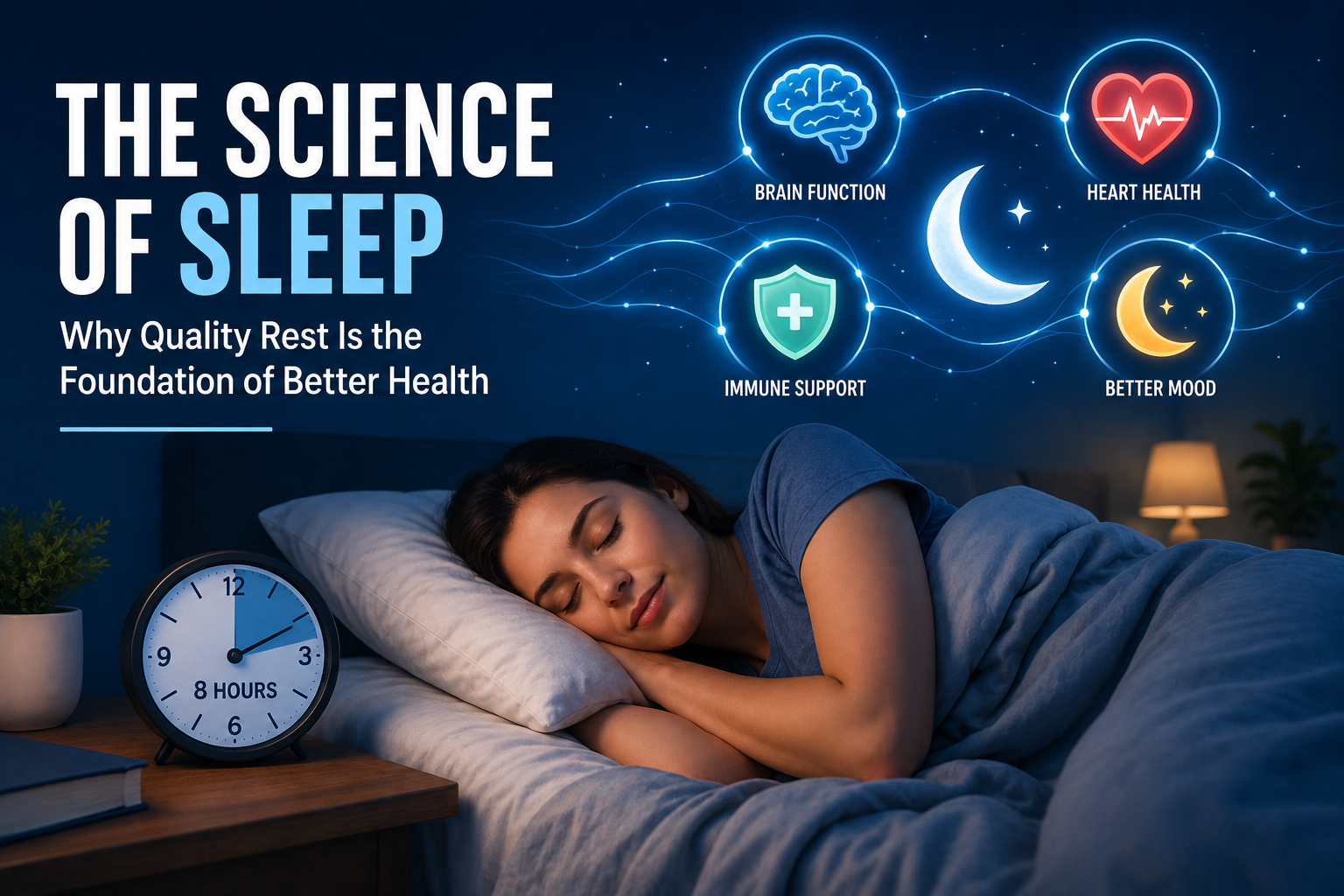
The Science of Sleep: Why Your Brain and Body Need Rest More Than You Think
You can survive for weeks without gourmet meals. You can go days without social media. But skip just one night of quality sleep, and your brain will notice before you do.
Sleep is one of the few biological needs every human shares, yet it is also one of the most misunderstood. In today’s always-connected world, getting by on four or five hours of sleep is often celebrated as a sign of ambition or productivity. Successful entrepreneurs boast about sleeping less. Students pull all-night study sessions. Professionals answer emails well past midnight.
But science tells a very different story.
Far from being “downtime,” sleep is one of the busiest periods your body experiences. While you’re unconscious, your brain reorganizes memories, your immune system strengthens its defenses, your muscles repair microscopic damage, hormones regulate everything from hunger to growth, and your body prepares itself for another day. :contentReference[oaicite:0]{index=0}
Researchers now consider sleep to be just as important as healthy eating and regular exercise. In fact, consistent sleep deprivation has been linked to heart disease, diabetes, obesity, depression, anxiety, weakened immunity, impaired memory, and reduced life expectancy.
So why do we sleep? What exactly happens inside the brain while we’re asleep? And how much rest do we actually need?
Let’s explore the fascinating science behind one of the most essential—and underestimated—parts of human life.
What Is Sleep?
Sleep is a naturally recurring state during which consciousness changes, muscle activity decreases, and the brain follows a series of highly organized cycles.
Although people often think sleep is simply “turning off,” the opposite is true.
Many parts of the brain become incredibly active during sleep.
Scientists describe sleep as a biological maintenance period during which the body performs essential repair and restoration that cannot occur efficiently while we’re awake.
Without adequate sleep, these processes begin to break down.
Why Do Humans Need Sleep?
Despite decades of research, scientists still debate the exact evolutionary reason humans sleep.
However, they agree on one important point:
Sleep is essential for survival.
Every major system in the body depends on it.
Sleep helps:
- Restore energy
- Consolidate memories
- Strengthen the immune system
- Regulate hormones
- Repair tissues
- Support emotional well-being
- Maintain brain function
Missing sleep affects nearly every organ.
That is why chronic sleep deprivation produces such widespread health problems.
The Four Stages of Sleep
Sleep is not one continuous state.
Instead, it occurs in repeating cycles lasting approximately 90 minutes.
Each cycle contains several stages.
Stage 1: Falling Asleep
This is the transition between wakefulness and sleep.
It usually lasts only a few minutes.
During this stage:
- Heart rate slows
- Muscles relax
- Eye movements become slower
- Brain activity begins changing
Many people experience sudden muscle jerks known as hypnic jerks.
These are completely normal.
Stage 2: Light Sleep
Most of the night is spent in Stage 2.
During this period:
- Body temperature decreases
- Heart rate slows further
- Brain activity changes dramatically
The brain produces unique electrical patterns called sleep spindles, which researchers believe help process memories and learning.
Stage 3: Deep Sleep
Often called slow-wave sleep, this is the body’s primary recovery phase.
Deep sleep is when:
- Muscles repair themselves
- Growth hormone is released
- Immune function strengthens
- Energy stores are replenished
This stage is especially important after physical exercise.
Children spend more time in deep sleep because growth and development depend heavily on it.
REM Sleep
REM stands for Rapid Eye Movement.
This is the stage most closely associated with dreaming.
During REM sleep:
- Brain activity becomes highly active
- Eyes move rapidly beneath closed eyelids
- Most muscles become temporarily inactive
- Dreams become vivid
Researchers believe REM sleep plays a major role in:
- Learning
- Creativity
- Emotional regulation
- Memory consolidation
A healthy night’s sleep cycles through these stages multiple times.
What Happens Inside Your Brain While You Sleep?
One of the most surprising discoveries in neuroscience is that the brain remains remarkably active during sleep.
Instead of shutting down, it performs essential maintenance.
Memory Processing
Every day, your brain receives enormous amounts of information.
Sleep helps organize that information.
Researchers believe memories move from short-term storage into long-term memory during sleep.
This explains why students who sleep after studying often remember information better than those who stay awake all night.
Brain Cleaning
In 2012, scientists identified the glymphatic system, sometimes described as the brain’s cleaning system.
While you sleep, this system removes waste products that accumulate throughout the day.
Some researchers believe poor sleep may reduce this natural cleaning process, which has prompted studies exploring possible links with neurodegenerative diseases.
Although research is ongoing, the findings highlight just how important sleep is for long-term brain health.
Emotional Processing
Sleep also helps regulate emotions.
People who consistently sleep well generally cope better with stress and decision-making.
Sleep deprivation, on the other hand, can increase:
- Irritability
- Anxiety
- Emotional reactivity
- Poor judgment
Why Sleep Is Critical for Physical Health
The benefits of sleep extend far beyond the brain.
Stronger Immune System
During sleep, the immune system produces proteins called cytokines that help fight infection and inflammation.
People who regularly sleep less than recommended often become more susceptible to illnesses like colds and flu.
Vaccines may also be more effective in individuals who get sufficient sleep.
Heart Health
Blood pressure naturally decreases during healthy sleep.
Poor sleep has been associated with increased risks of:
- High blood pressure
- Heart disease
- Stroke
Sleep allows the cardiovascular system to recover from daily stress.
Muscle Recovery
Exercise creates tiny tears in muscle fibers.
Repair occurs primarily during sleep.
Growth hormone, released mainly during deep sleep, supports:
- Muscle repair
- Tissue growth
- Bone health
This is one reason athletes place enormous emphasis on sleep as part of their training.
Weight Management
Sleep influences hormones that control hunger.
Two important hormones are:
Ghrelin
Stimulates appetite.
Leptin
Signals fullness.
When people don’t get enough sleep:
- Ghrelin increases
- Leptin decreases
The result is greater hunger and stronger cravings—particularly for sugary and high-calorie foods.
This helps explain why chronic sleep deprivation is associated with weight gain.
How Much Sleep Do You Really Need?
Sleep needs vary with age.
| Age Group | Recommended Sleep |
|---|---|
| Newborns | 14–17 hours |
| Infants | 12–16 hours |
| School-age children | 9–12 hours |
| Teenagers | 8–10 hours |
| Adults | 7–9 hours |
| Older adults | 7–8 hours |
Some individuals naturally require slightly more or less, but consistently sleeping below these ranges may increase health risks.
What Happens When You Don’t Sleep Enough?
Missing one night’s sleep can produce noticeable effects.
Long-term sleep deprivation is far more serious.
Common consequences include:
Reduced Concentration
- Attention span declines
- Mistakes become more common
- Reaction times slow
Poor Memory
The brain struggles to store and retrieve information effectively.
Learning becomes harder.
Mood Changes
Sleep deprivation can contribute to:
- Anxiety
- Depression
- Irritability
- Emotional instability
Weakened Immunity
The body becomes less effective at fighting infections.
Increased Accident Risk
Fatigue contributes to workplace accidents and traffic collisions because it reduces alertness and decision-making ability.
Common Sleep Disorders
Not everyone experiences healthy sleep every night.
Some common disorders include:
Insomnia
Difficulty falling asleep or staying asleep.
Sleep Apnea
Repeated interruptions in breathing during sleep.
This condition can significantly reduce sleep quality and should be medically evaluated.
Restless Legs Syndrome
An uncomfortable urge to move the legs, often interfering with sleep.
Narcolepsy
A neurological condition that causes excessive daytime sleepiness and sudden sleep episodes.
Persistent sleep problems should always be discussed with a qualified healthcare professional.
How to Improve Sleep Naturally
Better sleep often begins with better habits.
Here are science-backed strategies that can help.
Maintain a Consistent Schedule
Going to bed and waking up at the same time each day helps regulate your internal body clock.
Reduce Screen Time Before Bed
Phones, tablets, and computers emit blue light, which can suppress melatonin—the hormone that helps regulate sleep.
Limiting screen use before bedtime may make it easier to fall asleep.
Limit Caffeine Late in the Day
Caffeine can remain in the body for several hours.
Avoiding coffee, energy drinks, or strong tea late in the afternoon or evening may improve sleep quality.
Create a Comfortable Sleep Environment
A quiet, dark, and cool bedroom supports better rest.
Comfortable bedding and minimal noise can also make a difference.
Exercise Regularly
Regular physical activity has been linked to improved sleep quality.
However, intense exercise immediately before bedtime may make it harder for some people to fall asleep.
Myths About Sleep
Myth 1: “I Can Catch Up on Sleep on Weekends”
Sleeping in occasionally can help reduce short-term fatigue, but it does not completely reverse the effects of chronic sleep deprivation.
Myth 2: “Older Adults Need Less Sleep”
Older adults often sleep differently, but they still generally require around seven to eight hours per night.
Myth 3: “Alcohol Helps You Sleep Better”
Alcohol may make people feel sleepy, but it often disrupts sleep quality and reduces restorative REM sleep later in the night.
The Future of Sleep Science
Researchers continue to uncover new insights into the role of sleep.
Emerging areas of study include:
- Sleep and Alzheimer’s disease
- Artificial intelligence for diagnosing sleep disorders
- Wearable technology that tracks sleep quality
- Personalized sleep medicine
- The relationship between sleep and mental health
As science advances, one message grows clearer:
Sleep is not a luxury. It is one of the body’s most powerful tools for maintaining health.
Final Thoughts
For generations, sleep was viewed as little more than a necessary pause between productive hours.
Modern science has completely transformed that understanding.
Every night, while we rest, our bodies repair damaged tissues, strengthen immune defenses, organize memories, regulate hormones, and prepare us for the challenges of a new day.
Far from wasting time, sleep is an investment in nearly every aspect of health—from sharper thinking and better emotional resilience to stronger hearts and healthier immune systems.
In a culture that often celebrates constant productivity, perhaps the most productive thing we can do is something remarkably simple:
Get a good night’s sleep.
Because when your brain and body receive the rest they truly need, almost everything else works better too.




2 Comments
Micle harison
June 7, 2019Lorem ipsum dolor sit amet, usu ut perfecto postulant deterruisset, libris causae volutpat at est, ius id modus laoreet urbanitas. Mel ei delenit dolores.
John Doe
June 7, 2019Some consultants are employed indirectly by the client via a consultancy staffing company.