
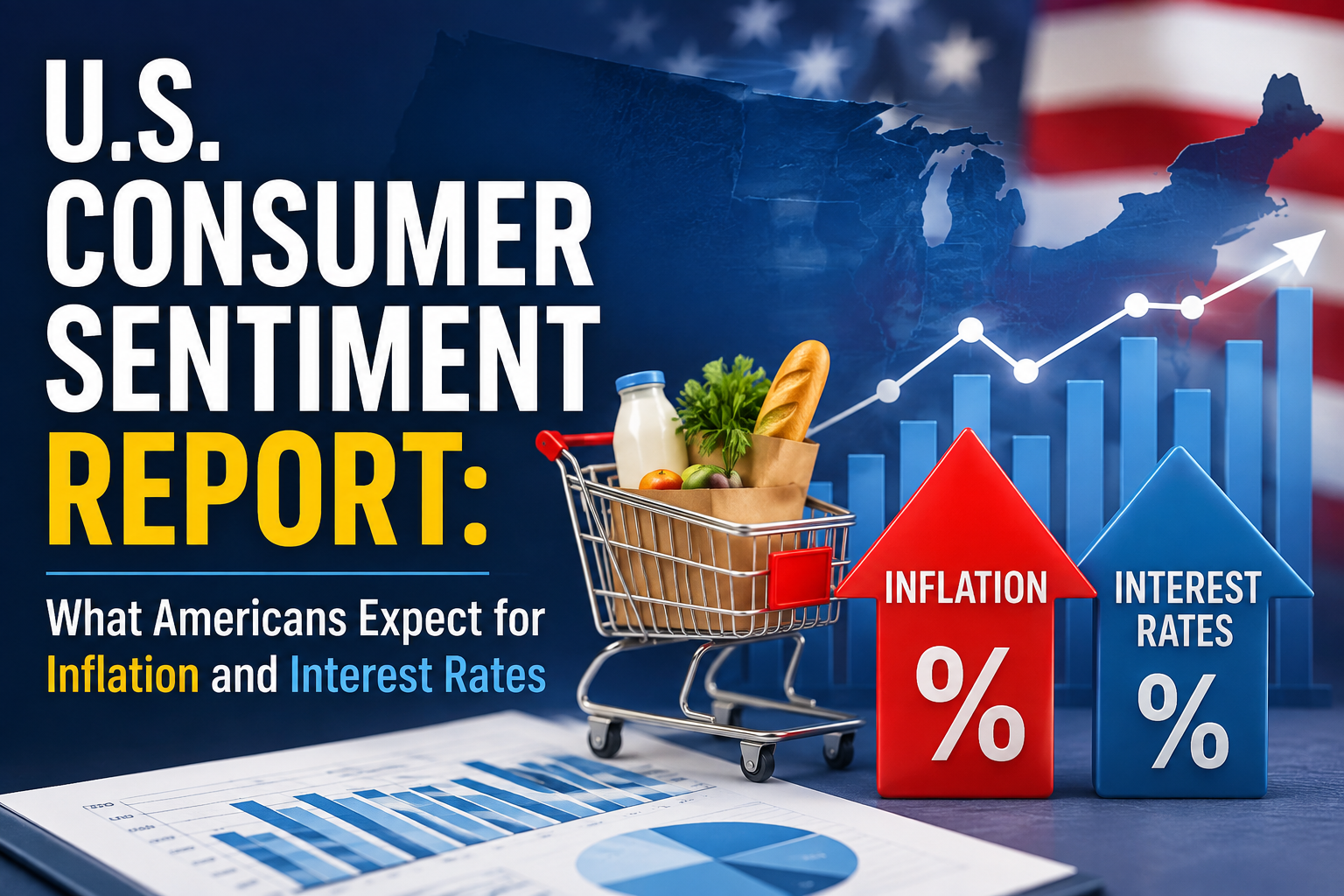
U.S. Consumer Sentiment Report: What Americans Expect for Inflation and Interest Rates
Americans are feeling somewhat better about the economy than they did earlier this summer, but the improvement is far from a return to optimism.
The latest consumer surveys show a complicated picture: household sentiment has recovered from recent lows, inflation expectations have eased somewhat, yet many Americans still expect prices to remain elevated and interest rates to stay high.
That combination matters because consumer expectations can influence spending, borrowing and saving decisions—and can also provide policymakers with an important measure of how households perceive the economy.
Consumer Sentiment Has Recovered, but Remains Weak
The University of Michigan’s final July survey showed its Consumer Sentiment Index rising to 55.2, up 11.5% from June’s 49.5. The Consumer Expectations Index also improved, reaching 55.4, while the Current Economic Conditions Index climbed to 54.8. (SCA ISR)
Despite that improvement, sentiment remained 10.5% below its level a year earlier.
That distinction is important.
The July increase suggests consumers were less pessimistic than they had been during the spring, but it does not necessarily mean households believe the economy is healthy. The University of Michigan said consumers remained focused heavily on purchasing power and persistent high prices. (SCA ISR)
The Conference Board’s July Consumer Confidence Survey painted a similarly cautious picture. Its Consumer Confidence Index declined 1.4 points to 90.8, while the Expectations Index remained at 74.7. The organization said consumers expected little improvement in business conditions over the following six months. (The Conference Board)
In other words, Americans appear to be less pessimistic without becoming particularly confident.
Inflation Expectations Are Still Above the Fed’s Target
One of the most closely watched elements of consumer sentiment is what households expect inflation to look like in the future.
The University of Michigan’s July survey found that consumers’ expectations for inflation over the next year fell from 4.6% in June to 4.2%. Five-year inflation expectations remained at 3.3%. (SCA ISR)
The decline in the one-year expectation is encouraging, but the level remains considerably higher than the Federal Reserve’s longer-run inflation goal.
The New York Federal Reserve’s July Survey of Consumer Expectations also showed some moderation. Median one-year-ahead inflation expectations declined 0.1 percentage point to 3.6%, while three-year expectations remained at 3.3% and five-year expectations stayed at 3.0%. (Federal Reserve Bank of New York)
The two surveys measure expectations differently, but they point toward the same broad message:
Consumers are seeing some improvement in the inflation outlook, but they are not yet convinced that price pressures will quickly return to low levels.
Why Consumer Inflation Expectations Matter
Inflation expectations are more than a measure of consumer mood.
If households believe prices will continue rising rapidly, they may change their financial behavior. Consumers might bring purchases forward, demand higher wages or become more cautious about saving.
Businesses can also respond to expectations by adjusting prices, wages and investment decisions.
This is one reason central banks pay close attention to whether inflation expectations remain anchored.
The Atlanta Federal Reserve has noted that long-term inflation expectations remaining near 2% help support price stability and moderate long-term interest rates. (Federal Reserve Bank of Atlanta)
The current survey readings therefore give policymakers a mixed signal.
Longer-term expectations are elevated compared with the Fed’s target, but they are not accelerating sharply. That suggests households still expect inflation to remain above the desired level for some time without necessarily anticipating a permanent return to the very high inflation rates seen during the worst periods of the inflation surge.
Americans Still Expect Higher Interest Rates
Inflation isn’t the only concern.
The Conference Board’s July survey found that 61.3% of consumers expected interest rates to be higher over the next 12 months, essentially unchanged from June. (The Conference Board)
That expectation is notable because consumers don’t experience Federal Reserve policy simply as an abstract economic statistic.
Interest rates affect:
- Mortgage costs
- Credit-card interest
- Auto financing
- Personal loans
- Business borrowing
- Savings yields
- Investment decisions
For households carrying variable-rate debt, expectations of higher rates can make future financial planning more difficult.
For savers, however, higher rates can have the opposite effect by keeping yields on savings accounts, money-market products and certificates of deposit relatively attractive.
The result is an economy in which the same interest-rate environment can help one household while hurting another.
The Fed Faces a Difficult Balancing Act
Recent inflation data have given policymakers some reason for caution rather than an obvious signal in either direction.
U.S. consumer prices increased 0.1% in July, while annual CPI inflation eased to 3.4% from 3.5% in June. Core CPI, which excludes food and energy, increased 0.2% for the month and 2.5% over the year. (Reuters)
Producer prices also provided some relief. The Producer Price Index was unchanged in July, while annual producer-price inflation slowed to 4.7% from 5.5% in June. (Reuters)
But inflation remains above the Federal Reserve’s 2% objective.
That leaves policymakers balancing two competing concerns: keeping monetary policy restrictive enough to bring inflation down while avoiding unnecessarily weakening economic activity and employment.
The Fed’s benchmark rate was being maintained in a 3.50%–3.75% range as of July, according to Reuters’ reporting on the latest policy and inflation developments. (Reuters)
What Rate Expectations Mean for Borrowers
For Americans with debt, expectations for interest rates can be just as important as the actual policy rate.
Mortgage borrowers
Higher rates generally mean higher borrowing costs for new homebuyers. Existing homeowners with fixed-rate mortgages are generally insulated from changes in the Federal Reserve’s policy rate until they refinance or take on additional borrowing.
Credit-card users
Credit-card rates can be particularly sensitive to the broader interest-rate environment. Consumers carrying balances may therefore feel the effects of elevated rates more directly than households that pay their balances in full.
Auto borrowers
Car financing costs can affect monthly payments and the total cost of purchasing a vehicle. When rates remain elevated, consumers may respond by choosing cheaper vehicles, making larger down payments or delaying purchases.
Personal loans
Higher borrowing costs can also make debt consolidation, home improvements and other financed expenses more expensive.
For households already carrying significant debt, the combination of elevated prices and borrowing costs can put additional pressure on monthly budgets.
What Rate Expectations Mean for Savers
The picture is different for people with cash savings.
Higher interest rates can provide better returns on savings accounts, money-market accounts and certificates of deposit, although the actual rate available depends on the financial institution and product.
Current market conditions illustrate that relationship. Recent savings-market data show high-yield savings accounts offering substantially more than the national average savings rate, although rates can change as monetary policy changes. (The Wall Street Journal)
That means consumers should not automatically assume that lower interest rates are better for every household.
A borrower may welcome lower rates, while a retiree or saver relying on interest income may prefer higher yields.
Why Consumer Sentiment Matters for the Economy
Consumer spending represents a major part of U.S. economic activity.
When households feel financially secure, they are generally more willing to make large purchases, travel, dine out and spend on discretionary goods and services.
When confidence deteriorates, consumers can become more selective.
The Conference Board has already described U.S. household affordability as an increasing constraint on consumer spending and expects the economy to become more investment-led as consumption faces greater pressure. (The Conference Board)
That makes consumer sentiment worth watching alongside inflation and employment data.
A consumer who says the economy is weak may still continue spending if their income and employment remain strong. But if pessimism eventually translates into reduced spending, the economic impact can become much larger.
Americans Are Caught Between Lower Inflation and Higher Prices
One of the most important distinctions in the current economic debate is the difference between inflation slowing down and prices falling.
If inflation falls from 5% to 3%, prices are still increasing. They are simply increasing more slowly.
That helps explain why sentiment can remain weak even when inflation data improve.
Many households are comparing today’s prices with the prices they remember several years ago—not merely looking at the current inflation rate.
The University of Michigan specifically reported that consumers remained focused on purchasing power and persistent high prices despite the improvement in sentiment. (SCA ISR)
For household budgets, that distinction is crucial.
A lower inflation rate does not automatically restore lost purchasing power.
What Americans Should Watch Next
Several indicators will be particularly important for understanding whether consumer expectations continue improving.
Inflation expectations
If one-year expectations continue falling while longer-term expectations remain stable, that could indicate that households increasingly believe recent price pressures will moderate.
Consumer confidence
A sustained improvement in sentiment would suggest households are becoming more comfortable with their financial and economic outlook.
Employment
Consumer confidence is closely connected to perceptions of job security and income prospects. A weakening labor market could undermine the recent improvement in sentiment.
Interest-rate expectations
The Conference Board’s finding that a majority of consumers still expect higher rates shows that households have not fully embraced the idea of rapidly falling borrowing costs. (The Conference Board)
Consumer spending
Ultimately, what people do with their money can matter more than what they say in surveys.
If cautious sentiment translates into weaker spending, businesses and policymakers may have to reassess the strength of economic growth.
What This Means for Household Finances
The latest surveys do not point to an economic collapse, but they also do not show a return to broad consumer confidence.
Instead, Americans appear to be navigating a complicated environment:
- Inflation expectations have eased, but remain elevated.
- Consumer sentiment has improved, but remains below last year’s level.
- Interest-rate expectations remain high.
- Household affordability remains a concern.
- Inflation is cooling, but prices themselves remain historically elevated.
- Borrowers and savers are experiencing interest rates differently.
For households, that makes flexibility particularly valuable.
People considering new debt may want to pay close attention to the total borrowing cost rather than focusing only on the monthly payment. Savers may want to compare available yields rather than leaving large cash balances in low-interest accounts. And households facing elevated living costs may benefit from maintaining sufficient emergency savings while prioritizing expensive debt.
None of those decisions requires predicting exactly what the Federal Reserve will do next.
The Bigger Signal From America’s Consumer Mood
The most revealing part of the latest consumer data may be the gap between improving sentiment and persistent financial anxiety.
Americans are less pessimistic than they were during the sharpest downturn in sentiment earlier this year, but they continue to feel the effects of high prices and elevated borrowing costs.
That creates a delicate environment for the economy.
If inflation expectations continue to moderate and employment remains resilient, consumer confidence could gradually recover. But if households continue to feel squeezed by prices, debt costs or weaker employment prospects, sentiment could remain fragile even as headline inflation improves.
For now, the surveys suggest that Americans are not necessarily expecting a return to runaway inflation—but neither are they convinced that the high-cost environment is behind them.
And that distinction could shape everything from household spending and borrowing to the Federal Reserve’s next policy decisions. (Federal Reserve Bank of New York)


2 Comments
Micle harison
June 7, 2019Lorem ipsum dolor sit amet, usu ut perfecto postulant deterruisset, libris causae volutpat at est, ius id modus laoreet urbanitas. Mel ei delenit dolores.
John Doe
June 7, 2019Some consultants are employed indirectly by the client via a consultancy staffing company.