
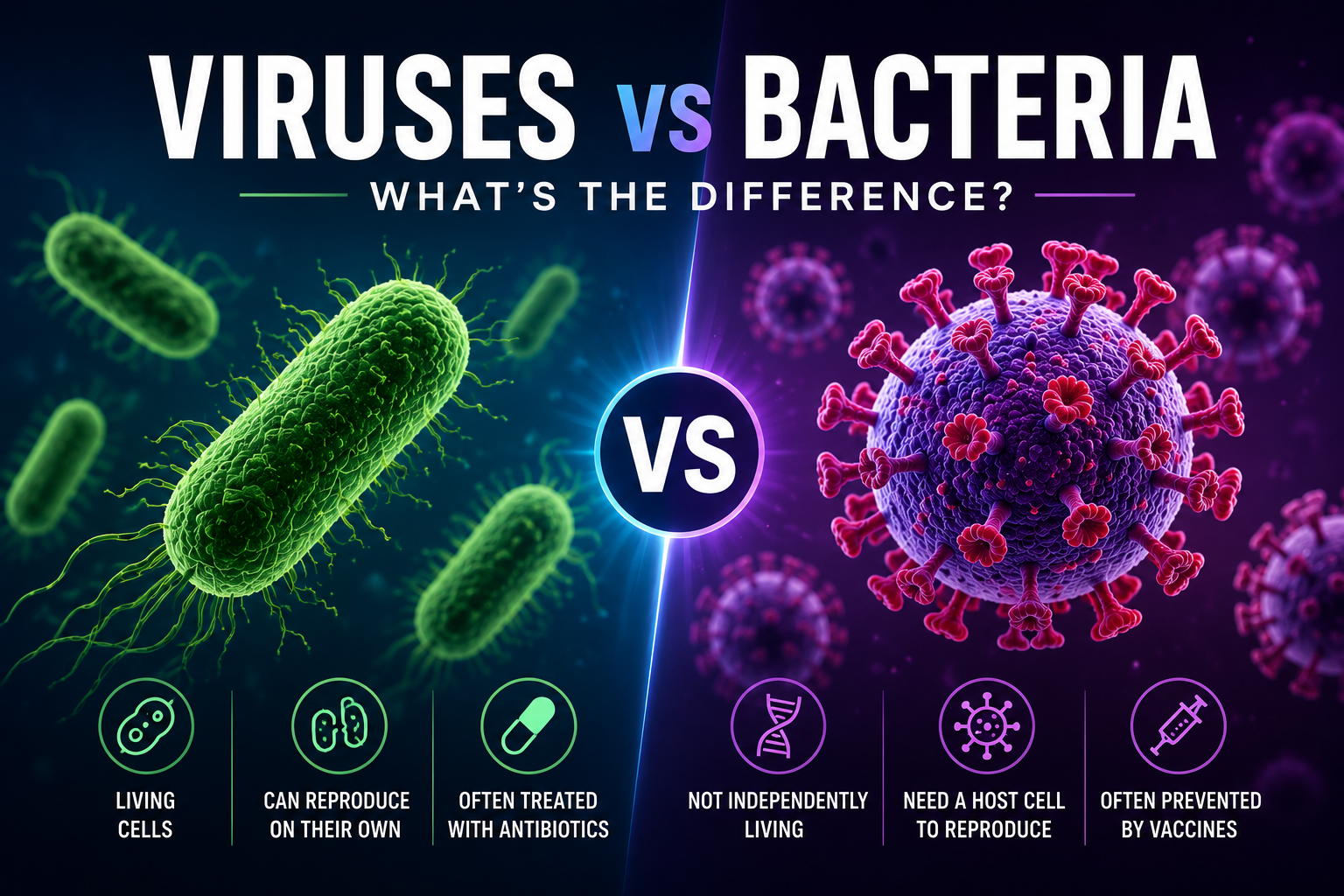
Viruses vs Bacteria: What’s the Difference? Understanding the Tiny Microbes That Shape Our World
You wake up with a sore throat, a runny nose, and a pounding headache.
Your first thought is probably simple:
“I must have a bacterial infection. I need antibiotics.”
But what if the illness is caused by a virus?
This misunderstanding is surprisingly common. Although the words virus and bacteria are often used interchangeably in everyday conversation, they are fundamentally different. They differ in structure, how they reproduce, how they spread, and—most importantly—how they are treated.
Understanding the difference isn’t just useful for passing a biology exam. It can help you make better healthcare decisions, understand why doctors don’t always prescribe antibiotics, and appreciate the incredible microscopic world that surrounds us every day.
These tiny organisms are among the most influential forms of life on Earth. Some cause devastating diseases, while others are essential for digestion, food production, and even maintaining the balance of ecosystems.
So, what exactly separates viruses from bacteria?
Let’s explore the science behind two of nature’s smallest—and most fascinating—biological entities.
What Are Bacteria?
Bacteria are living, single-celled microorganisms.
Although incredibly small, they are complete living cells capable of surviving and reproducing independently under the right conditions.
Scientists estimate that bacteria have existed on Earth for more than 3.5 billion years, making them among the oldest life forms on the planet.
They are found almost everywhere:
- In soil
- In oceans
- In rivers and lakes
- Deep underground
- On plants
- On animals
- Inside the human body
In fact, the average human body contains trillions of bacteria, many of which are beneficial.
Without them, life as we know it would not exist.
What Are Viruses?
Viruses are much simpler—and far more mysterious.
Unlike bacteria, viruses are not considered fully living organisms by many scientists.
A virus consists mainly of:
- Genetic material (DNA or RNA)
- A protective protein coat
- Sometimes an outer lipid envelope
Unlike bacteria, viruses cannot survive or reproduce on their own.
Instead, they must invade a living cell and hijack its machinery to make copies of themselves.
Without a host cell, viruses are biologically inactive.
This unique characteristic is one reason they occupy a fascinating gray area between living and non-living matter.
Viruses vs Bacteria: The Biggest Differences
| Feature | Bacteria | Viruses |
|---|---|---|
| Living organism | Yes | Not independently living |
| Cell structure | Single-celled | Not made of cells |
| Size | Larger | Much smaller |
| Can reproduce alone | Yes | No |
| Needs a host | No | Yes |
| Treated with antibiotics | Often | No |
| Vaccines available | Some diseases | Many viral diseases |
Although both can cause illness, they behave in dramatically different ways.
Size Matters
One of the easiest ways to understand the difference is through size.
- Most bacteria measure between 1 and 5 micrometers.
- Viruses are much smaller.
- Many are only 20 to 300 nanometers across.
To put that into perspective:
A single bacterium may be several times larger than a typical virus.
Scientists require powerful electron microscopes to observe most viruses clearly.
How Bacteria Reproduce
Bacteria reproduce through a process called binary fission.
The process is remarkably efficient.
One bacterial cell:
- Copies its DNA.
- Grows larger.
- Splits into two identical cells.
Under ideal conditions, some bacteria can divide every 20 minutes.
That means one bacterium can become millions within a single day.
This rapid reproduction explains why bacterial infections can spread quickly if left untreated.
How Viruses Reproduce
Viruses cannot reproduce independently.
Instead, they follow a completely different strategy.
First, a virus attaches to a suitable host cell.
Next, it injects its genetic material into that cell.
The infected cell then unknowingly begins producing:
- Viral proteins
- Viral genetic material
- New virus particles
Eventually, thousands of new viruses may emerge from a single infected cell.
Some viruses destroy the cell during this process.
Others leave while allowing the cell to survive for a period of time.
Either way, the virus relies entirely on its host.
Are All Bacteria Harmful?
Not at all.
In fact, most bacteria are beneficial—or completely harmless.
Beneficial bacteria help:
Digest Food
The human digestive system depends on bacteria to break down certain foods and produce nutrients.
Protect Against Harmful Germs
Healthy bacteria compete with disease-causing organisms, making infections less likely.
Produce Vitamins
Some gut bacteria help produce vitamins such as:
- Vitamin K
- Certain B vitamins
Support Agriculture
Nitrogen-fixing bacteria help plants grow by converting atmospheric nitrogen into forms crops can use.
Make Food
Many popular foods rely on bacteria during production, including:
- Yogurt
- Cheese
- Sauerkraut
- Kimchi
Without bacteria, many everyday foods simply would not exist.
Are All Viruses Harmful?
Not necessarily.
Although viruses are often associated with disease, many play important roles in nature.
Scientists have discovered viruses that:
- Help regulate ocean ecosystems
- Influence bacterial populations
- Contribute to nutrient recycling
Researchers are even studying bacteriophages, viruses that infect bacteria instead of humans.
These viruses may eventually help treat antibiotic-resistant bacterial infections.
However, many viruses do cause diseases in humans.
Common Bacterial Diseases
Examples include:
- Strep throat
- Tuberculosis
- Cholera
- Salmonella infection
- Urinary tract infections
- Whooping cough
Fortunately, many bacterial infections respond well to antibiotics.
Common Viral Diseases
Viruses cause illnesses such as:
- Influenza (flu)
- COVID-19
- Measles
- Chickenpox
- Hepatitis
- HIV infection
- Common cold
- Rabies
Because viruses reproduce inside human cells, treating them is often more difficult than treating bacterial infections.
Why Antibiotics Don’t Work Against Viruses
This is one of the most important differences.
Antibiotics target structures found inside bacteria.
For example, they may:
- Damage bacterial cell walls
- Prevent bacteria from producing proteins
- Stop bacterial reproduction
Viruses lack these bacterial structures.
As a result:
Antibiotics have no effect on viral infections.
Taking antibiotics for illnesses like influenza or the common cold will not help you recover faster.
Unnecessary antibiotic use also contributes to antibiotic resistance, one of the biggest public health challenges facing modern medicine.
What Is Antibiotic Resistance?
Over time, bacteria can evolve.
Some develop genetic changes that allow them to survive antibiotic treatment.
When antibiotics are overused or misused:
- Resistant bacteria survive.
- Sensitive bacteria die.
- Resistant strains multiply.
Eventually, infections become harder to treat.
This is why healthcare professionals encourage patients to use antibiotics only when medically appropriate.
How Vaccines Help
Vaccines train the immune system to recognize harmful pathogens before infection occurs.
Many vaccines protect against viral diseases, including:
- Measles
- Polio
- Influenza
- COVID-19
- Hepatitis B
Vaccines also exist for certain bacterial diseases, such as:
- Tetanus
- Diphtheria
- Pertussis (whooping cough)
- Pneumococcal disease
Rather than treating illness after infection, vaccines help prevent disease from developing in the first place.
How Your Immune System Responds
Whether facing bacteria or viruses, the body’s immune system launches a sophisticated defense.
White blood cells identify invading organisms.
Specialized immune cells then:
- Attack infected cells
- Produce antibodies
- Remember previous infections
This immune memory often provides faster protection if the same pathogen returns.
It is also the principle behind vaccination.
Can Viruses Become Bacteria?
No.
Viruses and bacteria belong to entirely different biological categories.
A virus cannot transform into a bacterium.
Likewise, bacteria cannot become viruses.
Although they sometimes cause similar symptoms—such as fever or coughing—the organisms themselves are fundamentally different.
The Surprising Role of the Human Microbiome
One of the biggest scientific discoveries of recent decades is the importance of the human microbiome.
This refers to the enormous community of microorganisms living in and on the human body.
Scientists estimate that trillions of bacteria inhabit:
- The digestive system
- The skin
- The mouth
- The respiratory tract
These microorganisms help regulate:
- Digestion
- Immune function
- Metabolism
- Overall health
Researchers continue discovering new ways these microscopic organisms influence everything from mental health to chronic disease.
Fascinating Facts About Viruses and Bacteria
- Bacteria existed billions of years before humans.
- Viruses are the most abundant biological entities on Earth.
- The human gut contains hundreds of different bacterial species.
- Some bacteria can survive in boiling hot springs and highly acidic environments.
- Giant viruses are so large they challenge traditional definitions of viruses.
- Certain bacteria produce oxygen through photosynthesis, helping sustain life on Earth.
Why Understanding the Difference Matters
Knowing whether an illness is caused by bacteria or viruses influences:
- Diagnosis
- Treatment
- Recovery
- Public health decisions
It also helps reduce unnecessary antibiotic use, slowing the spread of antibiotic-resistant bacteria.
As medicine continues advancing, understanding microorganisms becomes increasingly important.
From developing vaccines to discovering new antibiotics and studying the human microbiome, scientists continue learning how these microscopic organisms shape life on Earth.
The Future of Microbiology
Researchers are exploring exciting new frontiers, including:
- Bacteriophage therapy to combat drug-resistant bacteria
- Personalized microbiome treatments
- Next-generation vaccines
- Gene-editing technologies targeting infectious diseases
- Artificial intelligence for rapid disease diagnosis
These innovations could transform how future generations prevent and treat infections.
Final Thoughts
Although viruses and bacteria are both microscopic, they could hardly be more different.
Bacteria are living, single-celled organisms capable of surviving and reproducing on their own. Many are essential to life, supporting digestion, agriculture, and countless natural ecosystems.
Viruses, on the other hand, exist in a unique biological gray area. Unable to reproduce independently, they rely entirely on invading living cells to multiply.
Understanding these differences helps explain:
- Why antibiotics work for bacterial infections but not viral ones
- Why vaccines remain one of medicine’s greatest achievements
- Why proper diagnosis is essential for effective treatment
The next time you hear the words virus or bacteria, you’ll know they are not interchangeable.
They represent two very different microscopic worlds—both capable of causing disease, both fascinating in their own right, and both central to understanding the remarkable complexity of life on Earth.




2 Comments
Micle harison
June 7, 2019Lorem ipsum dolor sit amet, usu ut perfecto postulant deterruisset, libris causae volutpat at est, ius id modus laoreet urbanitas. Mel ei delenit dolores.
John Doe
June 7, 2019Some consultants are employed indirectly by the client via a consultancy staffing company.