
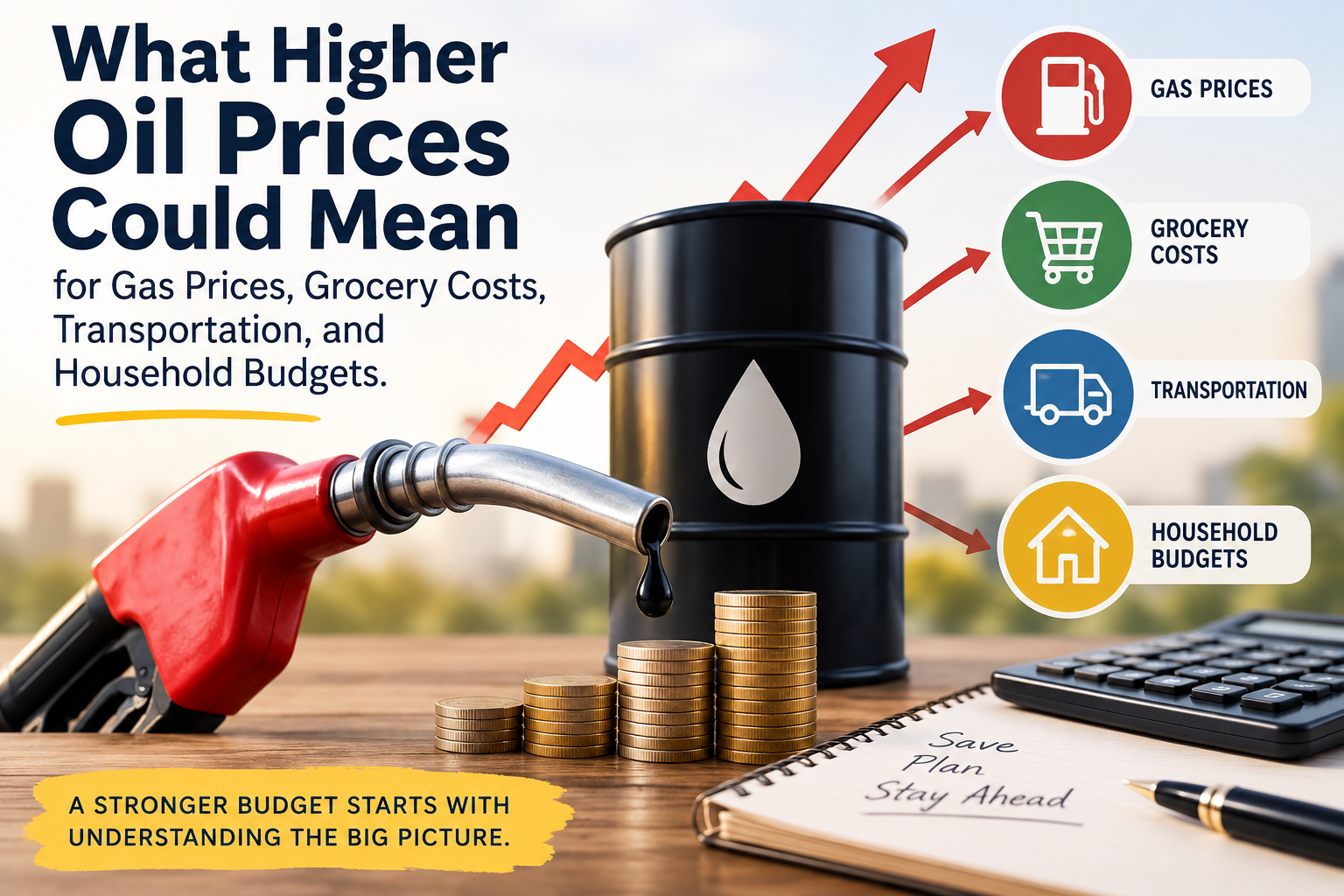
What Higher Oil Prices Could Mean for Gas Prices, Grocery Costs, Transportation, and Household Budgets
When oil prices rise, the effects rarely stop at the gas station.
Crude oil is a major input into the transportation system and is also connected to the production, packaging, and movement of many everyday goods. That means a sustained increase in oil prices can gradually work its way through household budgets, affecting everything from commuting costs to grocery bills and delivery expenses.
The size and speed of the impact can vary widely. Gasoline prices often respond relatively quickly to changes in crude oil prices, while the effect on groceries and other household expenses can take longer to appear. For consumers already managing tight budgets, however, even modest increases across several categories can add up.
Here’s how higher oil prices could affect everyday spending — and what households can do to prepare.
Why Oil Prices Matter to Household Budgets
Crude oil is one of the world’s most widely used commodities. It is refined into fuels such as gasoline and diesel, which power cars, trucks, buses, ships and other forms of transportation.
Transportation is particularly important because businesses depend on it to move raw materials and finished products.
A simplified chain looks like this:
Higher oil prices → higher fuel costs → higher transportation costs → potentially higher business costs → possible increases in consumer prices.
The process isn’t automatic or one-to-one. Companies may absorb some additional costs, switch suppliers, improve efficiency or adjust pricing at different times.
Still, prolonged increases in energy costs can create pressure throughout the economy.
For households, the most visible effect is usually at the pump.
Gas Prices Could Be One of the First Effects
Gasoline prices tend to be closely connected to crude oil prices, although they are also influenced by refining costs, taxes, distribution expenses and local market conditions.
When crude oil becomes more expensive, the cost of producing gasoline can rise. If other factors remain supportive, that can eventually translate into higher prices for drivers.
For someone who drives frequently, the impact can be significant.
Consider a household that uses 40 gallons of gasoline each month. A $0.25 increase in the price of a gallon would add approximately $10 per month, or about $120 per year, if the higher price remained in place.
A household using 80 gallons per month would see the same price increase add approximately $20 per month.
The financial impact becomes larger when higher fuel prices occur alongside increases in other essential expenses.
Who Could Feel Higher Gas Prices Most?
The effect isn’t evenly distributed.
Households that may be particularly exposed include:
- People with long daily commutes
- Workers who drive as part of their jobs
- Families with multiple vehicles
- Households living in areas with limited public transportation
- People who frequently travel long distances
- Small businesses that depend heavily on vehicles
Drivers with fuel-efficient vehicles may have more flexibility, while households with larger vehicles or high annual mileage can face greater exposure.
Transportation Costs Could Rise Beyond the Gas Station
Higher oil prices can affect transportation even when consumers aren’t driving their own vehicles.
Trucks, delivery vehicles, ships and other forms of freight transportation use fuel to move products between manufacturers, warehouses, stores and customers.
If transportation becomes more expensive, businesses may face higher operating costs.
Those costs can be handled in several ways. A company might absorb them, reduce other expenses, negotiate with suppliers or eventually pass some of the increase to customers.
This means higher oil prices can potentially influence the cost of:
- Package deliveries
- Online orders
- Freight services
- Public transportation
- Taxi and ride-hailing services
- Business travel
- Commercial transportation
The effect may not appear immediately on a household’s bill. Instead, transportation costs can become one component of a broader increase in the cost of goods and services.
Why Grocery Costs Can Be Affected
Oil isn’t a direct ingredient in most food, but energy and transportation play important roles in getting food from farms and factories to consumers.
A typical food supply chain can involve multiple stages:
Farm → processing facility → warehouse → distribution center → grocery store → household
Each stage can involve transportation, energy use, packaging or machinery.
Higher fuel costs can therefore create additional expenses for farmers, food processors, trucking companies, distributors and retailers.
However, it’s important not to assume that a rise in oil prices will cause grocery prices to increase by the same percentage.
Food prices are influenced by many other factors, including:
- Weather
- Crop yields
- Labor costs
- Fertilizer prices
- Commodity prices
- Supply and demand
- Transportation costs
- Packaging costs
- Exchange rates
- Retail competition
Oil prices are therefore only one part of the equation.
Some Grocery Categories May Feel Pressure Differently
Transportation-intensive products can be particularly sensitive to changes in logistics costs.
For example, products that travel long distances or require significant distribution may have more exposure to fuel-related transportation costs than goods produced closer to where they are sold.
But consumers shouldn’t assume that every grocery item will become more expensive simply because crude oil prices rise.
The relationship is more complicated — and often delayed.
Household Delivery Costs Could Become More Important
Consumers increasingly rely on home delivery for groceries, meals, online purchases and other products.
Those services depend heavily on transportation.
If fuel costs rise substantially, delivery companies and retailers may face higher costs for moving products over the final mile to customers.
Businesses may respond by:
- Raising delivery fees
- Increasing minimum order requirements
- Adjusting free-shipping thresholds
- Raising product prices
- Absorbing the additional expense
- Improving delivery efficiency
For households, the effect may therefore show up as a small increase in several different fees rather than one obvious oil-related charge.
Inflation Could Put Additional Pressure on Budgets
One of the biggest concerns surrounding sustained increases in energy prices is their potential contribution to broader inflation.
Energy affects many parts of the economy. Businesses use fuel and transportation to operate, while consumers directly purchase gasoline and other energy-related products.
When costs rise across multiple stages of the economy, some businesses may pass part of those increases on to customers.
That doesn’t mean higher oil prices automatically cause broad inflation. The overall effect depends on the size and duration of the oil-price increase, the condition of the economy and what happens to other costs.
But energy prices can be an important source of pressure.
Why Higher Oil Prices Don’t Affect Everyone Equally
Household exposure to oil prices depends heavily on lifestyle and location.
Consider two households with identical incomes.
One might live close to work, use public transportation, shop locally and own one fuel-efficient vehicle.
The other might have two cars, commute long distances, frequently order deliveries and live far from major commercial centers.
A similar increase in oil prices could have a much larger effect on the second household’s monthly budget.
This is why looking only at the national average can sometimes hide the personal impact of higher energy costs.
The Hidden Budget Effect: Small Increases Add Up
The biggest challenge may not be one dramatic expense.
Instead, households could face a collection of smaller increases:
- Gasoline costs more
- A delivery fee increases
- A grocery bill rises slightly
- A service provider adjusts its prices
- A commute becomes more expensive
- Travel costs increase
Individually, these changes might not seem significant.
Together, they can create a noticeable increase in monthly spending.
For a household operating with little room between income and expenses, that difference can affect savings, debt payments and discretionary spending.
How Households Can Prepare for Higher Fuel Costs
Consumers cannot control crude oil prices, but they can reduce their exposure to fuel-related expenses.
Review Your Monthly Fuel Spending
Start by looking at how much you actually spend on gasoline or other transportation.
Instead of estimating, review several months of bank or card transactions.
This gives you a realistic baseline.
Build a Fuel-Price Buffer
If fuel costs are an important part of your budget, consider creating a small buffer.
For example, if your household normally spends $200 per month on fuel, you might temporarily budget for $225 or $250.
If prices don’t rise, the extra money can remain in savings.
If they do, the adjustment is less disruptive.
Combine Trips When Practical
Planning errands around existing trips can reduce unnecessary mileage.
Several short journeys can consume more fuel than a carefully planned route that combines multiple stops.
Maintain Your Vehicle
Regular maintenance can help your vehicle operate efficiently and avoid preventable problems.
Tire pressure, routine servicing and other manufacturer-recommended maintenance can all matter to operating costs.
Reconsider Unnecessary Driving
Not every trip has to disappear from the calendar.
But when fuel prices are putting pressure on the household budget, it can be useful to distinguish between essential driving and trips that can be combined, postponed or replaced with another option.
Review Recurring Transportation Costs
Fuel isn’t the only transportation expense worth examining.
Look at:
- Car insurance
- Parking
- Maintenance
- Tolls
- Public transportation
- Ride-hailing
- Vehicle financing
Reducing one or two other transportation expenses can help offset higher fuel costs.
A Practical Household Stress Test
One useful budgeting exercise is to model what would happen if transportation costs increased.
For example, calculate your monthly budget under three scenarios:
| Scenario | Monthly Fuel Cost | Annual Fuel Cost |
|---|---|---|
| Current spending | $200 | $2,400 |
| Moderate increase | $250 | $3,000 |
| Larger increase | $300 | $3,600 |
The purpose isn’t to predict where oil or gasoline prices will go.
It’s to determine whether your household could absorb a higher transportation bill without relying on credit cards or reducing essential savings.
If the answer is no, identifying the gap early gives you more options.
What About Electric Vehicles and Public Transportation?
Households with access to public transportation, walking infrastructure or electric vehicles may have different exposure to oil-price changes.
Electric vehicles don’t use gasoline, so their owners aren’t directly affected by increases at the pump in the same way conventional vehicle owners are.
However, electricity costs, vehicle financing, insurance, maintenance and other expenses still matter.
Similarly, public transportation can reduce a household’s dependence on gasoline, but fares and service availability can vary.
The broader lesson is that transportation choices can influence how sensitive a household budget is to changes in fuel prices.
Don’t Make Major Financial Decisions Based on Oil Prices Alone
Higher oil prices can create financial pressure, but they shouldn’t automatically trigger major household decisions.
Selling a vehicle, taking on a new car loan, changing jobs or making another large financial commitment involves many factors beyond fuel prices.
Instead, households should look at their overall finances.
Ask:
- How much do I spend on transportation each month?
- How much could that cost under a higher-price scenario?
- Do I have an emergency fund?
- Are my essential expenses covered by reliable income?
- Am I carrying expensive debt?
- Can I reduce discretionary transportation costs?
- How much flexibility exists in my monthly budget?
This approach turns an uncertain external event into a manageable budgeting exercise.
The Bigger Personal-Finance Picture
Oil prices can influence household finances through several channels, but the impact isn’t necessarily immediate or uniform.
Gasoline is usually the most visible connection. Transportation costs can create another layer of pressure, while grocery and other consumer costs may be affected indirectly through supply chains and business expenses.
For households, the most useful response isn’t trying to predict the exact path of oil prices.
It’s understanding where your own budget is most exposed.
A family that knows it spends $300 a month on fuel can plan for a higher fuel bill. A household that understands its grocery and transportation spending can identify areas where a modest increase could be absorbed. And someone with an emergency fund has more flexibility when unavoidable expenses rise.
In other words, the best defense against an uncertain energy market may be a budget that has enough breathing room to handle it.




2 Comments
Micle harison
June 7, 2019Lorem ipsum dolor sit amet, usu ut perfecto postulant deterruisset, libris causae volutpat at est, ius id modus laoreet urbanitas. Mel ei delenit dolores.
John Doe
June 7, 2019Some consultants are employed indirectly by the client via a consultancy staffing company.