
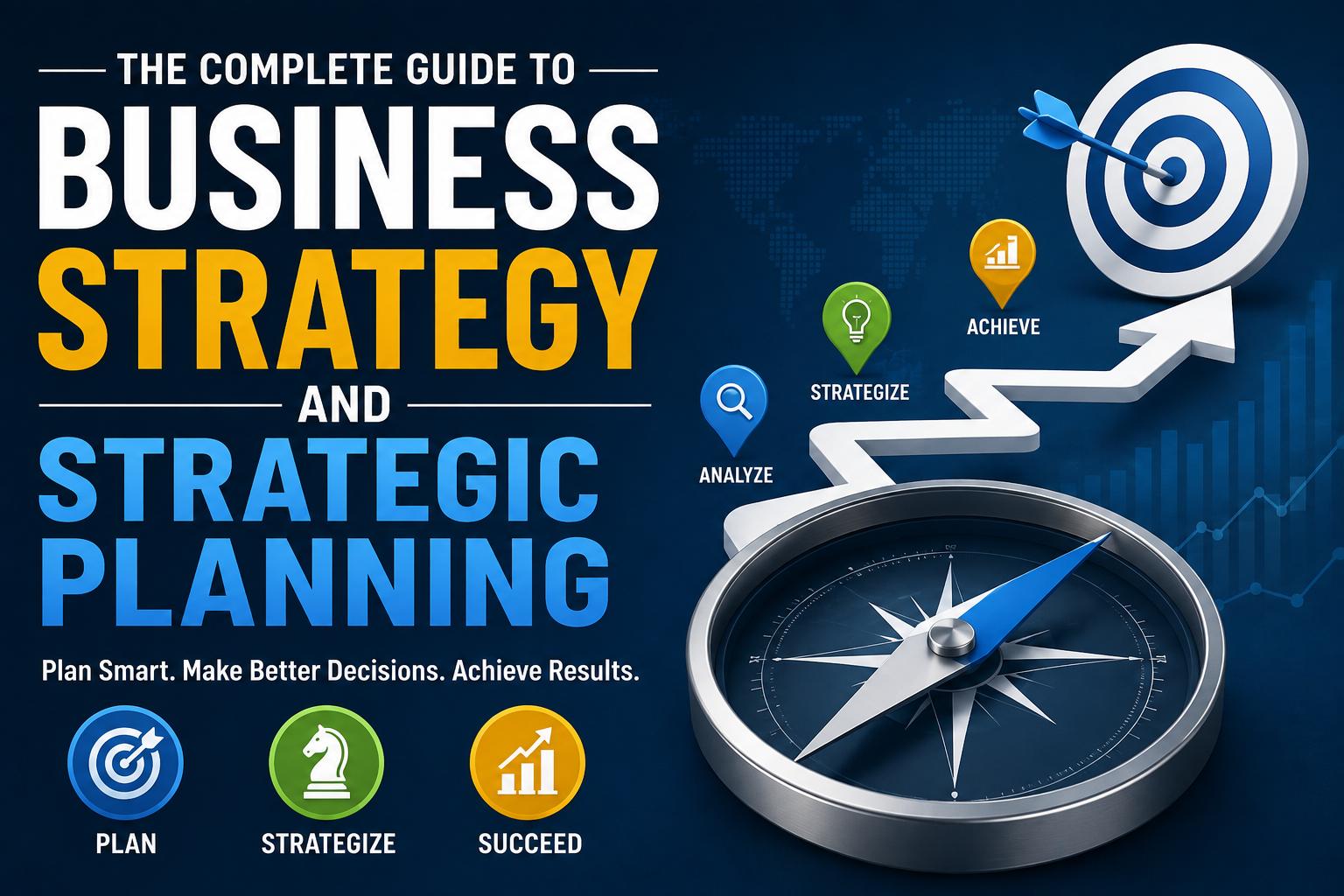
Complete Guide to Business Strategy and Strategic Planning
A business can have a great product, talented employees, and plenty of ambition and still struggle to grow. The missing ingredient is often not effort but direction.
Business strategy provides that direction. It helps an organization decide where it wants to compete, how it intends to create value, which customers it wants to serve, and how it can build an advantage over competitors. Strategic planning turns those choices into a practical roadmap by defining priorities, objectives, resources, responsibilities, and measures of progress.
Whether you are launching a small business, managing an established company, or leading a growing organization, understanding the relationship between strategy and planning can make decision-making more disciplined and effective.
This complete guide explains what business strategy is, how strategic planning works, the major components of a strong strategy, common mistakes to avoid, and how businesses can turn strategic ideas into measurable results.
What Is Business Strategy?
Business strategy is the long-term approach an organization uses to achieve its goals and compete effectively.
At its core, strategy answers several important questions:
- Where are we now?
- Where do we want to go?
- Who do we want to serve?
- What value will we provide?
- How will we compete?
- Which opportunities should we pursue?
- Which opportunities should we avoid?
- What resources do we need?
- How will we measure success?
A strategy is therefore more than a list of goals. A goal might be to increase revenue by 20%, while a strategy explains how the business intends to achieve that growth.
For example, a company might pursue growth by focusing on a specific customer segment, improving its product, expanding into new markets, developing a lower-cost operating model, or building a stronger digital sales channel.
Good strategy requires choices. A business cannot pursue every market, customer, product, and opportunity simultaneously.
What Is Strategic Planning?
Strategic planning is the structured process of developing, implementing, and reviewing an organization’s strategy.
While strategy determines the overall direction, strategic planning creates a framework for putting that direction into practice.
A strategic planning process commonly includes:
- Assessing the current business position.
- Defining a vision for the future.
- Establishing a mission and strategic priorities.
- Analyzing customers and competitors.
- Identifying opportunities and threats.
- Setting measurable objectives.
- Choosing strategic initiatives.
- Allocating resources.
- Assigning responsibilities.
- Measuring performance.
- Reviewing and adjusting the strategy.
Strategic planning should not be treated as a document that is created once and forgotten. Markets change, customer expectations evolve, competitors respond, and new opportunities emerge. Effective organizations regularly revisit their assumptions and adjust their plans.
Business Strategy vs. Strategic Planning
The two concepts are closely connected but are not identical.
| Business Strategy | Strategic Planning |
|---|---|
| Defines how the business will compete | Defines how the strategy will be implemented |
| Focuses on choices and competitive direction | Focuses on objectives, actions, resources, and timelines |
| Answers “How will we win?” | Answers “What must we do next?” |
| Establishes strategic priorities | Converts priorities into initiatives |
| Can remain relatively stable over time | Is reviewed and adjusted regularly |
| Guides major decisions | Coordinates execution |
A useful way to think about the relationship is:
Strategy chooses the direction. Strategic planning organizes the journey. Execution moves the business forward.
Why Business Strategy Matters
Without a clear strategy, businesses can become reactive.
Management may chase every new opportunity, employees may work toward conflicting priorities, and resources may be spread across too many initiatives.
A strong strategy creates alignment.
1. It Provides Direction
Employees and managers understand what the organization is trying to accomplish and why.
2. It Improves Decision-Making
Strategic priorities provide a framework for deciding which opportunities deserve attention and which do not.
3. It Helps Allocate Resources
Money, people, technology, time, and management attention are limited. Strategy helps direct those resources toward the activities that matter most.
4. It Creates Competitive Focus
A business needs to understand why customers should choose it instead of an alternative.
5. It Supports Long-Term Growth
Strategic thinking encourages businesses to consider not only immediate revenue but also capabilities, customer relationships, brand strength, operational efficiency, and future opportunities.
6. It Improves Organizational Alignment
When departments understand the same priorities, marketing, sales, operations, finance, technology, and human resources can work toward shared outcomes.
The Core Components of Business Strategy
Although strategies vary considerably between industries, most effective business strategies contain several fundamental elements.
1. Vision
A vision statement describes the future an organization wants to create.
It should provide a sense of direction without becoming an overly detailed operational plan.
A strong vision can answer:
What do we ultimately want this organization to become?
For example, a technology company might aspire to become a trusted provider of digital tools for small businesses.
The vision describes the destination.
2. Mission
A mission statement explains the organization’s fundamental purpose.
It typically describes:
- Who the organization serves
- What it provides
- The value it creates
- Why the organization exists
The mission should help employees understand the organization’s purpose beyond simply generating revenue.
3. Strategic Objectives
Strategic objectives translate broad ambitions into measurable outcomes.
Examples include:
- Increase customer retention.
- Expand into three new markets.
- Improve operating margins.
- Increase recurring revenue.
- Strengthen brand awareness.
- Reduce customer acquisition costs.
- Develop new distribution channels.
- Improve operational efficiency.
Strong objectives are specific enough to guide action and measurable enough to evaluate.
4. Target Customers
A strategy should clearly identify the customers the organization intends to serve.
Businesses should understand factors such as:
- Customer needs
- Buying behavior
- Budget
- Pain points
- Decision-making processes
- Geographic markets
- Demographics where relevant
- Customer expectations
- Alternatives currently being used
Trying to serve everyone can make positioning weak.
5. Value Proposition
The value proposition explains why customers should choose the business.
A compelling value proposition connects the customer’s problem with the organization’s solution.
It should answer:
What meaningful value do we provide, and why should customers believe we can provide it better than alternatives?
6. Competitive Advantage
Competitive advantage is the capability or position that allows a company to perform better than competitors in a meaningful area.
Potential sources include:
- Lower costs
- Strong brand recognition
- Superior customer experience
- Proprietary technology
- Specialized expertise
- Distribution advantages
- Network effects
- Operational efficiency
- Intellectual property
- Strong partnerships
- Customer loyalty
A sustainable strategy should avoid relying solely on advantages that competitors can easily copy.
7. Strategic Priorities
Strategic priorities identify the few areas that deserve disproportionate attention.
A business might prioritize:
- Customer retention
- Product innovation
- Geographic expansion
- Operational efficiency
The point is not to create a list of everything the company wants to accomplish. The point is to determine what matters most.
How to Conduct a Strategic Business Analysis
Before creating a strategic plan, leaders need a realistic understanding of the organization’s current position.
Several analytical frameworks can help.
SWOT Analysis
SWOT examines four categories:
| Internal Factors | External Factors |
|---|---|
| Strengths | Opportunities |
| Weaknesses | Threats |
Strengths
These are internal advantages such as:
- Strong brand
- Skilled workforce
- Loyal customers
- Efficient operations
- Strong financial position
Weaknesses
These are internal limitations such as:
- Limited resources
- Outdated systems
- Weak distribution
- Skill shortages
- Poor customer retention
Opportunities
These are external possibilities for growth, including:
- New customer segments
- Emerging markets
- New distribution channels
- Technological developments
- Changing customer needs
Threats
These are external factors that could negatively affect the business:
- New competitors
- Regulatory changes
- Economic pressures
- Substitute products
- Changing consumer behavior
SWOT is most useful when it leads to strategic decisions rather than simply becoming a four-box exercise.
PESTLE Analysis
PESTLE examines major external forces:
- Political
- Economic
- Social
- Technological
- Legal
- Environmental
This framework helps businesses identify external changes that could affect their strategy.
For example, a technology company might examine changes in regulation, consumer behavior, technology infrastructure, and economic conditions before entering a new market.
Competitive Analysis
Businesses should understand the competitive environment in which they operate.
Questions worth asking include:
- Who are the major competitors?
- What customer groups do they target?
- What do they do well?
- Where are they vulnerable?
- How are their products positioned?
- How do their prices compare?
- What distribution channels do they use?
- What makes customers switch between providers?
Competitive analysis should focus on customer value rather than simply creating lists of competitors.
Customer Analysis
Strategic planning should begin with the customer rather than the internal organization.
Research should identify:
- Customer problems
- Desired outcomes
- Purchase triggers
- Objections
- Alternatives
- Unmet needs
- Reasons for choosing competitors
- Reasons for leaving
Customer interviews, surveys, support conversations, reviews, sales data, and behavioral analytics can all contribute useful insights.
How to Build a Strategic Plan
Once the organization understands its current position, leadership can begin developing the strategic plan.
Step 1: Define the Current Situation
Document where the business stands today.
Consider:
- Revenue
- Profitability
- Market position
- Customer base
- Products and services
- Operational capabilities
- Workforce
- Technology
- Cash position
- Competitive position
A strategy built on inaccurate assumptions can quickly become ineffective.
Step 2: Define the Desired Future
Establish what the organization wants to achieve over the strategic planning period.
This might include financial, customer, operational, market, and organizational outcomes.
Step 3: Identify the Strategic Gap
The gap is the difference between the current state and desired future.
For example:
Current state: Strong regional business with limited online sales.
Desired state: National business with a significant digital sales channel.
The strategic question becomes:
What capabilities, investments, and decisions are necessary to close that gap?
Step 4: Establish Strategic Objectives
Objectives should translate the desired future into measurable outcomes.
A useful objective might be:
Increase online revenue from 15% to 35% of total sales within three years.
This is much more actionable than:
Improve digital sales.
Step 5: Develop Strategic Initiatives
Initiatives are major projects or programs designed to achieve strategic objectives.
For the digital-sales example, initiatives could include:
- Redesigning the website
- Improving online checkout
- Developing digital marketing capabilities
- Expanding online product selection
- Improving fulfillment
- Introducing customer analytics
Step 6: Prioritize Initiatives
Not every initiative can be funded or implemented simultaneously.
Evaluate initiatives based on:
- Strategic impact
- Cost
- Complexity
- Risk
- Time required
- Available capabilities
- Expected return
This is where strategy becomes a process of making choices.
Step 7: Allocate Resources
A strategy without resources is usually an aspiration.
Organizations need to determine:
- Budget
- Staffing
- Technology
- Management attention
- Training
- External expertise
- Infrastructure
Resource allocation should reflect strategic priorities.
Step 8: Establish Performance Measures
Determine how success will be measured.
Useful measures might include:
- Revenue growth
- Profit margin
- Customer retention
- Customer acquisition cost
- Conversion rate
- Market share
- Employee productivity
- Operating costs
- Customer satisfaction
- Recurring revenue
The right metrics depend on the organization’s strategy.
Step 9: Assign Ownership
Each major initiative should have a clear owner.
Without ownership, strategic priorities can become everyone’s responsibility and therefore nobody’s responsibility.
Step 10: Review Progress Regularly
Strategic reviews should examine:
- What has changed?
- What is working?
- What is not working?
- Which assumptions remain valid?
- Which initiatives are behind schedule?
- What new opportunities have emerged?
- What should be stopped, changed, or accelerated?
Common Business Strategy Models
Different situations require different strategic approaches.
Cost Leadership
A cost-leadership strategy focuses on achieving a lower cost structure than competitors while maintaining acceptable customer value.
This can involve:
- Efficient operations
- Scale
- Automation
- Supply-chain improvements
- Standardization
- Process optimization
Differentiation Strategy
Differentiation involves offering characteristics customers perceive as meaningfully different or better.
Differentiation can come from:
- Product quality
- Design
- Service
- Convenience
- Technology
- Brand
- Customization
Focus Strategy
A focus strategy concentrates resources on a specific market segment rather than attempting to serve the entire market.
A company might focus on:
- A particular industry
- A geographic market
- A customer type
- A specific use case
Growth Strategy
Growth strategies may involve:
- Increasing sales to existing customers
- Entering new markets
- Developing new products
- Forming partnerships
- Expanding distribution
- Acquiring businesses
Growth should be evaluated alongside profitability, risk, and operational capacity.
Strategic Planning Tools Businesses Can Use
No single framework is appropriate for every organization.
Useful tools include:
SWOT
Useful for understanding internal strengths and weaknesses alongside external opportunities and threats.
PESTLE
Useful for evaluating the broader external environment.
Porter’s Five Forces
Useful for examining competitive forces within an industry.
Ansoff Matrix
Useful for considering growth through existing or new products and markets.
Balanced Scorecard
Useful for measuring strategy through multiple perspectives rather than financial performance alone.
Scenario Planning
Useful when the future contains substantial uncertainty.
OKRs
Objectives and Key Results can help translate strategic priorities into measurable outcomes.
Business Model Canvas
Useful for examining how an organization creates, delivers, and captures value.
The best strategic planning process uses tools selectively rather than forcing every business into the same framework.
How Strategy Becomes Execution
One of the biggest challenges businesses face is the gap between strategy and execution.
A company can produce an impressive strategic document and still fail to change its performance.
Execution requires translating strategy into everyday decisions.
Strategy
Improve customer retention.
Strategic objective
Increase annual customer retention from 70% to 82%.
Initiative
Launch a structured customer-success program.
Action
Assign customer-success managers to high-value accounts.
Metric
Measure monthly retention and churn.
This chain connects a broad strategic ambition to measurable operational activity.
Common Strategic Planning Mistakes
1. Creating Too Many Priorities
If everything is a priority, nothing is.
Organizations should identify the few strategic issues that can make the greatest difference.
2. Confusing Goals With Strategy
“Increase revenue” is a goal.
It does not explain how the company will create an advantage or achieve the target.
3. Ignoring Customers
Internal assumptions can be dangerous when they are not supported by customer evidence.
4. Failing to Study Competitors
A strategy that ignores competitive behavior can quickly become irrelevant.
5. Planning Without Resources
Ambitious initiatives require money, people, skills, and management capacity.
6. Using Too Many Metrics
A large dashboard can make it harder to identify what actually matters.
Focus on a manageable set of meaningful indicators.
7. Treating Strategy as Fixed
A strategic plan should provide direction without preventing adaptation.
8. Failing to Assign Ownership
Strategic initiatives need accountable leaders.
9. Ignoring Execution Capacity
Organizations sometimes approve more initiatives than their employees can realistically deliver.
10. Writing the Plan and Forgetting It
A strategy document should be part of an ongoing management process, not an annual paperwork exercise.
How Small Businesses Can Approach Strategy
Small businesses do not necessarily need a complex strategic planning system.
A practical small-business strategy can answer six questions:
- Who are our best customers?
- What problem do we solve for them?
- Why should they choose us?
- Which products or services are most valuable?
- What is our most important growth opportunity?
- What should we stop doing?
Small businesses can then establish a handful of measurable objectives and review them regularly.
For example, a local service business might focus on:
- Increasing repeat customers
- Improving online visibility
- Raising average transaction value
- Reducing operational waste
- Building referral partnerships
The objective is clarity rather than complexity.
How Large Organizations Can Approach Strategy
Larger organizations generally require more formal strategic-management systems because they have multiple business units, markets, departments, and stakeholder groups.
Large organizations may need:
- Corporate strategy
- Business-unit strategy
- Functional strategies
- Portfolio management
- Capital allocation processes
- Enterprise risk management
- Performance dashboards
- Scenario planning
- Formal strategic reviews
The challenge is maintaining alignment while allowing individual teams enough flexibility to respond to their specific markets.
How Technology Supports Strategic Planning
Modern businesses can use technology to improve strategic decision-making.
Useful capabilities include:
- Business intelligence platforms
- Financial forecasting systems
- Customer relationship management software
- Project management tools
- Data analytics
- Customer feedback platforms
- Market research systems
- Performance dashboards
- Collaboration software
Technology should support strategic thinking rather than replace it.
A dashboard can show that customer churn is increasing, but leadership still needs to determine why it is increasing and what strategic response makes sense.
Building a Strategy That Can Adapt
Long-term strategy does not mean predicting the future perfectly.
Instead, organizations should build strategies that can adapt when circumstances change.
A resilient strategy typically includes:
- Clear long-term direction
- Flexible implementation
- Regular market analysis
- Scenario planning
- Defined decision-making principles
- Strong organizational capabilities
- Financial discipline
- Continuous learning
Businesses should distinguish between strategic commitments and assumptions.
A strategic commitment might be to serve a particular customer segment.
An assumption might be that customers will continue preferring a particular purchasing channel.
The commitment may remain stable while the assumption changes.
Measuring Strategic Success
Financial performance remains important, but it should not be the only measure of strategic progress.
A balanced measurement system can include four broad categories.
Financial
- Revenue growth
- Profitability
- Cash flow
- Return on investment
- Operating margin
Customer
- Retention
- Customer satisfaction
- Customer acquisition
- Market share
- Customer lifetime value
Operations
- Productivity
- Quality
- Delivery time
- Cost efficiency
- Capacity utilization
Organizational Capability
- Employee skills
- Innovation capacity
- Technology capabilities
- Leadership development
- Employee engagement
The exact metrics should follow the strategy rather than being selected simply because they are easy to measure.
Questions Leaders Should Ask During Strategic Reviews
A useful strategic review should go beyond asking whether targets were met.
Leadership teams can ask:
- Are our strategic assumptions still valid?
- Has customer behavior changed?
- Has the competitive environment changed?
- Which initiatives are producing the strongest results?
- Which initiatives are consuming resources without sufficient returns?
- Are we investing in the capabilities we will need in the future?
- What opportunities are we currently ignoring?
- What risks have become more significant?
- What should we stop doing?
- What should we accelerate?
- What should we change?
These questions keep strategic planning connected to reality.
Business Strategy and Strategic Planning Checklist
Before finalizing a strategic plan, make sure the organization can answer the following:
- What is our long-term vision?
- What is our mission?
- Who are our target customers?
- What problems do we solve?
- What makes our offering valuable?
- Who are our main competitors?
- What is our competitive advantage?
- What are our biggest opportunities?
- What are our most significant threats?
- What are our three to five most important strategic priorities?
- What measurable objectives support those priorities?
- Which initiatives will achieve those objectives?
- Who owns each initiative?
- What resources are required?
- Which metrics will measure progress?
- How frequently will the strategy be reviewed?
- What assumptions could cause the strategy to fail?
- How will the organization respond if conditions change?
If several of these questions cannot be answered clearly, the strategy probably needs additional work.
Turning Strategic Plans Into Business Results
The strongest business strategies are not necessarily the longest or most complicated. They are the ones that make difficult choices clear.
A useful strategic plan connects purpose, customers, competitive advantage, objectives, resources, execution, and measurement. It gives employees a shared understanding of what matters while giving leadership a framework for deciding where to invest time and money.
Most importantly, strategy should influence real decisions. If the strategic plan says customer retention is critical but the organization continues allocating most of its resources to acquiring new customers, there is a disconnect between strategy and execution.
Businesses that treat strategy as an ongoing discipline can learn from results, challenge outdated assumptions, and adjust their priorities as conditions change. That combination of clear direction and disciplined adaptability gives organizations a stronger foundation for sustainable growth.



2 Comments
Micle harison
June 7, 2019Lorem ipsum dolor sit amet, usu ut perfecto postulant deterruisset, libris causae volutpat at est, ius id modus laoreet urbanitas. Mel ei delenit dolores.
John Doe
June 7, 2019Some consultants are employed indirectly by the client via a consultancy staffing company.