
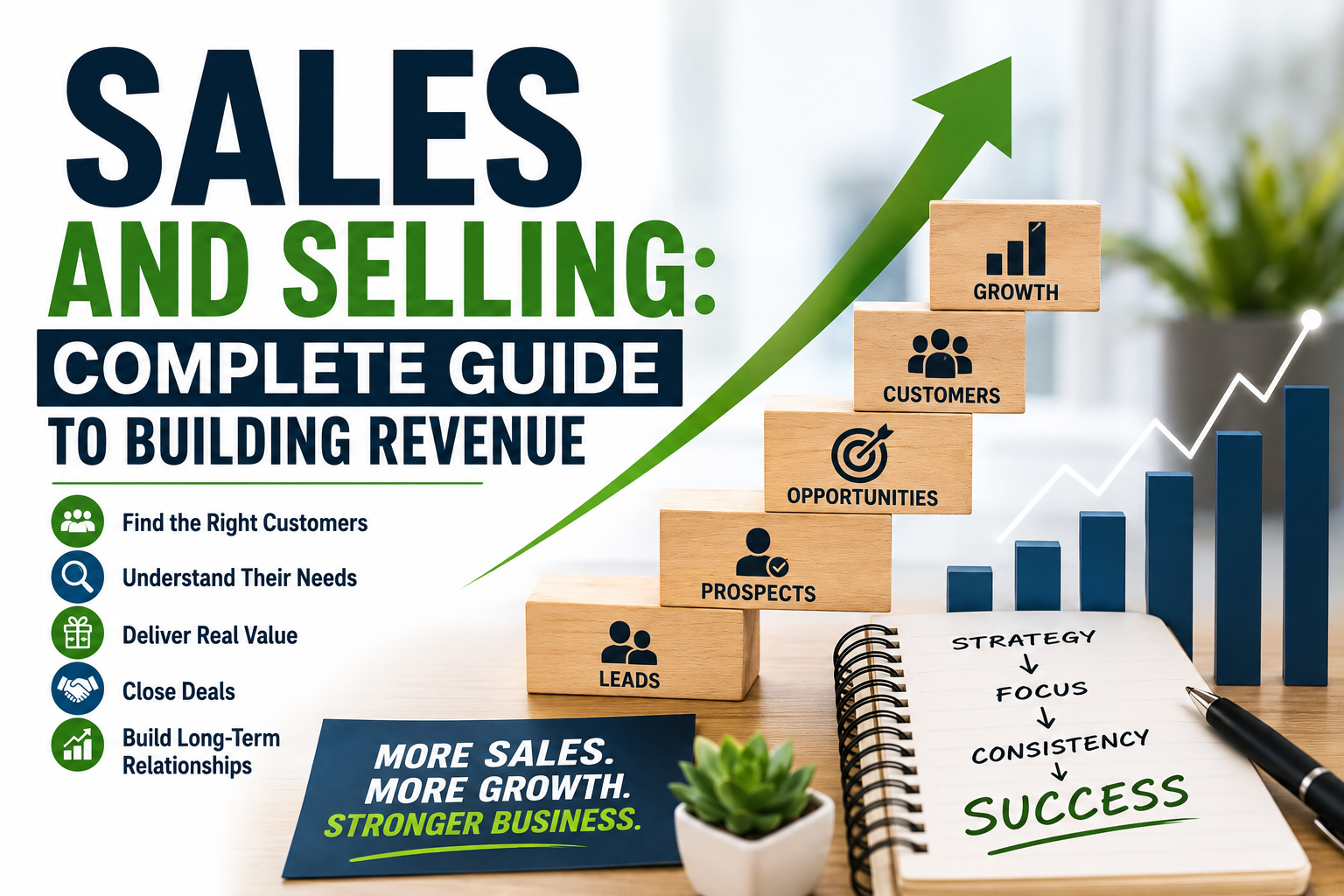
Sales and Selling: Complete Guide to Building Revenue
Revenue is the lifeblood of every commercial organization. A business can have a strong product, talented employees and an attractive brand, but without customers willing to pay for what it offers, sustainable growth becomes difficult.
That’s where sales comes in.
Sales is more than persuading someone to buy something. Modern selling involves understanding customer problems, communicating value, building trust, managing relationships and creating a buying experience that makes sense for both sides.
Whether you’re launching a small business, managing a sales team or trying to improve an established company’s growth engine, understanding the fundamentals of sales can help turn scattered customer activity into a repeatable revenue system.
This complete guide explains how sales works, the major selling approaches, how to build a sales process, how to find customers, how to handle objections, how to measure performance and how to create a sales strategy that supports long-term business growth.
Key idea: Sustainable sales isn’t about convincing everyone to buy. It’s about finding the right customers, understanding what they need and demonstrating why your solution is worth paying for.
What Is Sales?
Sales is the process of identifying potential customers, understanding their needs, presenting a relevant solution and helping them make a purchasing decision.
At its simplest, the sales process connects two things:
A customer problem or desire → A product or service that provides value.
Sales can happen through many channels, including:
- In-person meetings
- Telephone calls
- Websites
- Online stores
- Social media
- Demonstrations
- Consultations
- Retail locations
- Partner networks
- Self-service purchasing systems
The mechanics may differ, but the fundamental objective remains the same: create an exchange of value that benefits the customer and the business.
Why Sales Matters to Business Growth
Marketing can create awareness.
Product development can create solutions.
Operations can deliver those solutions.
But sales helps convert market interest into revenue.
A healthy sales function can help a business:
- Generate revenue
- Acquire new customers
- Increase average customer value
- Enter new markets
- Launch new products
- Build customer relationships
- Identify market demand
- Gather customer feedback
- Improve pricing decisions
- Create predictable growth
Sales also provides information that other departments may not see directly.
Salespeople hear customers explain:
- Why they are considering a purchase
- What alternatives they are evaluating
- What concerns prevent them from buying
- Which features matter most
- What they think is too expensive
- What competitors are offering
- What problems remain unsolved
That information can influence marketing, product development, customer service and business strategy.
Sales and Marketing Are Not the Same Thing
Sales and marketing are closely connected, but they perform different functions.
Marketing
Marketing generally focuses on creating awareness, generating interest and attracting potential customers.
Sales
Sales generally focuses on converting qualified opportunities into customers and generating revenue.
A simplified model looks like this:
Marketing → Attention → Interest → Leads → Sales → Customers → Retention
In reality, the process is rarely linear.
Customers may discover a company through marketing, speak with sales, return to the website, compare competitors, ask questions and then purchase weeks or months later.
The strongest organizations therefore treat sales and marketing as complementary parts of one customer journey.
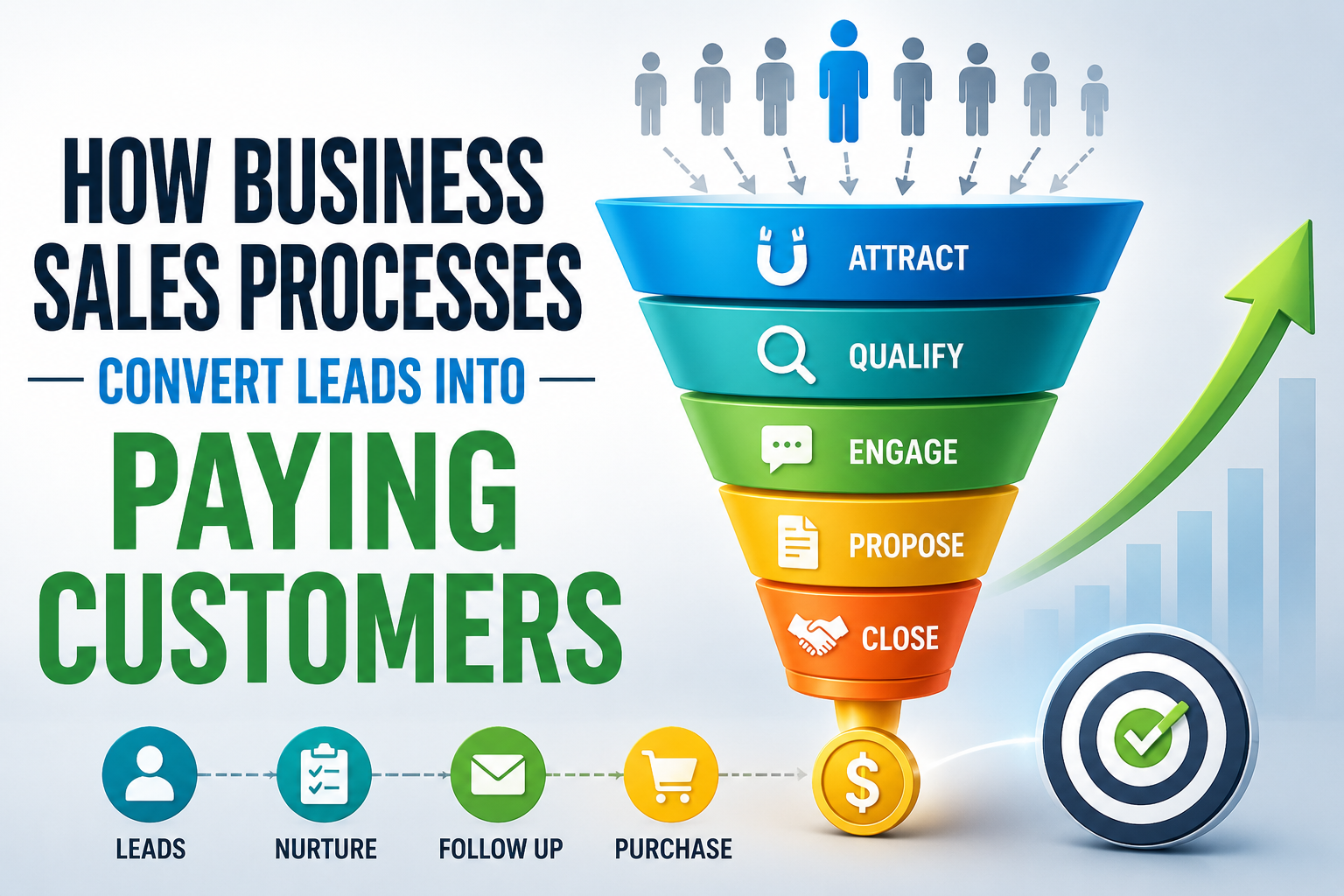
Understanding the Sales Funnel
The sales funnel describes how potential customers move from initial awareness toward purchasing.
A basic funnel may include:
- Awareness
- Interest
- Consideration
- Evaluation
- Purchase
- Retention
- Advocacy
Not every prospect reaches the bottom.
A large number of people may discover your business, but only a percentage will become leads. Some leads will become qualified opportunities, and some opportunities will become paying customers.
This is why sales teams need to understand conversion rates at every stage.
What Is a Sales Lead?
A sales lead is a person or organization that may have some potential to become a customer.
Leads can come from:
- Website forms
- Phone inquiries
- Referrals
- Advertising
- Social media
- Events
- Search engines
- Email campaigns
- Existing customers
- Partnerships
- Direct outreach
However, not every lead is equally valuable.
Someone who downloads a free guide may have very different purchasing intent from someone who requests a proposal.
That’s why businesses need a process for qualifying leads.
Lead Generation Explained
Lead generation is the process of attracting and identifying potential customers.
A business can generate leads through both inbound and outbound methods.
Inbound Lead Generation
Inbound methods encourage potential customers to discover the business.
Examples include:
- Search engine optimization
- Educational content
- Social media
- Email newsletters
- Webinars
- Online communities
- Free tools
- Referral programs
The prospect initiates some form of engagement.
Outbound Lead Generation
Outbound methods involve proactively approaching potential customers.
Examples include:
- Cold calling
- Cold email
- Direct messaging
- Business networking
- Sales events
- Account-based outreach
- Partnership development
Neither approach is automatically superior.
The appropriate method depends on the product, market, customer, sales cycle and available resources.
What Is a Qualified Lead?
Qualification determines whether a potential customer is worth pursuing.
A basic qualification process might examine:
- Does the prospect have a relevant problem?
- Do they need the product or service?
- Can they afford it?
- Do they have authority to make the decision?
- Is there a realistic timeframe?
- Is the solution appropriate?
- Is there genuine interest?
Some organizations use formal qualification frameworks, while smaller businesses may rely on simpler criteria.
The goal is the same:
Spend more time on opportunities that have a realistic chance of becoming valuable customers.
The Core Sales Process
A well-designed sales process gives salespeople a repeatable path from prospecting to closing.
A typical process looks like this:
1. Prospecting
Identify potential customers.
2. Qualification
Determine whether those prospects are a good fit.
3. Discovery
Understand their situation, needs and priorities.
4. Presentation
Explain how your solution addresses the relevant problem.
5. Objection Handling
Address concerns about price, timing, risk, implementation or alternatives.
6. Proposal
Present the commercial terms where appropriate.
7. Negotiation
Resolve legitimate differences over scope, pricing or conditions.
8. Closing
Complete the purchasing decision.
9. Onboarding
Help the new customer begin using the product or service successfully.
10. Follow-Up
Maintain the relationship and identify opportunities for retention, expansion or referral.
The strongest sales organizations treat the process as a system rather than expecting individual salespeople to improvise every step.
Prospecting: Finding the Right Customers
Prospecting is often where sales begins.
But effective prospecting isn’t simply about finding as many people as possible.
It’s about finding the right people.
A business should define its ideal customer profile.
This can include characteristics such as:
- Industry
- Company size
- Location
- Budget
- Job role
- Business model
- Customer needs
- Purchasing behavior
- Existing technology
- Operational challenges
For consumer businesses, the profile may instead include:
- Age range
- Household characteristics
- Location
- Interests
- Purchasing habits
- Income range
- Lifestyle needs
- Problems the product solves
The more clearly a company understands its ideal customer, the easier it becomes to focus sales resources.
The Importance of Customer Pain Points
People rarely buy products simply because products exist.
They buy because they expect something to improve.
That improvement might involve:
- Saving time
- Reducing costs
- Increasing revenue
- Improving convenience
- Reducing risk
- Solving a frustrating problem
- Improving status or appearance
- Increasing productivity
- Achieving a personal goal
A strong sales conversation therefore begins with the customer’s situation rather than immediately listing product features.
Instead of saying:
“Our software has 50 features.”
A salesperson might explore:
“What is currently slowing your team down?”
That question can reveal whether the product actually addresses a meaningful problem.
Features vs. Benefits
One of the most important distinctions in selling is the difference between features and benefits.
Feature
What the product has or does.
Benefit
What the customer gains from that feature.
For example:
Feature: Automated invoice reminders.
Benefit: Customers spend less time manually following up on overdue invoices.
The feature describes the product.
The benefit explains why the customer should care.
Strong sales communication connects the two.
The Discovery Conversation
Discovery is one of the most valuable stages of a sales process.
Its purpose is to understand the prospect before recommending a solution.
Useful discovery questions might include:
- What problem are you trying to solve?
- How are you handling it today?
- What isn’t working?
- How much time does the problem consume?
- What does the problem cost the business?
- What have you already tried?
- What would an ideal solution look like?
- Who else is involved in the decision?
- What timeline are you working with?
The salesperson should listen carefully rather than treating discovery as a checklist.
A prospect’s answers often reveal opportunities that weren’t obvious from the initial inquiry.
Why Listening Is a Sales Skill
Selling is often associated with talking.
In practice, effective salespeople spend considerable time listening.
Active listening can involve:
- Paying attention without interrupting
- Asking clarifying questions
- Reflecting important points
- Confirming understanding
- Noticing concerns
- Distinguishing symptoms from underlying problems
A salesperson who listens well can tailor the conversation instead of delivering the same pitch to every customer.
Building a Strong Sales Pitch
A sales pitch should explain three things:
- What problem exists?
- How does the solution address it?
- Why should the customer choose this solution?
A simple structure is:
Problem → Impact → Solution → Evidence → Next Step
For example:
Many small businesses lose time manually following up on invoices. Our automated reminder system handles those follow-ups automatically, reducing administrative work while helping businesses keep track of outstanding payments. Here’s how it works…
The pitch becomes more compelling when it reflects a problem the customer already recognizes.
Social Proof and Trust in Selling
Customers often want evidence before making a purchase.
Useful forms of social proof can include:
- Customer testimonials
- Case studies
- Reviews
- Demonstrations
- Before-and-after examples
- Industry certifications
- Independent research
- Client references
- Product data
- Guarantees where appropriate
Trust is particularly important for expensive or high-risk purchases.
The more consequential the decision, the more evidence customers may want before committing.
Businesses should never fabricate testimonials, reviews or performance claims.
Authenticity matters.
Handling Sales Objections
Objections are normal.
A prospect may say:
- “It’s too expensive.”
- “We need to think about it.”
- “We’re already using another provider.”
- “We don’t have the budget.”
- “This isn’t the right time.”
- “I need to speak with my manager.”
- “I’m not convinced it will work.”
The worst response is to become defensive.
Instead, understand the concern.
A useful framework is:
Listen
Allow the customer to explain the objection.
Clarify
Make sure you understand what is actually preventing the purchase.
Respond
Provide relevant information.
Confirm
Ask whether the concern has been addressed.
For example:
“When you say it’s too expensive, is the concern the total budget available, or whether the expected results justify the investment?”
That question can reveal whether the real issue is price, value, timing or risk.
Price Objections and Value
“Too expensive” doesn’t always mean the price is objectively too high.
It can mean:
- The customer doesn’t have enough budget.
- The value isn’t clear.
- The customer doesn’t trust the product.
- The customer found a cheaper alternative.
- The timing isn’t right.
- The product isn’t a strong enough priority.
A salesperson shouldn’t automatically discount the price.
Instead, determine what the customer is comparing.
If a product costs more but produces significantly greater value, the conversation should focus on the economic outcome, not simply the sticker price.
How to Close a Sale
Closing means helping the customer move from consideration to a purchasing decision.
Closing doesn’t have to involve aggressive tactics.
A simple close might be:
“Would you like to move forward with the standard package or the premium package?”
Another approach is a next-step close:
“Would Tuesday or Thursday work better for the implementation call?”
The key is that the customer should understand what happens next.
Ethical selling doesn’t pressure people into purchases that aren’t appropriate for them.
Common Sales Closing Techniques
Several closing approaches are commonly used.
Direct Close
Ask directly for the business.
Alternative Close
Offer two appropriate options.
Summary Close
Summarize the benefits the customer has identified as important.
Trial Close
Ask whether the proposed solution appears to address the customer’s needs.
Next-Step Close
Agree on a specific action that moves the opportunity forward.
The best closing technique depends on the customer and situation.
Sales Negotiation
Negotiation becomes necessary when buyer and seller have different expectations.
Common negotiation areas include:
- Price
- Quantity
- Contract length
- Payment terms
- Delivery
- Service levels
- Implementation
- Features
- Support
- Renewal terms
Businesses should avoid negotiating against themselves.
Before entering negotiations, establish:
- Ideal outcome
- Acceptable outcome
- Non-negotiable requirements
- Available concessions
- Customer priorities
- Business priorities
A concession should ideally receive something in return.
For example:
“If we reduce the upfront price, we would need a longer contract commitment.”
This is generally more sustainable than simply lowering prices whenever a prospect asks.
Why Discounting Can Be Dangerous
Discounts can help close deals, but excessive discounting can damage a business.
It can:
- Reduce margins
- Lower perceived value
- Train customers to wait for discounts
- Make future price increases harder
- Create inconsistent pricing
- Attract customers who are primarily price-sensitive
Discounts should have a clear strategic purpose.
Sometimes a better solution is to adjust:
- Scope
- Quantity
- Contract length
- Payment schedule
- Service level
rather than simply reducing the price.
Sales Channels Explained
Businesses can sell through multiple channels.
Direct Sales
The company sells directly to customers.
Retail Sales
Products are sold through physical retail locations.
E-Commerce
Customers purchase through an online store.
Inside Sales
Salespeople communicate remotely through phone, email or video.
Field Sales
Sales representatives meet customers in person.
Partner Sales
Third parties sell or refer the company’s products.
Self-Service Sales
Customers research and purchase independently through a website or application.
A business can use one channel or combine several.
B2B vs. B2C Sales
Sales processes differ depending on the customer.
Business-to-Consumer Sales
B2C sales typically involve individual consumers.
The purchasing process may be relatively short.
Factors can include:
- Price
- Convenience
- Brand
- Reviews
- Availability
- Personal preference
Business-to-Business Sales
B2B sales often involve organizations.
They can involve:
- Multiple decision-makers
- Larger purchases
- Longer sales cycles
- Contracts
- Procurement processes
- Demonstrations
- Negotiations
- Implementation requirements
The sales process must therefore account for organizational decision-making.
Sales Cycle Length
The sales cycle is the amount of time between the beginning of an opportunity and the purchase.
Some sales cycles are extremely short.
A consumer might purchase a product within minutes.
Others can take months or longer.
Factors influencing sales-cycle length include:
- Product complexity
- Purchase price
- Customer risk
- Number of decision-makers
- Contract requirements
- Procurement procedures
- Competition
- Budget availability
- Implementation complexity
Understanding the typical sales cycle helps businesses forecast revenue more realistically.
Customer Relationship Management
A customer relationship management (CRM) system helps businesses organize information about prospects and customers.
A CRM can track:
- Contact details
- Sales opportunities
- Conversations
- Meetings
- Follow-up tasks
- Proposals
- Purchase history
- Customer status
- Sales-stage progression
The value of a CRM isn’t the software itself.
The value comes from having accurate information that allows a sales team to understand what is happening with each opportunity.
Poor data produces poor decisions.
Sales Pipeline Management
A sales pipeline shows active opportunities and their current stages.
A simple pipeline might contain:
| Stage | Example Status |
|---|---|
| Prospect | Potential customer identified |
| Qualified | Need and fit established |
| Discovery | Customer requirements being explored |
| Proposal | Commercial offer presented |
| Negotiation | Terms being discussed |
| Closed Won | Customer purchased |
| Closed Lost | Opportunity ended |
Pipeline management helps managers identify bottlenecks.
If hundreds of prospects enter the pipeline but very few reach proposal stage, qualification or discovery may need improvement.
If many proposals are created but few close, the issue might involve pricing, value communication, competition or decision-making.
Essential Sales Metrics
You can’t effectively manage a sales organization without measuring performance.
Important metrics include:
Revenue
Total sales generated.
Number of New Customers
Measures customer acquisition.
Conversion Rate
Percentage of prospects or opportunities that become customers.
Average Deal Size
Average revenue generated per transaction.
Sales Cycle Length
Average time required to close a deal.
Customer Acquisition Cost
The cost associated with acquiring a customer.
Customer Lifetime Value
The expected economic value of a customer over the relationship.
Win Rate
Percentage of qualified opportunities that become customers.
Pipeline Value
Estimated value of active opportunities.
Retention Rate
Percentage of customers who remain customers over a defined period.
Metrics should be used to diagnose the business rather than simply create pressure for salespeople.
Revenue Forecasting
Sales forecasting estimates future revenue based on current opportunities and historical performance.
A basic forecast might consider:
Opportunity value × Probability of closing = Weighted pipeline value
For example:
- $20,000 opportunity
- 50% estimated probability
Weighted value:
$20,000 × 0.50 = $10,000
Businesses can aggregate these estimates across opportunities to develop a pipeline-based forecast.
However, probability estimates need to be based on meaningful evidence.
Simply assigning every opportunity a convenient percentage can make a forecast look precise while providing little useful information.
Customer Retention Is Part of Sales
Acquiring a customer is only one part of revenue generation.
Keeping that customer can be equally important.
Retention strategies can include:
- Good onboarding
- Reliable customer support
- Regular communication
- Product education
- Customer success programs
- Loyalty programs
- Renewals
- Upselling
- Cross-selling
- Feedback collection
A customer who remains satisfied can potentially purchase repeatedly and refer others.
That’s why sales shouldn’t end at the moment a transaction is completed.
Upselling and Cross-Selling
Upselling
Encouraging a customer to purchase a higher-value version of something they already want.
Cross-Selling
Offering a complementary product or service.
For example:
A customer purchasing a laptop might also need:
- A carrying case
- A monitor
- A keyboard
- Backup storage
Cross-selling is most effective when the additional product genuinely improves the customer’s outcome.
Randomly adding products simply to increase transaction value can damage trust.
Referral-Based Sales
Satisfied customers can become one of the most valuable sources of new business.
A referral system can encourage customers to recommend a company to people they know.
Strong referral programs generally work best when:
- The underlying product is good.
- Customers receive genuine value.
- Asking for referrals feels natural.
- The referral process is easy.
- Incentives are clearly explained where used.
No referral campaign can compensate indefinitely for a poor customer experience.
Building a High-Performing Sales Team
A sales team needs more than talented individual sellers.
It needs:
- Clear goals
- Defined customer segments
- A repeatable sales process
- Training
- Good sales tools
- Accurate data
- Effective management
- Incentive structures
- Coaching
- Accountability
Managers should regularly review both results and behaviors.
A salesperson who misses a target may have a problem with:
- Prospecting
- Qualification
- Discovery
- Presentation
- Follow-up
- Negotiation
- Closing
The solution depends on identifying the actual bottleneck.
Sales Training Fundamentals
Effective sales training can cover:
Product Knowledge
Salespeople need to understand what they are selling.
Customer Knowledge
They need to understand who buys the product and why.
Communication
They need to explain complex ideas clearly.
Discovery
They need to ask useful questions.
Objection Handling
They need to respond to concerns without becoming defensive.
Negotiation
They need to protect value while finding mutually acceptable terms.
CRM Discipline
They need to maintain accurate records.
Ethical Selling
They need to know when a product isn’t appropriate for a customer.
Training should be ongoing rather than a one-time event.
Common Sales Mistakes
Selling Before Understanding
Jumping into a pitch without understanding the customer can make the conversation irrelevant.
Talking Too Much
A salesperson who dominates the conversation may miss important information.
Focusing Only on Price
Customers often care about outcomes, reliability, convenience and risk—not price alone.
Pursuing Every Lead
Not every prospect is worth pursuing.
Ignoring Existing Customers
Acquisition without retention creates an expensive growth model.
Overpromising
Promises that can’t be delivered eventually damage trust.
Failing to Follow Up
Many legitimate opportunities disappear because no one maintains contact.
Offering Discounts Too Quickly
Discounting can reduce profitability without solving the actual objection.
Using Manipulative Tactics
Pressure may generate a short-term transaction but damage long-term relationships.
Ethical Selling and Long-Term Trust
A strong sales organization should know when not to sell.
If a product isn’t appropriate for a customer, the responsible action may be to explain that honestly.
Ethical selling means:
- Making accurate claims
- Being transparent about pricing
- Explaining important limitations
- Avoiding deceptive pressure
- Respecting customer decisions
- Protecting customer information
- Following applicable laws and regulations
- Delivering what was promised
Trust is an economic asset.
A company that repeatedly disappoints customers may eventually find that the cost of damaged reputation is far greater than the revenue from individual transactions.
How Technology Is Changing Sales
Technology has transformed how sales teams find prospects, communicate with customers and analyze performance.
Modern sales organizations may use:
- CRM platforms
- Marketing automation
- Video conferencing
- Sales analytics
- Email automation
- Customer-support platforms
- E-commerce systems
- Artificial intelligence
- Conversation intelligence
- Data enrichment tools
Technology can reduce repetitive work and help salespeople prioritize opportunities.
But technology doesn’t replace the need for understanding customers.
Automation can make a bad sales process faster without making it better.
The Role of Artificial Intelligence in Sales
AI can assist sales teams with tasks such as:
- Summarizing customer conversations
- Drafting emails
- Analyzing sales calls
- Identifying patterns in pipeline data
- Prioritizing opportunities
- Generating research summaries
- Automating routine administrative work
- Personalizing certain communications
However, businesses should consider accuracy, privacy, security and human oversight when deploying AI systems.
The best use of AI is often to augment salespeople rather than eliminate the human judgment required for complex customer relationships.
How to Build a Sales Strategy
A sales strategy should connect the company’s business objectives with its approach to customers.
A practical framework includes:
1. Define the Revenue Goal
How much revenue does the business need to generate?
2. Define the Ideal Customer
Who is most likely to benefit from the product?
3. Define the Value Proposition
Why should customers choose the company?
4. Choose Sales Channels
Where will customers be reached?
5. Build the Sales Process
How does a prospect move from first contact to purchase?
6. Establish Pricing
How will the product or service be priced?
7. Define Metrics
How will performance be measured?
8. Train the Team
What skills and knowledge are required?
9. Implement Technology
Which tools will support the process?
10. Review and Improve
Which stages are producing the strongest and weakest results?
A Simple Sales Strategy Example
Imagine a company selling accounting software to small businesses.
Its strategy might look like this:
Target customer: Small businesses with growing administrative workloads.
Core problem: Manual bookkeeping consumes time and creates reporting difficulties.
Value proposition: Simplify financial administration and provide better visibility into business finances.
Lead generation: Educational content, search traffic, partnerships and targeted outreach.
Sales process: Free consultation → needs assessment → demonstration → proposal → onboarding.
Key metrics:
- Qualified leads
- Demonstrations booked
- Demo-to-customer conversion
- Average subscription value
- Customer acquisition cost
- Retention rate
The strategy connects customer problems to a measurable revenue process.
How to Improve Sales Performance
If sales are declining, don’t immediately assume the salespeople need to “sell harder.”
Diagnose the system.
If leads are low:
Examine marketing and prospecting.
If leads are high but qualification is poor:
Improve targeting.
If qualified prospects don’t book meetings:
Review outreach and value communication.
If meetings don’t become proposals:
Improve discovery and qualification.
If proposals don’t close:
Examine value, pricing, competition and objections.
If customers leave quickly:
Investigate onboarding and product quality.
This approach identifies the actual constraint instead of treating every sales problem as a motivation problem.
The Economics of Sustainable Revenue
Revenue growth isn’t automatically healthy growth.
A company can increase sales while becoming less profitable if acquisition costs, discounts or delivery expenses rise too quickly.
That’s why businesses should evaluate:
Revenue + Gross Margin + Customer Acquisition Cost + Retention + Customer Lifetime Value
together.
A customer generating $10,000 in revenue isn’t necessarily valuable if acquiring and servicing that customer costs $9,500.
Sustainable growth requires understanding the economics behind each sale.
Sales and Customer Experience
The sales process creates expectations.
If a salesperson promises:
- Fast delivery
- Exceptional support
- Certain features
- Specific results
the rest of the organization needs to deliver accordingly.
A disconnect between sales promises and customer experience creates frustration.
The best sales organizations therefore work closely with:
- Operations
- Customer service
- Product teams
- Finance
- Marketing
Sales isn’t an isolated department.
It is part of the complete customer experience.
A Practical Sales Improvement Checklist
Businesses looking to improve their sales operation can start with these questions:
- Do we clearly understand our ideal customer?
- Is our value proposition easy to explain?
- Are we generating enough qualified leads?
- Are we qualifying leads consistently?
- Do salespeople ask enough discovery questions?
- Are we tracking opportunities accurately?
- Do we know where prospects leave the funnel?
- Are our prices aligned with customer value?
- Are objections documented and analyzed?
- Are proposals easy to understand?
- Do we follow up consistently?
- Are customers satisfied after purchase?
- Are we measuring retention?
- Do sales and marketing share information?
- Are sales forecasts based on reliable data?
The answers can reveal where the biggest opportunities lie.
The Future of Selling
The future of sales is unlikely to be defined by a single technique or technology.
Instead, successful businesses will increasingly combine:
- Better customer data
- Personalized communication
- Automation
- AI-assisted workflows
- Strong content
- Self-service purchasing
- Human expertise
- Transparent pricing
- Customer education
- Long-term relationship management
Buyers already have more access to information than ever before.
That changes the salesperson’s role.
Instead of simply providing information the customer could find elsewhere, salespeople increasingly need to provide context, expertise, problem-solving and confidence in the purchasing decision.
The companies that adapt to this shift can build stronger relationships while reducing unnecessary friction in the buying process.
Turning Sales Into a Predictable Revenue Engine
Great sales isn’t about having the most aggressive salesperson in the room.
It’s about creating a system that consistently connects the right customers with the right solutions.
That system starts with understanding the market and continues through prospecting, qualification, discovery, value communication, negotiation, closing and customer retention.
The strongest businesses don’t treat every sale as an isolated transaction. They build processes that generate useful data, learn from customer feedback, improve their offering and create reasons for customers to return.
When sales, marketing, product, operations and customer service work toward the same customer outcome, revenue becomes more than a number on a financial statement.
It becomes the measurable result of consistently creating value for the people a business is built to serve.


2 Comments
Micle harison
June 7, 2019Lorem ipsum dolor sit amet, usu ut perfecto postulant deterruisset, libris causae volutpat at est, ius id modus laoreet urbanitas. Mel ei delenit dolores.
John Doe
June 7, 2019Some consultants are employed indirectly by the client via a consultancy staffing company.