
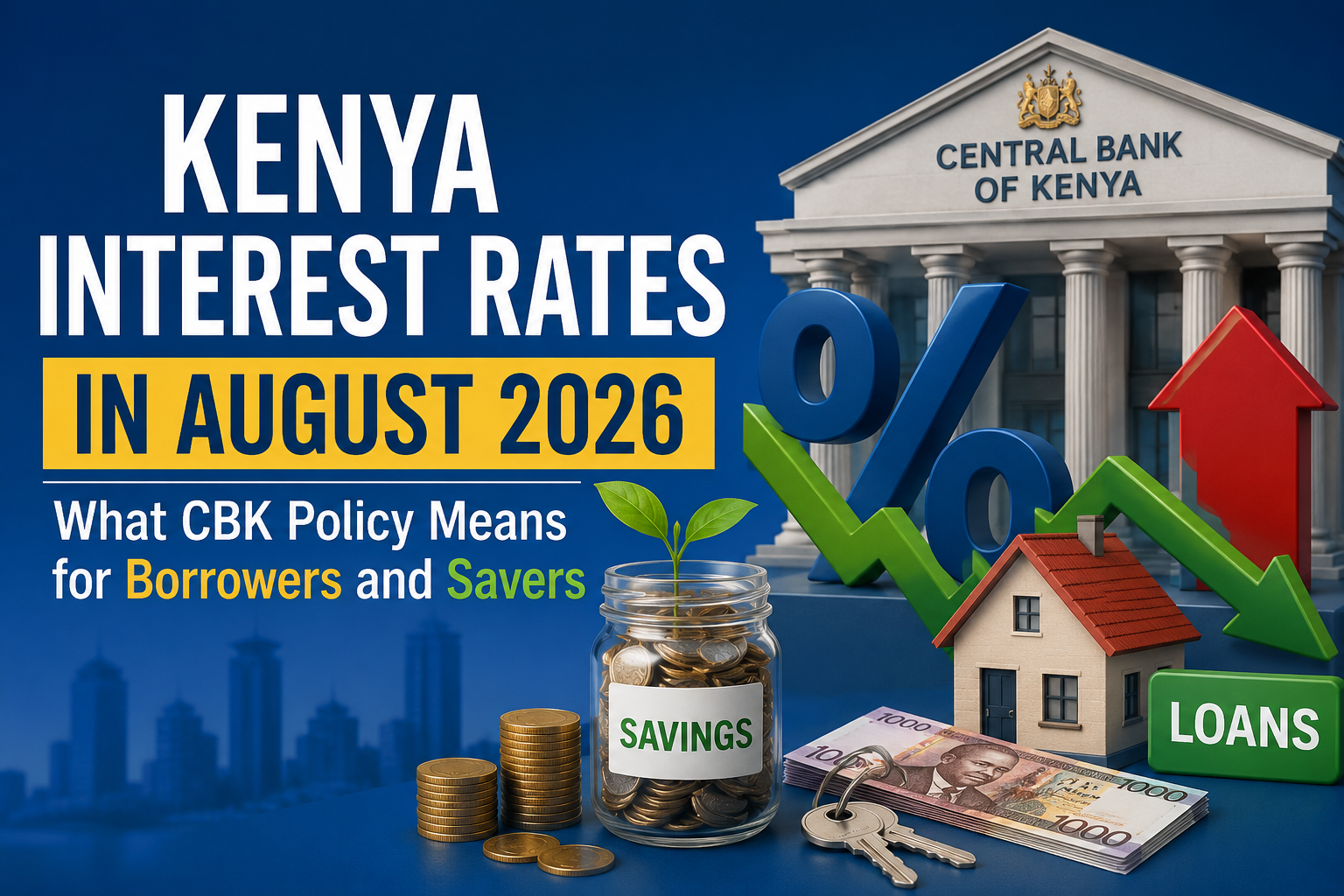
Kenya Interest Rates in August 2026: What CBK Policy Means for Borrowers and Savers
Kenya’s interest-rate environment remains a major factor for households deciding whether to borrow, save, invest or simply keep more cash in the bank. The Central Bank of Kenya (CBK) has spent the past year lowering its benchmark rate as inflation remained within its target range and monetary conditions improved.
As of the latest CBK figures available in mid-July, the Central Bank Rate (CBR) stood at 8.75%, while KESONIA was around 8.75%. CBK’s published figures also showed average lending rates at about 14.5% and savings rates at roughly 3.23%, although individual banks can offer materially different rates. [Central Bank of Kenya]
That means the headline policy rate is only part of the story. For ordinary Kenyans, the more important question is how monetary policy eventually shows up in loan repayments, deposit rates, mortgages, business credit and the purchasing power of savings.
Important August 2026 note: The latest official CBK data accessible for this article showed the CBR at 8.75% as of April 8, 2026. I could not verify a newer August MPC decision from CBK’s currently indexed publications, so this article does not assume an August rate change that has not been independently confirmed.
What Is the CBK Central Bank Rate?
The Central Bank Rate, commonly called the CBR, is the benchmark policy rate used by the CBK to influence monetary and financial conditions in Kenya.
When the CBK changes the policy rate, the effect does not necessarily appear immediately in the interest rate on every loan or savings account. Commercial banks consider several factors when setting their own rates, including their funding costs, credit risk, operating expenses, competition and the characteristics of individual borrowers.
The CBK has also been working to improve how monetary-policy decisions are transmitted to commercial lending rates. Its monetary-policy materials have highlighted declining interest rates and improved credit conditions as important channels through which monetary policy can support economic activity. [Central Bank of Kenya]
Why Kenya’s Interest Rates Matter to Households
Interest rates affect two sides of personal finance.
Borrowers care about the cost of credit. A lower lending environment can reduce the cost of servicing variable-rate loans or make new borrowing more affordable.
Savers, meanwhile, earn interest on deposits and fixed-income products. When market rates decline, however, banks may eventually reduce the returns offered on some deposit products.
This creates an important trade-off: falling rates can be good news for borrowers while making it more difficult for conservative savers to earn high returns on ordinary deposits.
What Lower Interest Rates Could Mean for Borrowers
1. Loan repayments may become more manageable
The biggest potential benefit of lower interest rates is cheaper credit.
For someone taking out a new loan, a lower effective borrowing rate can reduce the amount of interest paid over the life of the facility.
The impact can be particularly important for:
- Home loans
- Business loans
- Asset-financing facilities
- Personal loans
- Working-capital facilities
- Other variable-rate borrowing
However, borrowers should not assume that a reduction in the CBR automatically means their bank will reduce their loan rate by exactly the same amount.
2. Existing borrowers should check their loan terms
People who already have loans should look carefully at the pricing mechanism in their agreements.
Some loans are linked to a benchmark or reference rate, while others may have fixed pricing for a specified period. The timing and size of any change can therefore vary from one borrower to another.
Before refinancing or taking a new loan, check:
- Current outstanding balance
- Interest rate
- Whether the rate is fixed or variable
- Remaining repayment period
- Monthly installment
- Fees and charges
- Early repayment penalties
- Insurance costs
- Any benchmark used to determine the interest rate
A loan with a lower advertised rate is not automatically cheaper if it comes with substantially higher fees or a longer repayment period.
Lower Rates Could Also Help Businesses
Interest rates are particularly important for small and medium-sized businesses that depend on bank financing.
When borrowing becomes less expensive, businesses may find it easier to finance:
- Inventory
- Equipment
- Expansion
- Working capital
- Vehicles
- New branches
- Technology
- Property
The CBK reported in April that private-sector credit growth had improved, with credit growth reaching 8.1% in March from 7.4% in February. It also noted stronger credit demand in areas including construction, trade, agriculture and consumer durables. [KBC]
For entrepreneurs, however, cheaper credit should not be confused with cheap money. Borrowing still needs to generate enough additional income to justify its cost.
What CBK Policy Means for Savers
The picture is more complicated for people who rely on bank deposits for income.
CBK’s July figures showed a savings rate of about 3.23% and a deposit rate of approximately 6.8% based on the latest available May data published on its website. [Central Bank of Kenya]
The distinction matters because “savings rate” and “deposit rate” are not necessarily the same thing.
A basic savings account may pay a relatively low rate, while a fixed deposit or other deposit product may offer a higher return in exchange for restrictions on accessing the money.
Savers should therefore compare products rather than simply watching the CBR.
Before moving money, look at:
- Annual interest rate
- Minimum balance
- Fees
- Withdrawal restrictions
- Interest-payment frequency
- Deposit insurance considerations
- Tax treatment where applicable
- Whether the quoted rate is fixed or subject to change
The most attractive headline rate is not always the best option if accessing the money becomes difficult or fees substantially reduce the effective return.
Inflation Matters More Than the Interest Rate Alone
A savings account can pay interest while still losing purchasing power in real terms.
For example, suppose a savings product pays 5% annually, while inflation is 6%. Your account balance has increased in nominal terms, but the purchasing power of that money has fallen.
Kenya’s official inflation data showed annual consumer inflation at 6.4% in June 2026, driven particularly by food and non-alcoholic beverages, transport, and housing-related costs. [Kenya National Bureau of Statistics]
This is why savers should think about the real return on their money rather than looking only at the nominal interest rate.
A simplified way to think about it is:
Real return ≈ interest rate − inflation rate
The actual calculation is slightly more complicated, but the principle is useful: what matters is how much your money’s purchasing power changes after accounting for inflation.
Should You Borrow More When Rates Fall?
Not necessarily.
A lower-rate environment can make borrowing more attractive, but it does not make unnecessary debt financially sensible.
Before taking a loan, ask:
- Do I actually need the money?
- What will the loan finance?
- Can the purchase generate income?
- What will the total repayment be?
- Can I still afford the installment if rates rise?
- What happens to my finances if my income falls?
- Are there cheaper alternatives?
For a business, borrowing to purchase productive equipment may make sense if the additional income comfortably exceeds the financing cost.
Borrowing simply to increase discretionary spending is a very different proposition.
What Borrowers Should Do in August 2026
Review existing loans
Check your current interest rate and determine whether your loan pricing has changed as market rates have declined.
Compare refinancing options
If another lender offers substantially better terms, calculate the total cost of switching, including processing, legal, valuation, insurance and other charges.
Avoid extending debt unnecessarily
A lower monthly installment can sometimes result from extending the loan term rather than substantially reducing the overall cost of borrowing.
Consider accelerating expensive debt
If you have multiple loans, prioritize high-cost debt where possible.
Keep an emergency fund
Lower borrowing rates do not eliminate the need for accessible cash reserves. Ideally, financial decisions should leave enough liquidity to handle unexpected expenses.
What Savers Should Do in August 2026
Compare your bank’s savings rate
Don’t assume your current account is paying a competitive return.
Consider fixed deposits for money you don’t need immediately
A fixed deposit can potentially provide a higher return than a standard savings account, but money may be less accessible.
Don’t chase rates blindly
Moving money between institutions for a slightly higher advertised rate may not be worthwhile if the product has restrictive terms or additional fees.
Match the product to the purpose
Emergency money should prioritize accessibility. Long-term savings can potentially tolerate less liquidity if the return justifies it.
Think beyond ordinary savings accounts
Depending on your goals, risk tolerance and financial circumstances, savers may also consider other regulated savings and investment products rather than keeping every shilling in a conventional bank account.
How Interest Rates Affect Mortgages
For prospective homeowners, interest rates can significantly influence affordability.
A mortgage with a lower interest rate can mean:
- Lower monthly payments
- Lower total interest over the loan period
- Greater borrowing capacity
- Potentially improved housing affordability
But borrowers should be careful when comparing mortgages.
A meaningful comparison should consider the effective total cost, not simply the advertised interest rate.
A loan with a slightly lower rate but substantially higher fees may not be the cheapest option.
Homebuyers should also consider whether their income could withstand a future increase in repayments if they choose a variable-rate facility.
What About Money Market Funds and Other Investments?
A changing interest-rate environment also affects investment decisions.
Money market funds and other short-term fixed-income investments generally invest in instruments whose returns are influenced by prevailing market interest rates. As rates move lower, returns available on newly acquired short-term instruments can eventually decline.
That does not mean investors should automatically abandon such products.
The right choice depends on:
- Investment horizon
- Liquidity needs
- Risk tolerance
- Expected returns
- Fees
- Tax considerations
- Diversification
Investors should compare the after-fee and after-tax return with their financial objective rather than chasing whichever product currently displays the highest yield.
The Bigger Picture for Kenya’s Economy
Interest-rate policy is not only about personal loans and savings accounts.
The CBK’s monetary policy decisions are designed to balance several objectives, including maintaining price stability while supporting sustainable economic activity.
The bank has previously emphasized that inflation remained within its target range, the shilling was stable and declining interest rates were supporting private-sector credit and economic growth. [Central Bank of Kenya]
At the same time, inflation remains important for household budgets. Kenya’s June inflation rate of 6.4% shows why consumers cannot judge their financial position based on interest rates alone. [Kenya National Bureau of Statistics]
If inflation rises significantly, the room for further monetary easing could become more limited. Conversely, continued price stability could provide more flexibility for monetary policy.
What to Watch Next
For Kenyan borrowers and savers, several indicators deserve attention during the coming months:
CBK monetary-policy decisions
Future MPC decisions will provide the clearest indication of whether the easing cycle continues, pauses or reverses.
Inflation
Changes in food, transport, energy and housing costs will influence the monetary-policy environment.
Commercial bank lending rates
The CBR is important, but consumers ultimately pay the rate attached to their individual loans.
Deposit and savings rates
Savers should monitor whether banks adjust deposit returns as market rates change.
Private-sector credit growth
Stronger lending can indicate improving access to financing, although rapid credit expansion can also introduce risks.
The Kenya shilling
Exchange-rate stability affects imported goods, inflation and the broader economic environment.
A Lower-Rate Environment Requires Smarter Money Decisions
Kenya’s interest-rate story in August 2026 is not simply a question of whether rates are “high” or “low.” The more important issue for households is how monetary policy flows through to the actual price of borrowing and the actual return on savings.
With the latest available CBK data showing an 8.75% Central Bank Rate, while average lending and deposit rates remained materially different from the policy rate, consumers should focus on the products directly affecting their finances rather than treating the CBR as their personal interest rate. [Central Bank of Kenya]
For borrowers, that means comparing total loan costs and avoiding unnecessary debt. For savers, it means comparing deposit products, considering inflation and choosing an account or investment according to when the money will be needed.
Ultimately, the smartest response to changing monetary policy is not simply to borrow more or save more. It is to understand how rates affect each part of your financial plan and make decisions based on the cost, return, liquidity and risk of each option.



2 Comments
Micle harison
June 7, 2019Lorem ipsum dolor sit amet, usu ut perfecto postulant deterruisset, libris causae volutpat at est, ius id modus laoreet urbanitas. Mel ei delenit dolores.
John Doe
June 7, 2019Some consultants are employed indirectly by the client via a consultancy staffing company.