
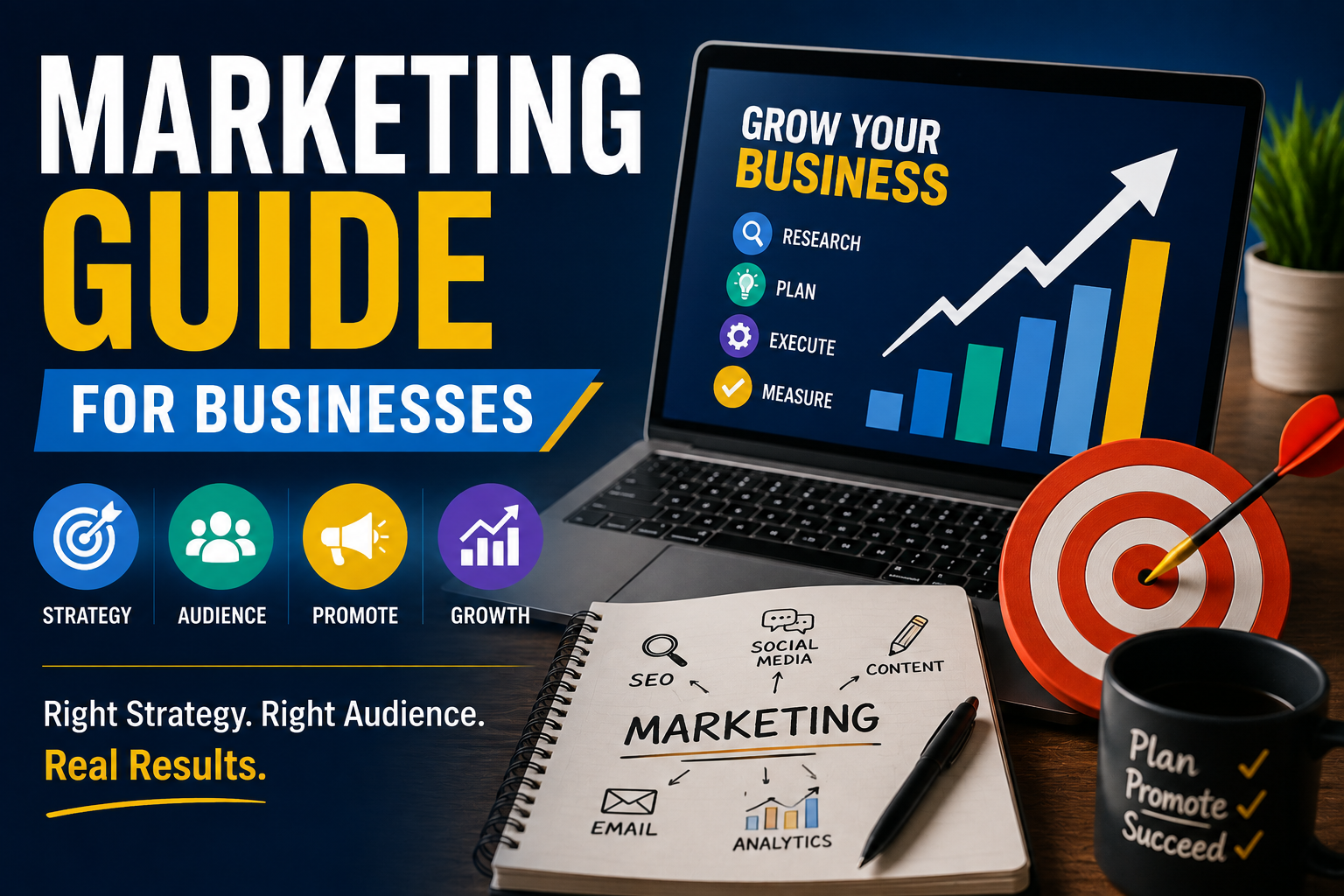
Marketing Guide for Businesses
In today’s competitive marketplace, effective marketing is no longer optional—it’s essential for business growth. Whether you’re a startup looking for your first customers or an established company aiming to expand your market share, a well-planned marketing strategy helps attract new audiences, build brand awareness, generate sales, and foster long-term customer loyalty.
Modern marketing extends far beyond traditional advertising. Businesses now have access to digital channels, social media, search engines, email campaigns, content marketing, and data analytics, allowing them to connect with customers more effectively than ever before.
This guide explains the fundamentals of business marketing, the most effective marketing strategies, and practical steps organizations can take to build sustainable growth.
What Is Business Marketing?
Business marketing is the process of promoting products or services to potential customers through various communication channels. Its primary goal is to attract, engage, convert, and retain customers while building a strong and recognizable brand.
Successful marketing combines creativity with data-driven decision-making to understand customer needs and deliver value.
Marketing activities may include:
- Market research
- Branding
- Advertising
- Content creation
- Social media marketing
- Search engine optimization (SEO)
- Email marketing
- Public relations
- Customer relationship management (CRM)
- Performance analytics
Why Marketing Matters
Regardless of industry or company size, marketing plays a critical role in business success.
Effective marketing helps businesses:
- Increase brand awareness
- Generate qualified leads
- Build customer trust
- Drive website traffic
- Increase sales
- Improve customer retention
- Differentiate from competitors
- Launch new products successfully
- Support long-term business growth
- Build a loyal customer community
Without consistent marketing, even excellent products and services may struggle to reach their intended audience.
Understanding Your Target Audience
One of the most important aspects of marketing is understanding who your customers are.
Businesses should identify:
- Customer demographics
- Interests
- Purchasing habits
- Pain points
- Online behavior
- Budget expectations
- Preferred communication channels
- Buying motivations
Creating customer personas can help businesses tailor messaging and marketing campaigns more effectively.
Building a Strong Brand
A brand is more than a logo or company name—it represents how customers perceive a business.
A strong brand includes:
- A clear mission
- Consistent visual identity
- Memorable messaging
- Professional design
- Reliable customer experience
- Distinct value proposition
Businesses with recognizable brands often build stronger customer trust and loyalty over time.
Developing a Marketing Strategy
A successful marketing strategy begins with clearly defined goals.
Common objectives include:
- Increasing website traffic
- Generating leads
- Boosting sales
- Growing social media engagement
- Building email subscribers
- Expanding into new markets
- Improving customer retention
Marketing plans should also define target audiences, budgets, timelines, and performance metrics.
Digital Marketing Channels
Modern businesses can reach customers through numerous online platforms.
Search Engine Optimization (SEO)
SEO helps websites rank higher in search engine results, increasing visibility and attracting organic traffic.
SEO best practices include:
- Keyword research
- High-quality content
- Technical optimization
- Mobile-friendly design
- Fast website performance
- Quality backlinks
SEO often delivers long-term value by generating consistent traffic over time.
Content Marketing
Content marketing involves creating valuable information that educates, informs, or entertains potential customers.
Examples include:
- Blog articles
- Buying guides
- Videos
- Infographics
- Podcasts
- White papers
- Case studies
- Tutorials
Helpful content positions businesses as trusted authorities within their industries.
Social Media Marketing
Social platforms allow businesses to connect directly with customers.
Common goals include:
- Building brand awareness
- Sharing educational content
- Engaging with followers
- Promoting products
- Providing customer support
- Driving website traffic
Consistency and authentic communication often outperform purely promotional messaging.
Email Marketing
Email remains one of the most cost-effective marketing channels.
Businesses use email to:
- Share newsletters
- Promote products
- Announce updates
- Deliver personalized offers
- Nurture leads
- Retain existing customers
Segmentation and personalization often improve campaign performance.
Paid Advertising
Businesses can accelerate growth through paid advertising across search engines, social media, display networks, and video platforms.
Common advertising formats include:
- Search ads
- Display ads
- Social media ads
- Video advertising
- Shopping ads
- Retargeting campaigns
Well-managed campaigns focus on reaching the right audience while maximizing return on investment.
The Importance of Customer Experience
Marketing doesn’t end after a customer makes a purchase.
Providing excellent customer experiences encourages:
- Repeat purchases
- Positive reviews
- Referrals
- Brand advocacy
- Long-term loyalty
Satisfied customers often become valuable promoters of a business through word-of-mouth recommendations.
Measuring Marketing Performance
Successful businesses continuously evaluate marketing effectiveness.
Important performance indicators include:
- Website traffic
- Conversion rate
- Customer acquisition cost
- Return on advertising spend
- Click-through rate
- Email open rate
- Customer lifetime value
- Social engagement
- Lead generation
- Revenue growth
Data-driven analysis allows businesses to refine campaigns and improve future results.
Common Marketing Mistakes
Many businesses reduce marketing effectiveness by making avoidable mistakes.
Common challenges include:
- Failing to define a target audience
- Inconsistent branding
- Ignoring SEO
- Neglecting content quality
- Posting irregularly on social media
- Not measuring campaign performance
- Overlooking mobile users
- Focusing only on short-term sales
- Ignoring customer feedback
- Inconsistent messaging across channels
Avoiding these mistakes helps create more sustainable marketing success.
Emerging Marketing Trends
Technology continues to reshape how businesses communicate with customers.
Important developments include:
- Artificial intelligence for content creation
- Marketing automation
- Predictive analytics
- Personalization
- Voice search optimization
- Video-first marketing
- Influencer partnerships
- Interactive content
- Conversational chatbots
- Privacy-focused marketing strategies
Businesses that adapt to changing consumer behavior often remain more competitive.
Building a Sustainable Marketing Strategy
Long-term marketing success depends on consistency rather than one-time campaigns.
Businesses should focus on:
- Publishing valuable content regularly
- Building trust with customers
- Improving website performance
- Investing in SEO
- Growing email audiences
- Strengthening brand recognition
- Using analytics for continuous improvement
- Adapting to market changes
Sustainable marketing creates lasting customer relationships that continue generating value over time.
Final Thoughts
Effective marketing is one of the most powerful tools a business can use to grow, compete, and build meaningful relationships with customers. By understanding target audiences, developing a clear brand, leveraging digital marketing channels, and measuring performance, organizations can create strategies that support both short-term objectives and long-term success.
As technology and consumer expectations continue evolving, businesses that prioritize customer value, embrace innovation, and remain adaptable will be best positioned to thrive in an increasingly competitive marketplace. Marketing is not simply about promoting products—it’s about building trust, solving customer problems, and creating experiences that encourage lasting loyalty.


2 Comments
Micle harison
June 7, 2019Lorem ipsum dolor sit amet, usu ut perfecto postulant deterruisset, libris causae volutpat at est, ius id modus laoreet urbanitas. Mel ei delenit dolores.
John Doe
June 7, 2019Some consultants are employed indirectly by the client via a consultancy staffing company.