
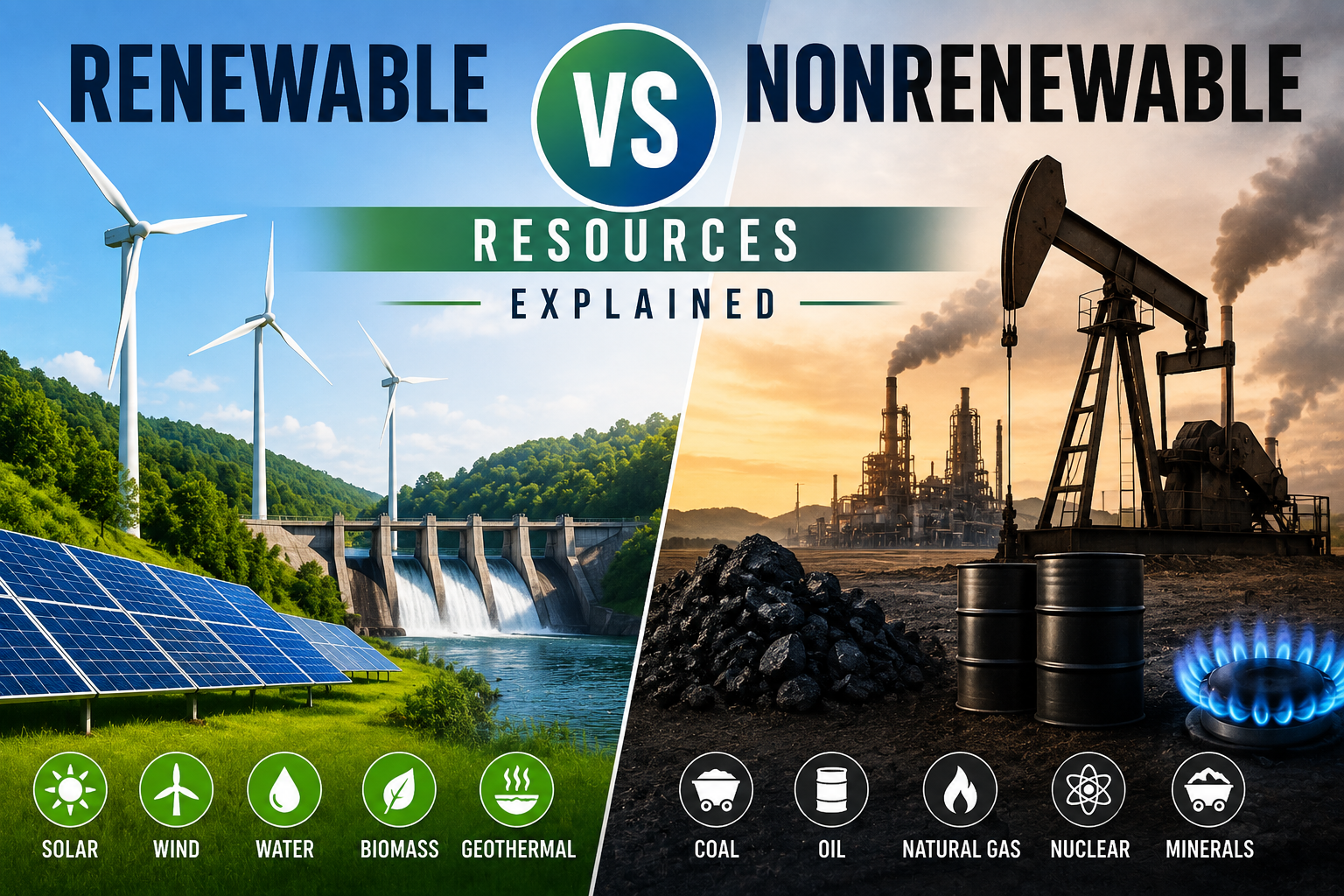
Renewable vs Nonrenewable Resources Explained
As the world faces growing energy demands, climate challenges, and the need for sustainable development, understanding the difference between renewable and nonrenewable resources has become increasingly important. These natural resources power our homes, fuel transportation, manufacture everyday products, and support modern economies—but they differ significantly in how they are formed, replenished, and used.
While renewable resources can naturally replenish over relatively short periods, nonrenewable resources exist in limited quantities and may take millions of years to form. Choosing how societies use these resources has significant environmental, economic, and social implications.
This guide explains what renewable and nonrenewable resources are, their advantages and disadvantages, common examples, and the role they play in shaping a more sustainable future.
What Are Natural Resources?
Natural resources are materials and energy sources that occur naturally in the environment and can be used by humans. They support nearly every aspect of daily life, from producing electricity and growing food to manufacturing products and constructing buildings.
Natural resources are generally divided into two main categories:
- Renewable resources
- Nonrenewable resources
The primary distinction is whether the resource can be naturally replaced within a human timescale.
What Are Renewable Resources?
Renewable resources are natural resources that can replenish themselves through natural processes at a rate comparable to or faster than human consumption, provided they are managed responsibly.
These resources are considered more sustainable because they can continue supplying energy or materials over the long term when properly protected.
Common examples include:
- Solar energy
- Wind energy
- Hydroelectric power
- Geothermal energy
- Biomass
- Forests (when sustainably managed)
- Freshwater (under sustainable use)
Although renewable resources can regenerate, they are not unlimited. Poor management, pollution, and overuse can reduce their availability.
Examples of Renewable Resources
Solar Energy
Solar panels convert sunlight into electricity using photovoltaic technology. Solar power has become one of the fastest-growing renewable energy sources due to falling costs and technological improvements.
Wind Energy
Wind turbines generate electricity by converting the kinetic energy of moving air into mechanical and electrical energy.
Hydroelectric Power
Hydropower facilities use flowing water to spin turbines that generate electricity. It remains one of the world’s largest renewable energy sources.
Geothermal Energy
Heat from beneath Earth’s surface can be used to generate electricity or provide direct heating for homes and businesses.
Biomass
Organic materials such as wood, agricultural waste, and certain crops can be converted into heat, electricity, or biofuels.
Advantages of Renewable Resources
Renewable resources offer numerous long-term benefits.
These include:
- Reduced greenhouse gas emissions
- Improved air quality
- Greater energy sustainability
- Lower dependence on fossil fuels
- Opportunities for technological innovation
- Long-term energy security
- Job creation in clean energy industries
As renewable technologies continue advancing, many have become increasingly cost-competitive with traditional energy sources.
Challenges of Renewable Resources
Despite their advantages, renewable resources also present challenges.
These may include:
- Weather-dependent energy production
- High upfront installation costs
- Energy storage requirements
- Land use considerations
- Grid modernization needs
- Environmental impacts in certain locations
Ongoing research aims to improve efficiency, storage technologies, and power distribution systems.
What Are Nonrenewable Resources?
Nonrenewable resources are natural resources that exist in finite quantities or require extremely long geological periods to form. Once these resources are extracted and consumed, they cannot be replaced within a human lifetime.
Because supplies are limited, careful management is essential to ensure responsible use.
Common examples include:
- Coal
- Petroleum (crude oil)
- Natural gas
- Uranium
- Many metal ores
- Certain mineral deposits
Examples of Nonrenewable Resources
Coal
Coal has long been used to generate electricity and produce steel. It remains an important energy source in many parts of the world despite concerns about emissions.
Petroleum
Crude oil is refined into gasoline, diesel, jet fuel, lubricants, and numerous products used in transportation and manufacturing.
Natural Gas
Natural gas is widely used for heating, electricity generation, industrial processes, and cooking.
Uranium
Uranium fuels nuclear power plants, producing electricity through controlled nuclear fission.
Metallic Minerals
Resources such as copper, iron ore, aluminum, nickel, and rare earth elements are essential for construction, electronics, transportation, and renewable energy technologies.
Advantages of Nonrenewable Resources
Nonrenewable resources have supported industrial development for centuries.
Benefits include:
- High energy density
- Reliable energy production
- Established infrastructure
- Continuous electricity generation
- Mature extraction technologies
- Broad industrial applications
These characteristics have made fossil fuels central to global economic growth.
Challenges of Nonrenewable Resources
Nonrenewable resources also present important environmental and economic challenges.
These include:
- Finite supplies
- Greenhouse gas emissions
- Air pollution
- Habitat disruption from extraction
- Water contamination risks
- Price volatility
- Dependence on global supply chains
As resources become more difficult to access, extraction costs may increase over time.
Renewable vs Nonrenewable Resources
| Feature | Renewable Resources | Nonrenewable Resources |
|---|---|---|
| Supply | Naturally replenished | Finite supply |
| Formation Time | Months to decades | Millions of years |
| Sustainability | High when managed responsibly | Limited |
| Carbon Emissions | Generally lower | Often higher |
| Long-Term Availability | Renewable with proper management | Eventually depleted |
| Examples | Solar, wind, hydro, biomass | Coal, oil, natural gas, uranium |
The Role of Energy Transition
Many countries are investing in renewable energy to diversify energy supplies, improve energy security, and reduce emissions associated with fossil fuels.
The transition often includes:
- Expanding renewable electricity generation
- Modernizing power grids
- Improving energy efficiency
- Developing battery storage
- Supporting electric transportation
- Investing in clean technology research
At the same time, many economies continue relying on nonrenewable resources while gradually integrating cleaner alternatives.
Why Resource Conservation Matters
Regardless of resource type, conservation plays an essential role in supporting long-term sustainability.
Responsible resource management includes:
- Improving energy efficiency
- Recycling materials
- Reducing waste
- Protecting ecosystems
- Using sustainable forestry practices
- Conserving freshwater supplies
- Supporting responsible mining and extraction
Efficient resource use helps reduce environmental impacts while extending the availability of valuable natural resources.
Looking Ahead
Future energy systems will likely involve a combination of renewable technologies, improved efficiency, advanced storage systems, and continued innovation across multiple industries. Scientists and engineers continue developing solutions that make renewable energy more reliable, affordable, and accessible while reducing the environmental impacts associated with traditional energy production.
Although nonrenewable resources will remain important in many sectors for the foreseeable future, the global emphasis on sustainability is accelerating investment in cleaner energy sources and more efficient resource management.
Final Thoughts
Renewable and nonrenewable resources each play important roles in modern society, but they differ significantly in availability, environmental impact, and long-term sustainability. Renewable resources offer the potential for cleaner, more sustainable energy production, while nonrenewable resources continue to provide reliable energy and raw materials for countless industries.
Understanding these differences helps individuals, businesses, and policymakers make informed decisions about energy use, conservation, and future investments. As technology advances and global energy needs evolve, balancing resource development with environmental stewardship will remain one of the defining challenges of the twenty-first century.




2 Comments
Micle harison
June 7, 2019Lorem ipsum dolor sit amet, usu ut perfecto postulant deterruisset, libris causae volutpat at est, ius id modus laoreet urbanitas. Mel ei delenit dolores.
John Doe
June 7, 2019Some consultants are employed indirectly by the client via a consultancy staffing company.