
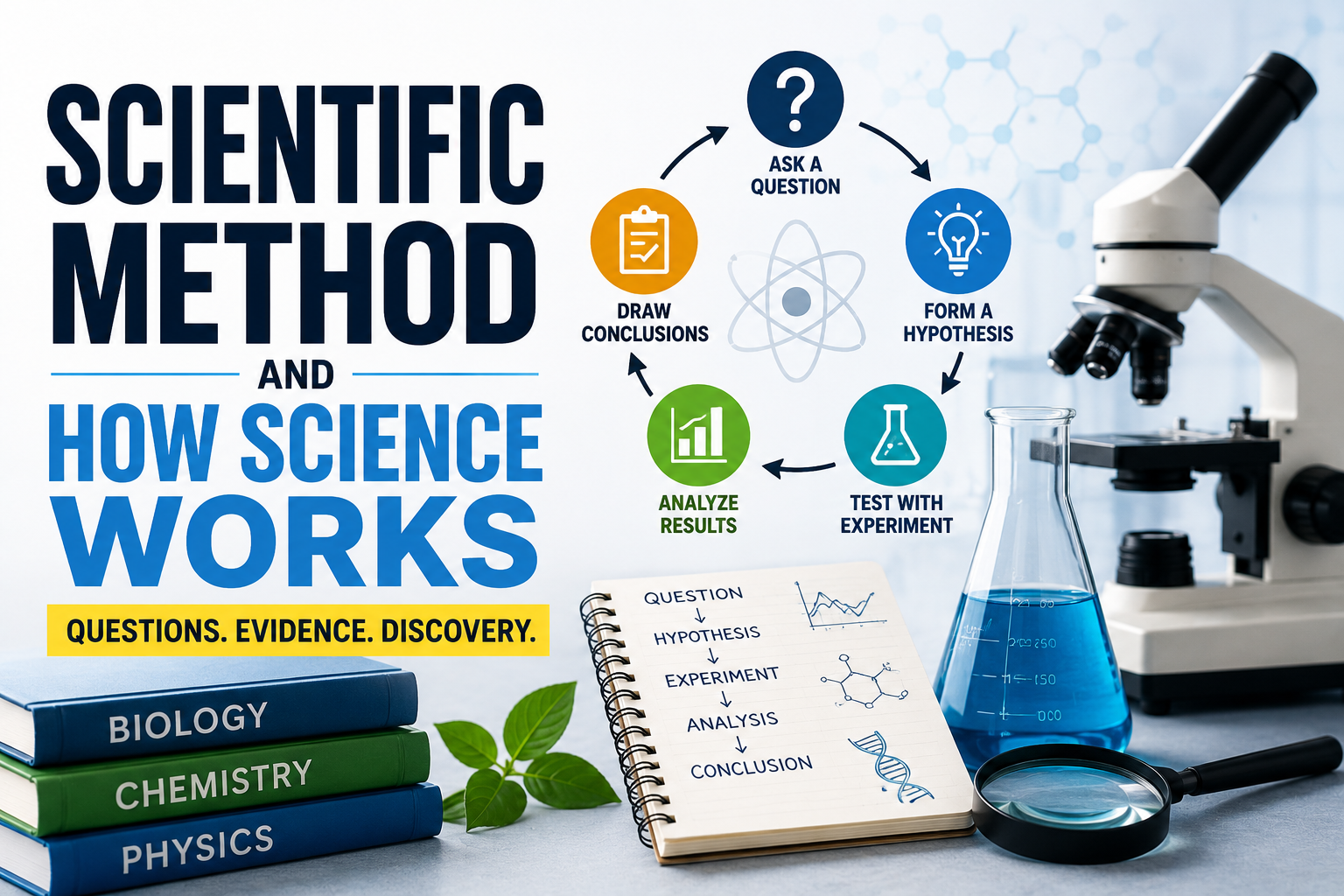
Scientific Method and How Science Work
Science is often presented as a list of steps: ask a question, form a hypothesis, conduct an experiment, analyze the results and reach a conclusion.
That description is useful, especially for beginners, but it misses something important.
Science is not simply a rigid sequence of experiments. It is a broader process of asking questions, gathering evidence, testing explanations, challenging results and gradually building reliable knowledge. Scientists may use laboratory experiments, field observations, computer models, surveys, measurements, historical records or other methods depending on the question they are investigating. (National Academies Publications)
Understanding how this process works makes it easier to interpret scientific claims, evaluate research and understand why scientific knowledge sometimes changes.
What Is the Scientific Method?
The scientific method is a systematic approach for investigating questions about the world using observations, evidence, testing and critical analysis.
There is no single universal checklist that every scientist follows in exactly the same order. The methods used by an astronomer studying distant galaxies can be very different from those used by a biologist studying ecosystems or a geologist examining ancient rocks.
However, many scientific investigations share common elements:
- Asking a question
- Reviewing existing knowledge
- Developing a hypothesis or explanation
- Making predictions
- Designing an investigation
- Collecting observations or experimental data
- Analyzing the evidence
- Evaluating the explanation
- Communicating the findings
- Testing and building on the work through further research
The U.S. National Institutes of Health describes research as an evolving process in which scientists ask questions, examine previous research, develop ideas, test them, analyze findings and share their work with other scientists. (National Institutes of Health)
The process is therefore better understood as a cycle of investigation and refinement than as a straight line.
How Science Begins With Questions
Most scientific investigations begin with curiosity about something that has been observed.
A scientist might notice that:
- A particular species is declining in one area.
- A material behaves differently under certain conditions.
- Two populations show different characteristics.
- A chemical reaction produces an unexpected result.
- A planet or star behaves differently from predictions.
- A disease appears to spread under particular circumstances.
The observation leads to a question.
For example:
Why are plants growing faster in one section of a field than another?
That question can then be refined into something that can actually be investigated.
Good scientific questions are generally specific enough that researchers can identify what evidence would help answer them.
Reviewing What Is Already Known
Scientists rarely begin from zero.
Before conducting new research, researchers examine existing studies, observations, theories, models and data. This helps them understand what is already known and identify unanswered questions.
A literature review can also reveal:
- Previous experiments
- Competing explanations
- Methodological problems
- Gaps in existing research
- Results that have been independently reproduced
- Questions that remain uncertain
This cumulative nature is one of science’s defining characteristics. New research usually builds on earlier work rather than existing in isolation. (NCBI)
It also helps prevent researchers from unnecessarily repeating work that has already been done—although replication of previous studies can itself be scientifically valuable.
What Is a Scientific Hypothesis?
A hypothesis is a proposed explanation that can be tested against evidence.
Suppose researchers observe that a particular plant grows more rapidly when exposed to a certain wavelength of light.
They might propose:
Plants exposed to this wavelength of light will grow faster than plants exposed to other wavelengths under otherwise similar conditions.
The important feature is that the hypothesis produces a prediction that can be compared with observations.
A hypothesis is therefore more than a guess. It is an explanation or proposition that can be investigated using evidence.
If the evidence does not support it, scientists may modify the hypothesis, replace it with another explanation or investigate whether problems with the study affected the result.
Hypotheses Must Lead to Testable Predictions
A useful hypothesis allows researchers to ask:
What should we observe if this explanation is correct?
That prediction can then be tested.
For example, if researchers hypothesize that a particular fertilizer increases plant growth, they could predict that plants receiving the fertilizer will grow more than comparable plants that do not receive it.
The researchers can then measure plant growth and compare the results.
This relationship between hypotheses, predictions and evidence is central to scientific investigation. (NCBI)
Designing a Scientific Investigation
Once researchers have a question and a testable explanation, they need to determine how to investigate it.
Study design matters because poorly designed research can produce misleading results even when the researchers analyze the data correctly.
Depending on the field, scientists may need to decide:
- What will be measured?
- How will it be measured?
- Which variables will change?
- Which variables should remain controlled?
- How many observations or participants are needed?
- How will potential sources of bias be reduced?
- How will the data be analyzed?
- What comparison will be used?
- What would count as evidence against the hypothesis?
NOAA’s explanation of the scientific method, for example, emphasizes defining variables and controls before conducting an experiment. (NOAA NESDIS)
Variables and Controls
In an experiment, a variable is something that can change.
Researchers may deliberately change one variable while measuring another.
Imagine scientists want to determine whether the amount of sunlight affects plant growth.
They could vary the amount of light while measuring plant height over a defined period.
Other factors—such as plant type, soil, water and temperature—might need to be kept consistent as much as possible.
A control or comparison group can provide a reference point.
The purpose is to make it easier to determine whether observed differences are associated with the factor being investigated rather than something else.
Collecting Scientific Data
After an investigation is designed, researchers collect evidence.
Data can take many forms.
Quantitative data
Quantitative data involve numerical measurements, such as:
- Temperature
- Mass
- Distance
- Blood pressure
- Population size
- Growth rate
- Concentration
- Time
Qualitative data
Qualitative information can involve observations, descriptions, interviews, images or other non-numerical evidence.
Not every scientific question can be answered by putting everything into a spreadsheet.
The appropriate form of evidence depends on the research question and scientific discipline.
The key issue is whether the evidence is collected systematically and is appropriate for evaluating the question.
Why Scientists Analyze Data
Raw observations do not automatically provide an answer.
Scientists need to determine what patterns the data contain and whether those patterns are meaningful.
Analysis may involve:
- Calculations
- Statistical tests
- Graphs
- Mathematical models
- Comparisons
- Measurements of uncertainty
- Computer simulations
- Qualitative analysis
Researchers also need to consider alternative explanations.
A difference between two groups, for example, does not necessarily mean that the variable being studied caused the difference.
Other factors may have influenced the outcome.
This is why study design, measurement quality and statistical reasoning are so important.
Does Science Prove a Hypothesis?
One of the most common misunderstandings about science is the idea that a hypothesis becomes permanently “proven” after one successful experiment.
Science generally does not work that way.
A study can provide evidence supporting a hypothesis, while another study may later produce evidence that challenges it.
The National Academies describes science as a process in which explanations are accepted, modified or abandoned as evidence warrants. (National Academies)
This does not mean scientific knowledge is unreliable.
It means scientific conclusions are connected to the strength and consistency of the evidence available.
An explanation that survives many independent tests is generally more strongly supported than one based on a single experiment.
What Is Replication in Science?
Replication means repeating research or testing a finding again to determine whether similar results can be obtained.
Replication is important because individual studies can contain:
- Measurement errors
- Sampling problems
- Statistical anomalies
- Unexpected environmental effects
- Methodological weaknesses
- Researcher bias
If independent researchers repeatedly obtain similar results using sound methods, confidence in the finding generally increases.
The National Academies describes scientific knowledge as cumulative, with scientists repeatedly testing and building on one another’s work. (National Academies Publications)
Replication does not guarantee that a finding is correct, but it is an important part of strengthening scientific evidence.
What Is Peer Review?
Before many scientific studies are formally published in academic journals, they undergo peer review.
In this process, experts with relevant knowledge evaluate aspects of the research.
Reviewers may examine:
- The research question
- Study design
- Methods
- Data analysis
- Interpretation
- Whether conclusions are supported by evidence
- Potential limitations
They may recommend revisions, rejection or publication.
Peer review is an important quality-control mechanism, but it is not a guarantee that a study is correct.
The NIH notes that peer review can identify problems, suggest additional experiments and improve interpretation of research. (National Institutes of Health)
A published paper therefore represents a piece of scientific evidence—not automatically the final word on a question.
Why One Scientific Study Is Rarely Enough
A single study can be interesting and potentially important, but it usually needs to be considered alongside the broader body of evidence.
Different studies may:
- Use different populations
- Measure different outcomes
- Follow participants for different periods
- Use different experimental methods
- Have different sample sizes
- Produce different levels of uncertainty
This can sometimes make scientific reporting appear contradictory.
The NIH explains that studies may reach different conclusions because researchers examine different aspects of a problem, use different techniques or study different timeframes. (National Institutes of Health)
The right response is not necessarily to choose whichever study supports a preferred viewpoint.
Instead, researchers examine the totality of evidence.
Why Scientific Knowledge Changes
Science changes because scientists discover new evidence.
That is a feature—not a failure—of the scientific process.
A scientific explanation may be modified when researchers discover:
- New observations
- Better measurements
- Previously unknown mechanisms
- Evidence that contradicts an existing model
- More accurate instruments
- Better statistical methods
- Results that cannot be reproduced
The National Academies describes science as a process of discovery, confirmation and correction. (National Academies Publications)
This means a change in scientific understanding does not necessarily mean researchers were careless before.
It may mean the available evidence has improved.
The Difference Between Facts, Hypotheses and Theories
Scientific terminology can be confusing because words such as theory, law and hypothesis have different meanings in everyday conversation.
Scientific fact
A scientific fact is an observation or measurement supported by reliable evidence.
For example, scientists can measure physical properties such as temperature, mass or atmospheric composition.
Scientific hypothesis
A hypothesis is a proposed explanation that can be tested.
Scientific theory
A scientific theory is a broad, well-supported explanatory framework that accounts for many observations and generates predictions.
A theory is therefore not simply an unproven idea.
The National Academies defines a theory as a coherent and predictive explanation for a broad range of natural phenomena that integrates multiple hypotheses and evidence. (NCBI)
Scientific law
A scientific law generally describes a consistent relationship observed in nature. Some laws are expressed mathematically.
A law describes what happens, while a theory can help explain why or how it happens.
They are not simply different levels of certainty.
Scientific Models Also Matter
Scientists often use models to represent complicated systems.
A model might be:
- Mathematical
- Computational
- Physical
- Conceptual
Models allow researchers to explore relationships and make predictions that may be difficult or impossible to test directly.
For example, scientists can use models to investigate complex interactions within Earth’s climate system, ecosystems or astronomical systems.
Models are not perfect copies of reality. Their usefulness depends on their assumptions, evidence, design and ability to explain or predict observations.
Observation Versus Experiment
Not all science involves controlled laboratory experiments.
Sometimes an experiment would be impossible, unethical or impractical.
Astronomers cannot manipulate stars to test every hypothesis. Geologists cannot rerun Earth’s geological history. Ecologists may need to observe ecosystems in their natural environments.
In such cases, scientists can rely heavily on observation, measurement, natural experiments, historical evidence or statistical analysis.
The scientific process can therefore accommodate many different research methods.
Why Correlation Does Not Automatically Mean Causation
Suppose researchers discover that two variables change together.
That is a correlation.
But correlation alone does not establish that one variable caused the other.
There could be:
- A third variable influencing both
- Reverse causation
- Selection effects
- Measurement problems
- Random chance
Establishing causation generally requires stronger evidence and an appropriate research design.
This is one reason scientists carefully distinguish between association and cause-and-effect relationships.
What Happens When Scientists Disagree?
Scientific disagreement is not necessarily evidence that science has failed.
Researchers may disagree because:
- Evidence is incomplete
- Studies have different designs
- Measurements have uncertainty
- Competing explanations remain plausible
- New evidence has challenged an existing interpretation
Scientific disagreement can actually be productive when researchers test competing explanations.
The National Academies notes that when studies disagree, scientists can investigate why and use the disagreement to generate new research. (National Academies Publications)
Over time, repeated testing can help clarify which explanations are better supported.
Scientific Consensus Is More Than a Vote
A scientific consensus does not mean every scientist agrees about every detail.
Instead, consensus generally develops when a large body of evidence points toward a broadly supported explanation.
Confidence increases when:
- Multiple studies produce compatible results
- Independent researchers reach similar conclusions
- Different methods point in the same direction
- Competing explanations perform poorly
- Evidence accumulates over time
The National Academies describes scientific consensus as emerging when many studies reach similar conclusions and confidence in those conclusions increases. (National Academies Publications)
There can still be legitimate uncertainty within a consensus.
Science does not require absolute agreement on every detail.
The Role of Uncertainty
Scientific uncertainty is sometimes misunderstood as ignorance.
In reality, scientists routinely quantify and communicate uncertainty.
A measurement may have a range rather than a single perfectly precise value.
A prediction may have probabilities attached to different outcomes.
A study may have limitations that affect how broadly its results can be applied.
Being transparent about uncertainty allows readers and decision-makers to understand how much confidence should be placed in a conclusion.
A strong scientific claim therefore does not hide uncertainty. It explains it.
What Makes Scientific Evidence Stronger?
Evidence becomes more convincing when it survives multiple forms of scrutiny.
Important factors can include:
- Appropriate study design
- Reliable measurements
- Adequate sample sizes
- Transparent methods
- Appropriate statistical analysis
- Independent replication
- Consistency across different studies
- Agreement with established evidence
- Clear acknowledgment of limitations
- Plausible mechanisms
- Successful predictions
No single factor automatically determines whether research is correct.
Scientific reliability comes from the overall quality and consistency of the evidence.
Science Is a Community Process
Science is sometimes portrayed as a lone genius making a discovery in a laboratory.
Modern science is much more collaborative.
Researchers:
- Share findings
- Publish papers
- Attend conferences
- Review one another’s work
- Reanalyze existing data
- Replicate experiments
- Develop competing hypotheses
- Build on previous discoveries
This community structure is important because scientific claims are exposed to scrutiny from people who may have different perspectives, expertise and interests.
The National Academies describes science as a communal process in which knowledge is continually tested and challenged. (NCBI)
Common Misunderstandings About the Scientific Method
“Scientists always follow the same seven steps.”
Not necessarily. The familiar step-by-step model is useful for teaching, but actual scientific research is often iterative and nonlinear.
“A theory is just a guess.”
No. A scientific theory is a well-supported explanatory framework that integrates substantial evidence.
“If scientists change their minds, science cannot be trusted.”
Scientific conclusions can change when better evidence becomes available. Updating conclusions is part of the process.
“Peer-reviewed means proven.”
Peer review provides scrutiny but does not guarantee that every published result is correct.
“One study settles the question.”
Usually not. Scientific conclusions become stronger when findings are replicated and supported by multiple lines of evidence.
“Experiments are the only real science.”
No. Observation, modeling, measurement and other research approaches can also produce scientific knowledge.
How to Read Scientific Claims More Carefully
You do not need to be a professional scientist to evaluate scientific information.
When encountering a scientific claim, ask:
- What exactly is being claimed?
- What evidence supports it?
- Was the evidence based on observation or an experiment?
- How large was the study?
- Was the research independently replicated?
- Has the work undergone peer review?
- What limitations did the researchers identify?
- Do other studies support or challenge the result?
- Is the claim stronger than the evidence warrants?
- Is there a broader scientific consensus?
These questions are particularly useful when evaluating scientific claims shared through social media, news articles or commercial marketing.
Why Scientific Literacy Matters
Scientific literacy is not simply memorizing scientific facts.
It means understanding how evidence is generated, how uncertainty works and how scientific knowledge develops.
That skill can help people make better-informed decisions about issues involving:
- Health
- Food
- Technology
- Energy
- Climate
- Environmental protection
- Agriculture
- Consumer products
- Public policy
Science cannot answer every question humans face, and scientific evidence does not automatically determine what values society should adopt.
But it provides a structured way to investigate claims about the world.
The National Academies describes science as one of the strongest tools available for developing reliable knowledge because it is a collective, cumulative process of assessing evidence and correcting mistakes. (National Academies Publications)
From Questions to Better Knowledge
The scientific method is best understood not as a rigid recipe but as part of a larger system for producing and testing knowledge.
Scientists ask questions, examine previous evidence, propose explanations, make predictions, collect observations, analyze data and communicate their findings. Other researchers then have opportunities to challenge, replicate, refine or extend that work.
Some ideas fail. Others survive repeated testing. Still others are modified as new evidence emerges.
That continuous process is what makes science powerful.
The goal is not to produce a permanent list of unquestionable answers. The goal is to develop explanations that increasingly withstand evidence, scrutiny and repeated testing. (National Academies)
And when new evidence shows that an explanation needs to change, science has a mechanism for changing it—turning uncertainty and correction into part of the path toward better understanding.



2 Comments
Micle harison
June 7, 2019Lorem ipsum dolor sit amet, usu ut perfecto postulant deterruisset, libris causae volutpat at est, ius id modus laoreet urbanitas. Mel ei delenit dolores.
John Doe
June 7, 2019Some consultants are employed indirectly by the client via a consultancy staffing company.