
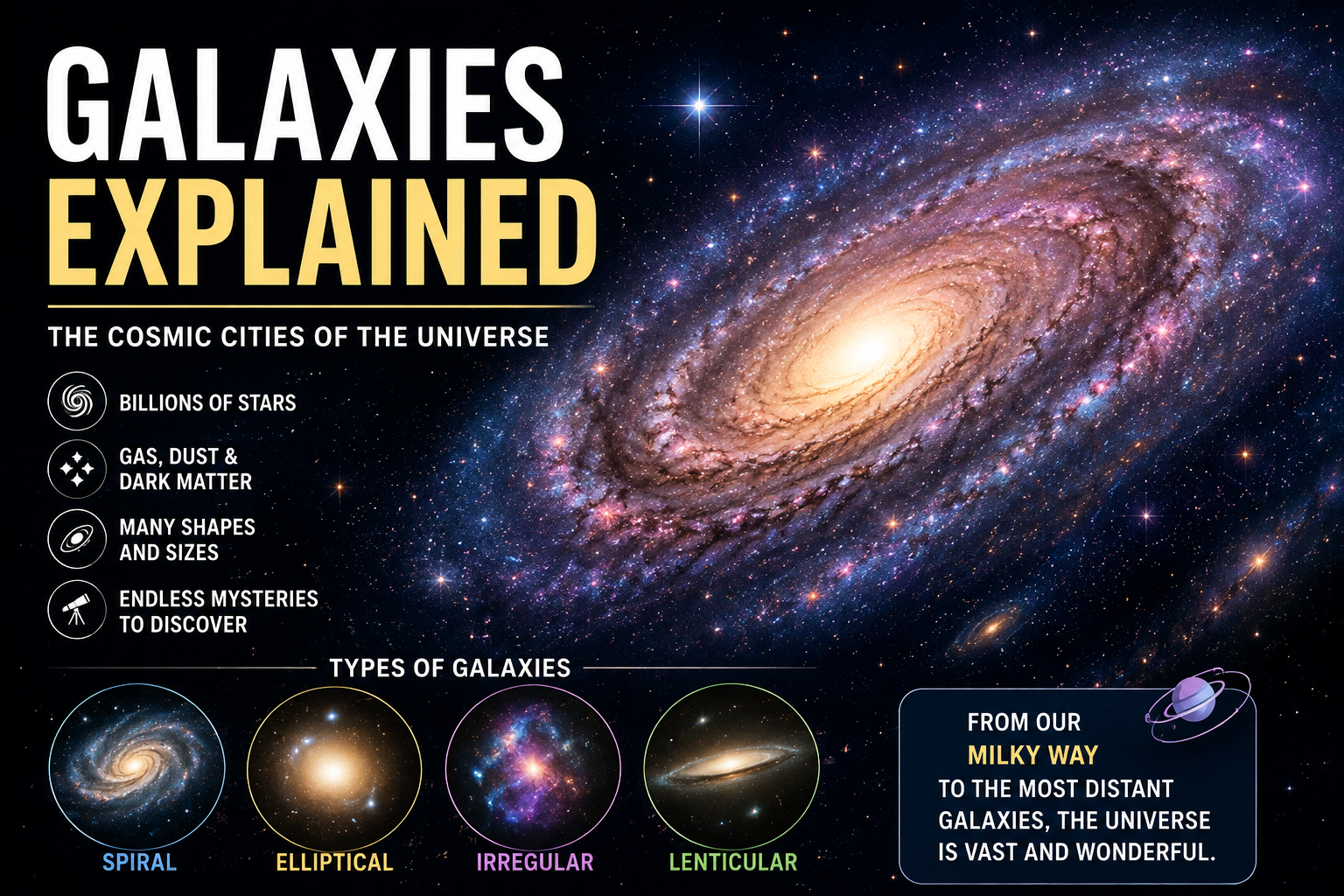
Galaxies Explained
When we look up at the night sky, the stars visible to the naked eye represent only a tiny fraction of what’s out there. Beyond our own solar system lies the Milky Way, one of billions—perhaps even trillions—of galaxies scattered across the observable universe.
Each galaxy is a vast cosmic city containing stars, planets, gas, dust, black holes, and enormous amounts of dark matter. Together, galaxies form the large-scale structure of the universe, helping scientists uncover its history, evolution, and future.
This guide explores everything you need to know about galaxies, including how they form, the different types of galaxies, and the remarkable role they play in modern astronomy.
What Is a Galaxy?
A galaxy is a massive collection of stars, stellar remnants, gas, dust, planets, and dark matter, all held together by gravity.
Galaxies vary enormously in size. Some contain only a few million stars, while the largest are home to hundreds of billions or even trillions of stars.
Most galaxies also contain:
- Nebulae
- Star clusters
- Planetary systems
- Interstellar gas
- Cosmic dust
- Supermassive black holes
Gravity keeps these components bound together over billions of years.
How Many Galaxies Are There?
Astronomers estimate that the observable universe contains hundreds of billions to possibly trillions of galaxies.
As telescope technology has improved, scientists have continued discovering galaxies that are farther away and formed earlier in the universe’s history.
Powerful space telescopes now observe galaxies that existed only a few hundred million years after the Big Bang.
How Galaxies Form
Scientists believe galaxies began forming shortly after the Big Bang.
Over time:
- Tiny fluctuations in matter grew through gravity.
- Clouds of hydrogen and helium collapsed.
- The first stars formed.
- Groups of stars clustered together.
- Gravity continued pulling material inward.
- Galaxies gradually grew through mergers and new star formation.
Galaxies continue evolving today through collisions, interactions, and the birth of new stars.
The Main Types of Galaxies
Astronomers generally classify galaxies into four primary categories.
Spiral Galaxies
Spiral galaxies have a flat rotating disk with graceful spiral arms extending outward from a central bulge.
Characteristics include:
- Young stars
- Active star formation
- Large amounts of gas and dust
- Distinct spiral structure
The Milky Way is a spiral galaxy.
Elliptical Galaxies
Elliptical galaxies range from nearly spherical to elongated shapes.
They typically contain:
- Older stars
- Very little gas
- Minimal new star formation
- Smooth appearance
Many of the largest known galaxies belong to this category.
Irregular Galaxies
Irregular galaxies lack a clearly defined shape.
They often result from:
- Galaxy collisions
- Gravitational interactions
- Intense star formation
These galaxies may appear chaotic but remain important laboratories for studying galaxy evolution.
Lenticular Galaxies
Lenticular galaxies share characteristics of both spiral and elliptical galaxies.
They possess:
- A central bulge
- A disk structure
- Few spiral arms
- Limited star formation
They are often considered transitional between spiral and elliptical galaxies.
The Milky Way: Our Home Galaxy
Earth resides inside the Milky Way, a barred spiral galaxy estimated to contain hundreds of billions of stars.
Major features include:
- Spiral arms
- A dense central bulge
- A supermassive black hole at its center
- Vast clouds of gas and dust
- Numerous star clusters
Our solar system orbits the center of the Milky Way approximately once every 225–250 million years, a period sometimes called a galactic year.
What Is at the Center of a Galaxy?
Many galaxies contain a supermassive black hole at their centers.
These black holes can have masses millions or even billions of times greater than the Sun.
Scientists believe they influence:
- Star formation
- Galactic structure
- Gas movement
- Galaxy evolution
Although black holes are invisible, astronomers detect them by observing their effects on nearby stars and gas.
What Are Galaxy Clusters?
Galaxies rarely exist in isolation.
Instead, many belong to:
- Galaxy groups
- Galaxy clusters
- Superclusters
These enormous structures are connected through gravity and form part of the cosmic web, the largest known structure in the universe.
Our Milky Way belongs to the Local Group, which includes dozens of neighboring galaxies.
Galaxy Collisions
Despite the immense distances between stars, galaxies occasionally collide over billions of years.
During these interactions:
- Gas clouds collide.
- New stars form.
- Galactic shapes change.
- Gravity redistributes matter.
Interestingly, individual stars usually do not collide because the distances between them are so vast.
Astronomers predict that the Milky Way and the Andromeda Galaxy are expected to merge several billion years in the future.
Dark Matter and Galaxies
One of the greatest mysteries in astronomy involves dark matter.
Although it cannot be seen directly, scientists believe dark matter makes up much of a galaxy’s total mass.
Evidence comes from observations showing that galaxies rotate faster than visible matter alone can explain.
Dark matter appears to provide additional gravitational support that helps hold galaxies together.
How Scientists Study Galaxies
Modern astronomy relies on both ground-based and space-based observatories.
Scientists study galaxies using:
- Optical telescopes
- Radio telescopes
- Infrared observations
- X-ray telescopes
- Spectroscopy
- Computer simulations
Each method reveals different information about stars, gas, black holes, and galactic evolution.
Why Galaxies Matter
Studying galaxies helps scientists answer some of the biggest questions in science.
Research improves our understanding of:
- The Big Bang
- Star formation
- Planet formation
- Black holes
- Dark matter
- Dark energy
- Cosmic evolution
Every newly observed galaxy offers another piece of the universe’s history.
Fascinating Facts About Galaxies
- The Milky Way contains hundreds of billions of stars.
- Some galaxies contain trillions of stars.
- Light from distant galaxies can take billions of years to reach Earth.
- Many galaxies host supermassive black holes.
- Galaxies continue growing through mergers and star formation.
- The observable universe contains an astonishing number of galaxies.
The Future of Galaxy Research
Advances in telescope technology are allowing astronomers to observe galaxies with greater detail than ever before.
Future discoveries may help answer long-standing questions about:
- Dark matter
- Dark energy
- Galaxy formation
- The first stars
- Black hole evolution
- The expansion of the universe
As observations improve, scientists expect our understanding of galaxies to continue evolving.
Final Thoughts
Galaxies are among the most awe-inspiring structures in the cosmos. These immense collections of stars, gas, dust, planets, and dark matter provide valuable clues about how the universe formed and continues to change.
From the familiar spiral arms of the Milky Way to distant galaxies whose light has traveled billions of years to reach us, each discovery expands our understanding of the universe. As astronomy enters a new era of powerful telescopes and advanced space missions, galaxies will remain at the center of humanity’s quest to understand our place in the cosmos.
Frequently Asked Questions
What is a galaxy?
A galaxy is a massive system of stars, gas, dust, planets, dark matter, and other celestial objects held together by gravity.
What type of galaxy is the Milky Way?
The Milky Way is a barred spiral galaxy with a central bulge and distinct spiral arms.
How many galaxies exist in the universe?
Astronomers estimate that the observable universe contains hundreds of billions to possibly trillions of galaxies.
Do all galaxies have black holes?
Most large galaxies appear to contain supermassive black holes at their centers, although research into their formation and evolution continues.
Can galaxies collide?
Yes. Galaxies can merge over billions of years through gravitational interactions. While gas clouds and galactic structures are affected, individual stars rarely collide because they are separated by immense distances.
Key Takeaways
- Galaxies are enormous systems held together by gravity.
- The Milky Way is a barred spiral galaxy containing hundreds of billions of stars.
- The four main galaxy types are spiral, elliptical, irregular, and lenticular.
- Dark matter plays a major role in galaxy structure and motion.
- Galaxy collisions, star formation, and black holes shape galactic evolution.
- Studying galaxies helps scientists better understand the origins, structure, and future of the universe.


2 Comments
Micle harison
June 7, 2019Lorem ipsum dolor sit amet, usu ut perfecto postulant deterruisset, libris causae volutpat at est, ius id modus laoreet urbanitas. Mel ei delenit dolores.
John Doe
June 7, 2019Some consultants are employed indirectly by the client via a consultancy staffing company.