
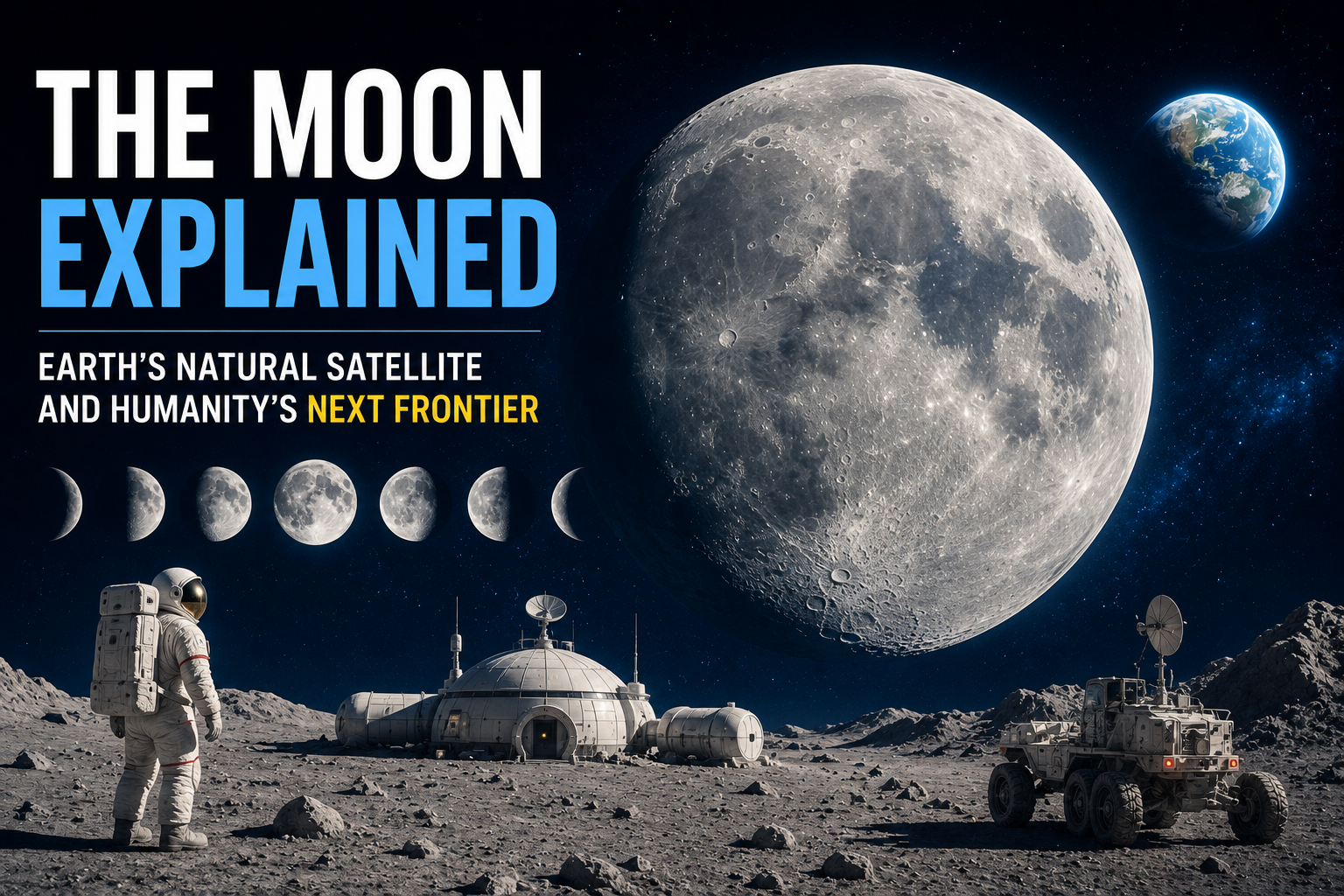
The Moon Explained: Earth’s Natural Satellite and Humanity’s Next Frontier
For thousands of years, the Moon has fascinated humanity. It has inspired myths, guided calendars, influenced ocean tides, and served as the brightest object in Earth’s night sky after the Sun. Today, the Moon is once again at the center of global attention—not only as a scientific treasure but also as the next frontier for human exploration, space technology, and future lunar settlements.
As governments and private space companies prepare for a new era of lunar missions, understanding our closest celestial neighbor has never been more important. This guide explores what the Moon is, how it formed, why it matters, and how it could shape the future of space exploration.
What Is the Moon?
The Moon is Earth’s only natural satellite. It orbits our planet at an average distance of about 384,400 kilometers (238,855 miles) and is the fifth-largest moon in the Solar System.
Unlike Earth, the Moon has:
- No breathable atmosphere
- No liquid water on its surface
- No weather
- Extremely weak gravity
- Large impact craters
- Vast plains of ancient volcanic rock
Although it appears bright at night, the Moon does not produce its own light. Instead, it reflects sunlight.
How Did the Moon Form?
The leading scientific explanation is the Giant Impact Hypothesis.
According to this theory:
- Around 4.5 billion years ago, a Mars-sized object collided with the young Earth.
- Massive amounts of rock and debris were thrown into space.
- Over millions of years, this debris came together through gravity.
- The Moon gradually formed from this material.
This theory explains why Moon rocks share many similarities with Earth’s outer layers.
Basic Facts About the Moon
| Feature | Information |
|---|---|
| Age | About 4.5 billion years |
| Diameter | 3,474 km (2,159 miles) |
| Average Distance from Earth | 384,400 km |
| Gravity | About 1/6 of Earth’s |
| Length of One Day | About 29.5 Earth days (lunar cycle) |
| Atmosphere | Extremely thin exosphere |
| Surface Temperature | Approximately -173°C to 127°C (-280°F to 260°F) |
Why the Moon Looks Different Every Night
The Moon goes through phases because different portions of its sunlit side become visible from Earth as it orbits our planet.
The eight primary lunar phases are:
- New Moon
- Waxing Crescent
- First Quarter
- Waxing Gibbous
- Full Moon
- Waning Gibbous
- Third Quarter
- Waning Crescent
A complete lunar cycle takes approximately 29.5 days.
Why the Moon Always Shows the Same Side
Many people believe the Moon doesn’t rotate.
It actually does.
The Moon rotates once on its axis in exactly the same amount of time it takes to orbit Earth.
This phenomenon is called tidal locking, causing the same hemisphere to always face Earth.
The opposite side is often called the “far side,” although it receives just as much sunlight.
What Is the Moon Made Of?
The Moon’s structure consists of several layers.
Crust
The outer rocky surface is covered by:
- Dust (regolith)
- Rocks
- Craters
- Ancient lava plains
Mantle
Below the crust lies a rocky mantle containing minerals formed billions of years ago.
Core
Scientists believe the Moon has a relatively small metallic core composed largely of iron.
The Moon’s Surface
The Moon’s landscape appears gray because of billions of years of impacts from asteroids and comets.
Major surface features include:
Craters
Large circular depressions formed by impacts.
Some are billions of years old.
Maria
Dark, flat plains formed by ancient volcanic eruptions.
The word maria means “seas” in Latin because early astronomers mistakenly believed they contained water.
Highlands
Bright, heavily cratered regions that are generally older than the maria.
Mountains
Several mountain ranges were created by ancient impacts and geological processes.
Why the Moon Is Important to Earth
Although it seems distant, the Moon plays a critical role in Earth’s environment.
Ocean Tides
The Moon’s gravity pulls on Earth’s oceans, creating:
- High tides
- Low tides
These tides influence marine ecosystems, coastal environments, and navigation.
Earth’s Stability
The Moon helps stabilize Earth’s axial tilt.
Without the Moon, Earth’s climate could experience much greater long-term variations.
Slowing Earth’s Rotation
The Moon gradually slows Earth’s rotation through tidal interactions.
Billions of years ago, days on Earth were much shorter than they are today.
The Moon and Space Exploration
The Moon became a major target during the Space Race.
In 1969, NASA’s Apollo 11 mission successfully landed astronauts on the lunar surface.
Neil Armstrong famously became the first human to walk on the Moon, followed shortly by Buzz Aldrin.
Between 1969 and 1972:
- Twelve astronauts walked on the Moon.
- Hundreds of kilograms of lunar rocks were collected.
- Numerous scientific experiments were conducted.
These missions dramatically expanded humanity’s understanding of the Moon.
Why Countries Are Returning to the Moon
After decades of limited exploration, interest in the Moon has surged.
Several reasons explain this renewed focus.
Scientific Research
The Moon preserves billions of years of Solar System history.
Studying lunar rocks helps scientists better understand planetary formation.
Water Ice
Scientists have discovered evidence of frozen water in permanently shadowed craters near the lunar poles.
Water could potentially support:
- Future astronauts
- Oxygen production
- Rocket fuel manufacturing
Testing Deep Space Missions
The Moon provides an ideal environment for testing technologies needed for future missions to Mars.
Resource Exploration
Researchers continue studying whether the Moon contains useful resources including:
- Helium-3
- Rare minerals
- Metals
- Water ice
Commercial mining remains speculative but is an active area of discussion.
Artemis and the New Lunar Era
NASA’s Artemis program aims to return astronauts to the Moon and establish a sustainable human presence.
Long-term goals include:
- Landing the first woman on the Moon
- Landing the first person of color on the Moon
- Building the Lunar Gateway space station
- Supporting long-duration missions
- Preparing for human exploration of Mars
Other nations and private companies are also developing lunar missions, making the coming decades an exciting period for space exploration.
Could Humans Live on the Moon?
Permanent lunar settlements remain a future goal rather than a present reality.
Challenges include:
- Radiation exposure
- Extreme temperatures
- Limited water
- Dust hazards
- Low gravity
- Transportation costs
Researchers are exploring solutions such as underground habitats, radiation shielding, and using lunar materials to construct buildings.
Fun Facts About the Moon
- The Moon is slowly moving away from Earth at about 3.8 centimeters (1.5 inches) per year.
- There is no sound on the Moon because it lacks a substantial atmosphere.
- Footprints left by Apollo astronauts may remain for millions of years because there is no wind or rain to erase them.
- The Moon experiences moonquakes, although they are generally weaker than earthquakes.
- More than 100 spacecraft have visited the Moon.
Common Myths About the Moon
| Myth | Reality |
|---|---|
| The Moon produces its own light. | It reflects sunlight. |
| There is a permanently dark side of the Moon. | Every part of the Moon receives sunlight during its orbit. |
| The Moon is perfectly round. | It is slightly irregular in shape. |
| The Moon has no gravity. | It has gravity, but only about one-sixth as strong as Earth’s. |
| Humans have fully explored the Moon. | Large areas remain unexplored in detail. |
What the Future Holds
The Moon is expected to play a major role in the future of space exploration.
Scientists envision:
- Long-term research stations
- International lunar cooperation
- Robotic mining missions
- Advanced telescopes
- Fuel production using lunar resources
- Preparation for Mars exploration
Rather than being the final destination, the Moon is increasingly viewed as a stepping stone toward deeper exploration of the Solar System.
Frequently Asked Questions
Why does the Moon have phases?
The Moon’s phases occur because different portions of its sunlit side become visible from Earth as it orbits our planet.
Can people breathe on the Moon?
No. The Moon lacks a breathable atmosphere, so astronauts require spacesuits and life-support systems.
Why is the Moon important?
The Moon influences Earth’s tides, helps stabilize the planet’s rotation, supports scientific research, and serves as a key destination for future space exploration.
Is there water on the Moon?
Evidence suggests that water ice exists in permanently shadowed regions near the lunar poles, making it an important resource for future missions.
Will people live on the Moon someday?
Scientists and space agencies are working toward technologies that could support long-term human presence, but permanent lunar settlements remain a goal for the future.
How long does it take to travel to the Moon?
Depending on the mission profile and spacecraft, a journey from Earth to the Moon typically takes about three days.
Conclusion
The Moon has shaped Earth’s history for billions of years, influencing our oceans, stabilizing our planet, and inspiring generations of explorers and scientists. Once viewed simply as a distant object in the night sky, it is now becoming the focus of a new era of space exploration, scientific discovery, and technological innovation.
As humanity prepares to return to the lunar surface and establish a lasting presence beyond Earth, the Moon represents more than a destination—it is a gateway to the future of deep-space exploration. Understanding our closest celestial neighbor not only deepens our appreciation of the universe but also brings us one step closer to becoming a truly spacefaring civilization.


2 Comments
Micle harison
June 7, 2019Lorem ipsum dolor sit amet, usu ut perfecto postulant deterruisset, libris causae volutpat at est, ius id modus laoreet urbanitas. Mel ei delenit dolores.
John Doe
June 7, 2019Some consultants are employed indirectly by the client via a consultancy staffing company.