
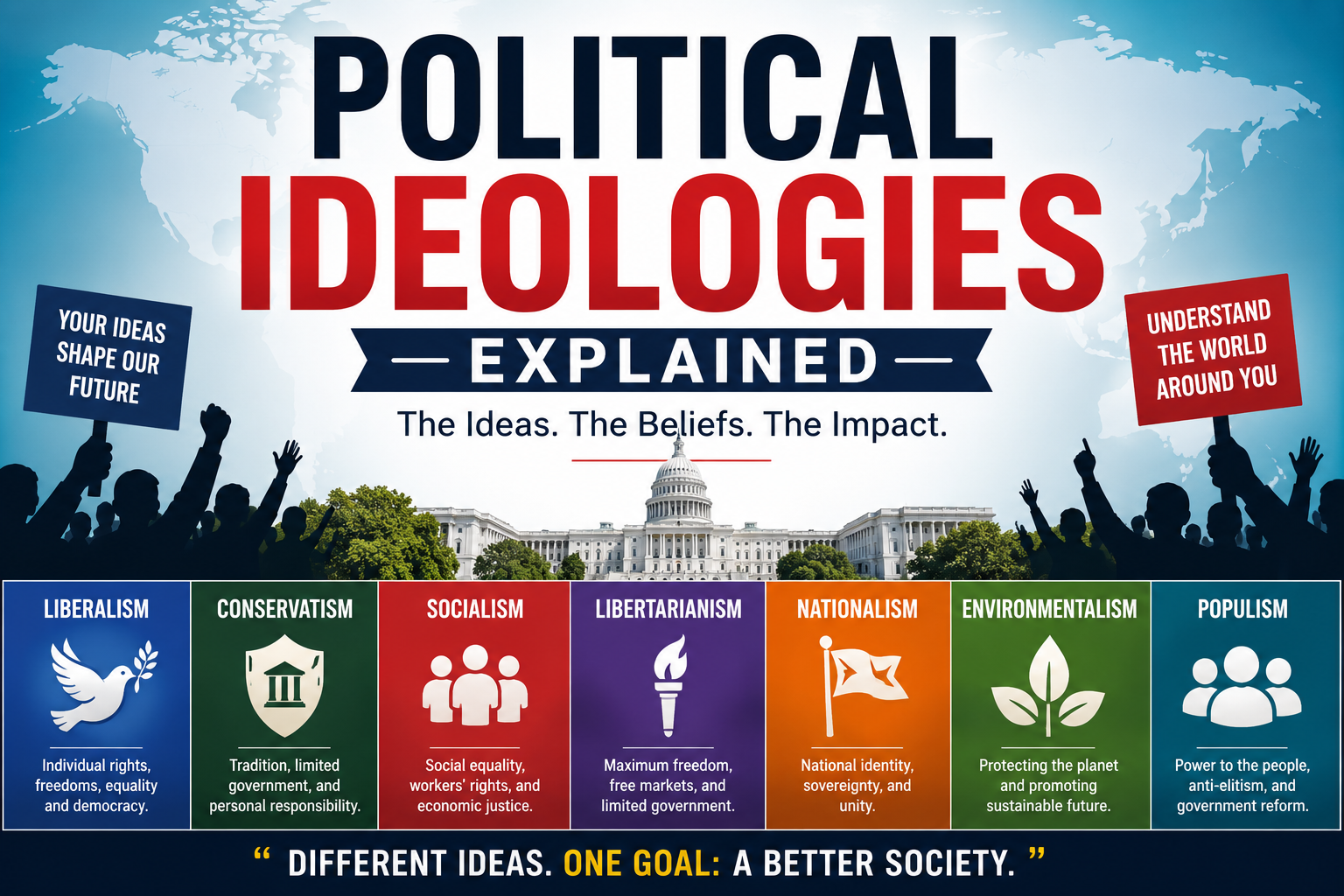
Political Ideologies Explained
Politics shapes nearly every aspect of modern society, from economic policies and healthcare systems to education, human rights, and international relations. At the heart of political decision-making are political ideologies—sets of beliefs and values that influence how governments should be organized, how power should be exercised, and what role the state should play in society.
Political ideologies help explain why political parties, leaders, and voters often disagree on major issues despite sharing common goals such as prosperity, security, and justice. Understanding these ideologies provides valuable insight into elections, public policy, and global affairs.
This guide explores the major political ideologies, their core principles, historical development, and their influence on governments around the world.
What Are Political Ideologies?
A political ideology is a collection of beliefs, values, and ideas about how society should be governed. It provides a framework for addressing political, economic, and social issues while guiding public policy and government decision-making.
Political ideologies typically address questions such as:
- What is the role of government?
- How should wealth be distributed?
- What rights and freedoms should individuals have?
- How should laws be created and enforced?
- What economic system should a country adopt?
- How should nations interact with one another?
While many ideologies share certain goals, they often propose different paths to achieving them.
Why Political Ideologies Matter
Political ideologies influence nearly every aspect of public life.
They help shape:
- Government policies
- Economic systems
- Taxation
- Healthcare
- Education
- Immigration
- Environmental policy
- Foreign affairs
- Civil liberties
- Social welfare programs
Understanding political ideologies enables citizens to make more informed decisions and better understand public debates.
The Political Spectrum
Political ideas are often represented along a political spectrum, although real-world politics is usually more complex than a single line.
Common descriptions include:
- Left
- Center
- Right
In many countries:
- Left-leaning ideologies often emphasize social equality, public services, and government involvement in the economy.
- Right-leaning ideologies often emphasize free markets, limited government, individual responsibility, and traditional institutions.
- Centrist approaches combine elements from multiple perspectives depending on the issue.
Political beliefs vary widely across countries, and the meaning of “left” and “right” can differ depending on national history and culture.
Liberalism
Liberalism is one of the world’s most influential political ideologies.
Core principles include:
- Individual freedom
- Equal rights
- Rule of law
- Democratic government
- Protection of civil liberties
- Freedom of speech
- Religious freedom
- Free and fair elections
Many liberal political systems also support market-based economies while recognizing varying roles for government regulation and public services.
Conservatism
Conservatism generally emphasizes preserving established institutions, traditions, and social stability while supporting gradual rather than rapid change.
Common principles include:
- Limited government
- Individual responsibility
- Rule of law
- Private property
- Free enterprise
- Strong national institutions
- Fiscal responsibility
- Cultural traditions
Modern conservative movements differ considerably between countries and may prioritize different economic or social policies.
Socialism
Socialism advocates greater public or collective involvement in managing economic resources with the goal of reducing inequality and improving social welfare.
Key ideas often include:
- Expanded social services
- Greater economic equality
- Worker protections
- Public investment
- Universal access to essential services
- Government regulation of certain industries
Socialist policies exist in various forms, ranging from mixed-market economies to systems with greater public ownership.
Social Democracy
Social democracy combines democratic political systems with market economies while supporting strong public institutions and social safety nets.
Typical priorities include:
- Universal healthcare
- Public education
- Worker rights
- Progressive taxation
- Social insurance
- Consumer protections
Many countries operate mixed economies that incorporate elements associated with social democratic principles.
Libertarianism
Libertarianism places a strong emphasis on individual liberty and limited government.
Common beliefs include:
- Personal freedom
- Free markets
- Limited taxation
- Private property rights
- Reduced government regulation
- Freedom of expression
- Voluntary exchange
Different libertarian perspectives vary regarding the appropriate role of government in areas such as national defense and public infrastructure.
Nationalism
Nationalism emphasizes the interests, identity, and sovereignty of a nation.
It may focus on:
- National unity
- Cultural identity
- National independence
- Border security
- Self-determination
- Protection of national interests
Nationalism has played significant roles in both independence movements and international conflicts throughout history.
Environmentalism
Environmental political movements prioritize environmental protection and sustainable development.
Key issues often include:
- Climate change
- Renewable energy
- Conservation
- Pollution reduction
- Biodiversity
- Sustainable agriculture
- Resource management
Many political parties now incorporate environmental policies regardless of their broader ideological positions.
Populism
Populism is a political approach rather than a traditional ideology.
It often portrays politics as a struggle between “ordinary people” and perceived political or economic elites.
Populist movements may emerge across different parts of the political spectrum and often emphasize:
- Government accountability
- Political reform
- National sovereignty
- Anti-corruption measures
- Direct engagement with voters
Mixed Political Systems
Few governments follow a single ideology exclusively.
Most modern democracies combine elements from multiple political philosophies.
For example, a country may support:
- Free-market businesses
- Public education
- Universal healthcare
- Environmental regulation
- Private property rights
- Social welfare programs
Political systems frequently evolve as societies respond to changing economic, social, and global conditions.
Political Parties and Ideologies
Political parties often organize around broad ideological principles.
However:
- Parties may change over time.
- Coalitions often require compromise.
- Policies vary by country.
- Leaders may emphasize different priorities.
As a result, parties with similar names in different countries may hold substantially different positions.
Common Misconceptions
Understanding political ideologies requires recognizing their complexity.
Myth: Every Political Party Fits One Ideology
Most parties combine ideas from multiple traditions rather than following one ideology exactly.
Myth: Political Beliefs Never Change
Individuals, parties, and governments often adapt their views as new challenges emerge.
Myth: Left and Right Mean the Same Everywhere
Political labels differ significantly between countries and historical periods.
Myth: Political Ideologies Explain Every Government Decision
Real-world policymaking also involves economic conditions, public opinion, legal constraints, international relations, and practical considerations.
Political Ideologies in the Modern World
Today’s political debates increasingly address issues that extend beyond traditional economic questions.
Modern topics include:
- Artificial intelligence regulation
- Cybersecurity
- Data privacy
- Global trade
- Climate policy
- Immigration
- Public health
- Digital rights
- Renewable energy
- International cooperation
Political ideologies continue to evolve as societies confront new technological, environmental, and economic challenges.
The Importance of Civic Engagement
Understanding political ideologies helps citizens participate more effectively in democratic processes.
Being informed allows people to:
- Evaluate policy proposals
- Compare political platforms
- Participate in elections
- Engage in respectful public discussion
- Better understand global events
Constructive civic engagement depends on considering multiple viewpoints and evaluating information critically.
Final Thoughts
Political ideologies provide valuable frameworks for understanding how societies organize governments, distribute resources, protect rights, and address public challenges. While liberalism, conservatism, socialism, libertarianism, nationalism, environmentalism, and other traditions each offer different perspectives, no single ideology fully defines every political system or policy.
Modern governments often combine ideas from multiple political philosophies to address complex issues. By understanding the principles behind different ideologies, citizens can better interpret political debates, evaluate public policies, and participate thoughtfully in civic life. Regardless of personal political beliefs, informed discussion and respect for diverse perspectives remain essential components of healthy democratic societies.



2 Comments
Micle harison
June 7, 2019Lorem ipsum dolor sit amet, usu ut perfecto postulant deterruisset, libris causae volutpat at est, ius id modus laoreet urbanitas. Mel ei delenit dolores.
John Doe
June 7, 2019Some consultants are employed indirectly by the client via a consultancy staffing company.